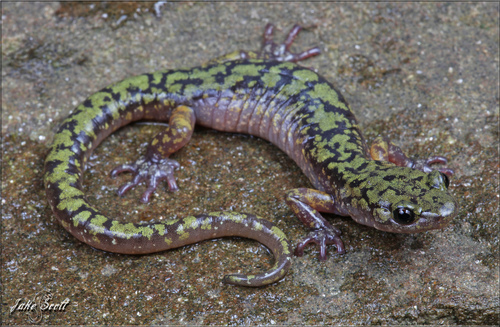
(c) Jake Scott, all rights reserved, uploaded by Jake Scott
Species
Near ThreatenedGreen Salamander
species
via IUCN
Described at
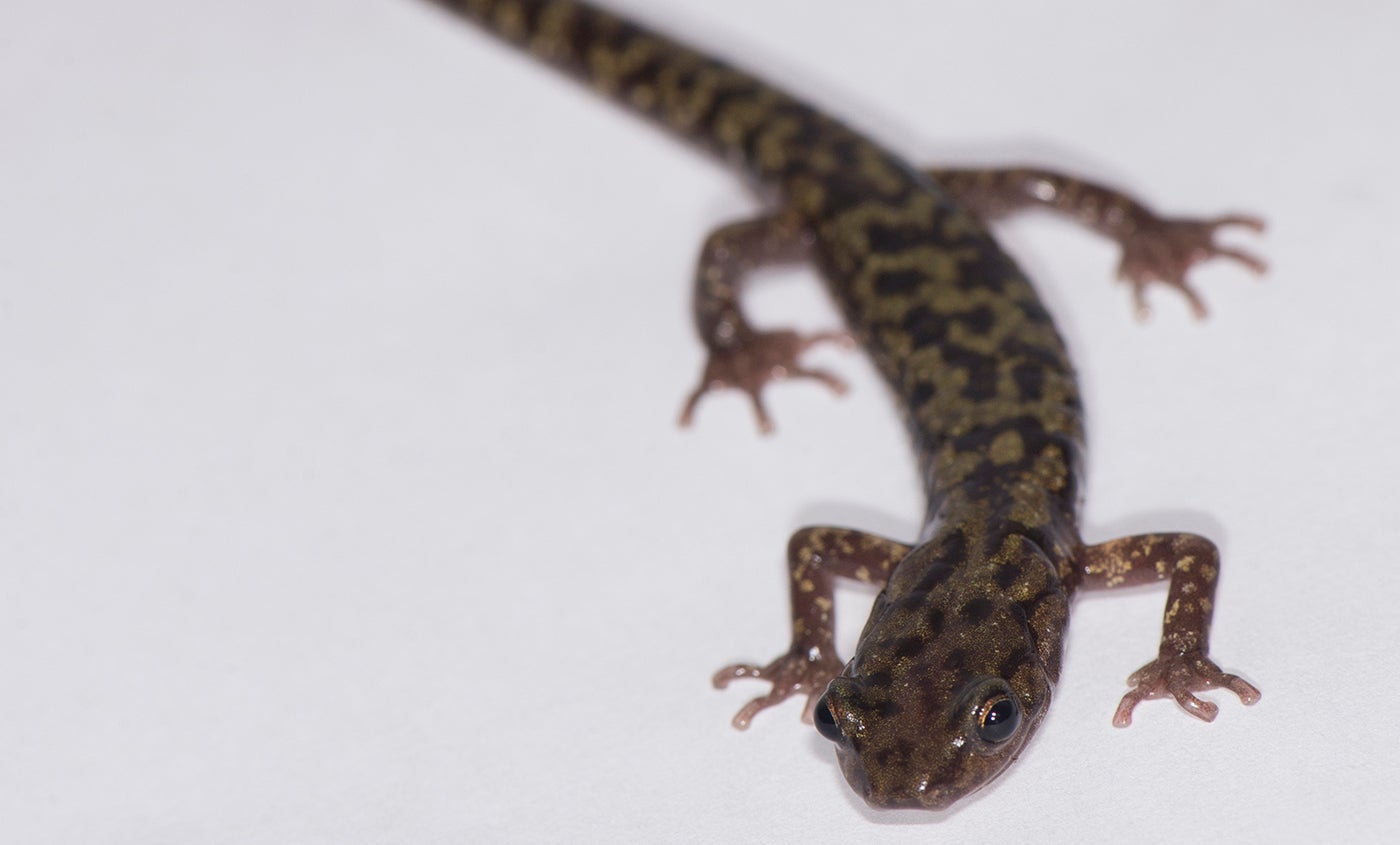
Green salamander | Smithsonian's National Zoo and Conservation Biology Institute
Green salamanders live predominantly in wet, damp crevices and are the only salamander of the genus Aneides found in the eastern United States.
nationalzoo.si.edu →Green salamanders live predominantly in wet, damp crevices and are the only salamander of the genus Aneides found in the eastern United States. Green salamanders are mottled green and black, gray or brown with lighter bellies that are bluish grey to pale yellow. This mottled patterning provides the green salamander with camouflage from predators, especially when hiding among the mosses and lichen its skin resembles. Their flattened bodies, long limbs and square-shaped toes help them to easily climb and fit into rock and log crevices. Green salamanders are indigenous to the Appalachian region, with a patchy distribution from southern Pennsylvania to northern Alabama and Mississippi. Isolated populations occur west to Indiana and east to North and South Carolina. They prefer rocky habitats, including sandstone and limestone outcroppings or caves and are most often found in tree or rock crevices. When not tucked into a crevice, green salamanders can be found among other moist or damp environments, including bark, leaves and logs. In the wild, green salamanders feed on a wide variety of small invertebrates, including arachnids, insects, snails and slugs. At the Smithsonian's National Zoo, green salamanders receive a mixture of crickets, fruit flies, bean beetles, isopods, springtails and black worms. Green salamander breeding season is from May to late September. Males breed annually, while females breed every other year. Females lay between 10 and 30 eggs in rock or log crevices and guard their eggs until they hatch 80 to 90 days later. Young stay with their mother for one or two months and will reach maturity around the age of three. Green salamanders are threatened by development of roads, over-collecting, habitat loss, over-harvesting, disease and drought. Share the story of this animal with others. Simply raising awareness about this species can contribute to its overall protection. Avoid single-use plastics, such as plastic bottles, bags and utensils. Choosing reusable options instead can help reduce plastic pollution. Protect local waterways by using fewer pesticides when caring for your garden or lawn. Using fertilizers sparingly, keeping storm drains free of litter and picking up after your pet can also improve watershed health. Cite this page: Smithsonian's National Zoo and Conservation Biology Institute. (n.d.). Green salamander. Retrieved July 14, 2026, from With only a few hundred red wolves left, Smithsonian scientist Jennifer Nagashima is pioneering new ways to preserve their genetic diversity. How Well Do You Know America’s Bird? 9 Fascinating Facts About the Bald Eagle › It's on our currency, our seals, and in our imagination. But how well do you really know the bald eagle? Think cats hate water? Learn what makes the fishing cat one of Asia’s most remarkable, and least understood, wild predators.
Excerpt from a page describing this subject · 5,887 chars · not written by Vinony
Wikidata facts
Show 8 more facts
- taxon rank
- species
- IUCN conservation status
- Near Threatened
- Commons category
- Aneides aeneus
- taxon name
- Aneides aeneus
- taxon common name
- Green Salamander
- endemic to
- United States
- described at URL
- nationalzoo.si.edu/animals/green-salamander
- short name
- A. aeneus
Sources (2)
via Wikidata · CC0