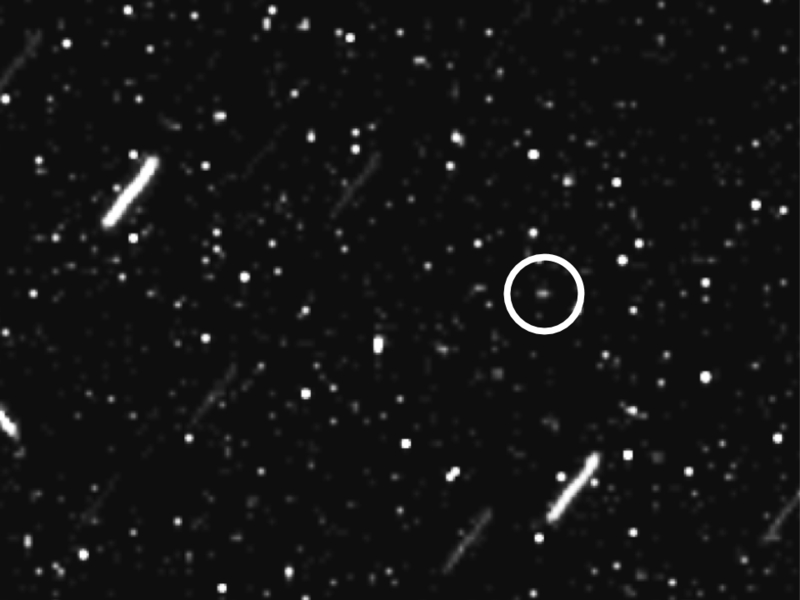
File:Greip-cassini.png · Wikimedia Commons · See Wikimedia Commons
In the Vinony graph
Vinony's link graph records 125 inbound references to Greip, and connects out to Cassini−Huygens, Mimas and moon of Saturn.
It sits within the topics Astronomical objects discovered in 2006, Discoveries by Scott S. Sheppard and Irregular satellites.
Vinony links it to 41 Wikipedia language editions.
Key facts
- Discovered by
- Scott S. Sheppard , David C. Jewitt , Jan T. Kleyna , Brian G. Marsden
- Designation
- Saturn LI
- Pronunciation
- / ˈ ɡ r eɪ p /
- Named after
- Greipa
- Alternative names
- S/2006 S 4
- Semi major axis
- 18 206 000 km
- Orbital period sidereal
- −921.2 days
- Inclination
- 179.8°
- Satellite of
- Saturn
- Group
- Norse group
- Mean diameter
- 5 +50%, −30% km
- Synodic rotation period
- 12.75 ± 0.35 ? h
- Albedo
- 0.06 (assumed)
via Wikipedia infobox
Wikidata facts
- Instance of
- irregular moon
- Parent body
- Saturn
- Diameter
- 5
- Orbital period
- -921.2
- Image
- Greip-cassini.png
Show 8 more facts
- semi-major axis of an orbit
- 18105000
- Commons category
- Greip (moon)
- orbital inclination
- 179.8
- apparent magnitude
- 24.4
- orbital eccentricity
- 0.374
- discoverer or inventor
- Brian G. Marsden
- time of discovery or invention
- 2006-01-05
- provisional designation
- S/2006 S 4
Sources (2)
via Wikidata · CC0
~1 min read
Encyclopedic overview
Greip or Saturn LI is a natural satellite of Saturn. Its discovery was announced by Scott S. Sheppard, David C. Jewitt, Jan Kleyna, and Brian G. Marsden on 26 June 2006, from observations taken between 5 January and 1 May 2006. Greip is about 5 kilometres in diameter, and orbits Saturn at an average distance of 18,066 Mm in 906.556 days, at an inclination of 172.7° to the ecliptic (159.2° to Saturn's equator), in a retrograde direction and with an eccentricity of 0.3735, and is presumably at high risk of eventually colliding with Phoebe. It is unknown whether Greip is more similar to Suttungr or Hyrrokkin in color. Its rotation period is most likely 12.75±0.35 hours with two minima in the light curve, but a longer period of 19 hours cannot be ruled out due to the short observation time by Cassini–Huygens.
It is named after Greip, a giantess in Norse mythology.
Excerpted from Wikipedia’s “Greip” article, available under the CC BY-SA 4.0 licence.