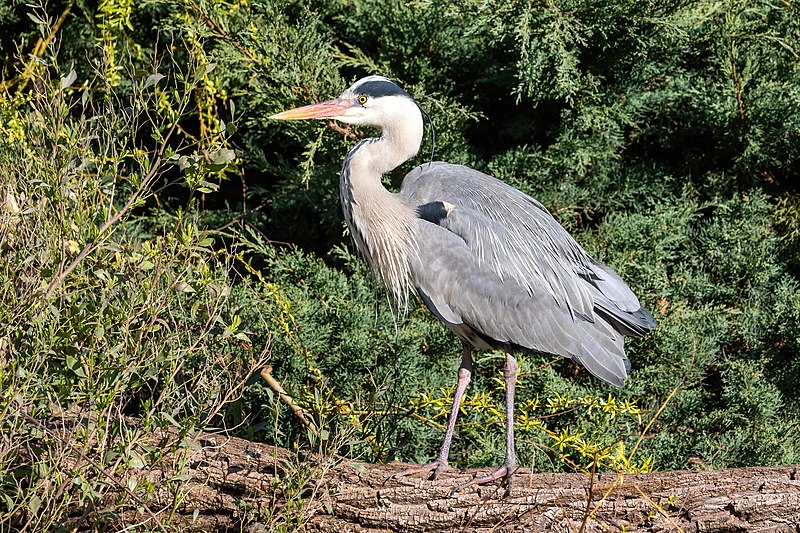
File:Grey_heron_2022_03_18_01.jpg · Wikimedia Commons · See Wikimedia Commons
OverviewAI-generated
The grey heron, scientifically known as Ardea cinerea, is a species within the family Ardeidae. It belongs to the order Ciconiiformes, class Aves, and phylum Chordata. The taxon was established by Linnaeus in 1758 and is classified as a taxon of accepted status. It is an instance of a taxon and serves as the iconic taxon for Aves observations.
This organism has a wingspan of 1.73 and a mass of 61. It inhabits freshwater environments and physically interacts with the Eurasian otter. The species is distributed across Brazil, Hefei, the Nanling Mountains, and South America. Its conservation status is listed as Least Concern by the IUCN Red List as of 2019.
Reproductive data indicates an egg incubation period of 27 days and a litter size of 3.9. The species is not extinct. It is referenced by 862 other encyclopedia articles and has recorded observations on iNaturalist. Common names for the species include Crëyr Glas, Graureiher, and Garza real.
Synthesized by Vinony from 33 facts across 5 sources: Wikidata, iNaturalist, IUCN Red List, WoRMS, Vinony graph. Generated from structured data (not the Wikipedia text) and checked against those facts — may still contain errors.
Species
Least Concerngrey heron
Species
- PhylumChordata
- ClassAves
- OrderCiconiiformes
- FamilyArdeidae
via IUCN
Wikidata facts
Show 12 more facts
- taxon rank
- species
- IUCN conservation status
- Least Concern
- Commons category
- Ardea cinerea
- taxon name
- Ardea cinerea
- Commons gallery
- Ardea cinerea
- taxon common name
- Vanokasira
- wingspan
- 1.73
- litter size
- 3.9
- egg incubation period
- 27
- taxon range
- Africa
- short name
- A. cinerea
- physically interacts with
- Eurasian otter
Sources (8)
via Wikidata · CC0
~20 min read
Encyclopedic overview
The grey heron (Ardea cinerea) is a long-legged wading bird of the heron family, Ardeidae, native throughout temperate Europe and Asia, and also parts of Africa. It is resident in much of its range, but some populations from the more northern parts migrate southwards in autumn. A bird of wetland areas, it can be seen around lakes, rivers, ponds, marshes and on the sea coast. It feeds mostly on aquatic creatures which it catches after standing stationary beside or in the water, or stalking its prey through the shallows.
Standing up to 1 metre (3 ft 3 in) tall, adults weigh from 1 to 2 kg (2 to 4 lb). They have a white head and neck with a broad black stripe that extends from the eye to the black crest. The body and wings are grey above and the underparts are greyish-white, with some black on the flanks. The long, sharply pointed beak is pinkish-yellow and the legs are brown.
Excerpted from Wikipedia’s “Grey Heron” article, available under the CC BY-SA 4.0 licence.
Gallery (13)
Available in 110 languages
- Español
- Français
- Deutsch
- 中文
- 日本語
- Русский
- Português
- Italiano
- العربية
- Afrikaans
- Albanian
- Aragonese
- Armenian
- Assamese
- Asturian
- Azerbaijani
- Bahasa Indonesia
- Balinese
Show 91 more
- Bangla
- Bashkir
- Basque
- bat_smg
- be_x_old
- Belarusian
- Bhojpuri
- Breton
- Bulgarian
- Burmese
- Catalan
- Cebuano
- Chuvash
- Corsican
- Croatian
- Czech
- Danish
- Egyptian Arabic
- Erzya
- Esperanto
- Estonian
- Faroese
- Filipino
- Finnish
- Fon
- Galician
- Georgian
- Greek
- Gujarati
- Hebrew
- Hungarian
- Icelandic
- Ingush
- Javanese
- Kabardian
- Kannada
- Kashubian
- Kazakh
- Kurdish
- Latin
- Latvian
- Lithuanian
- Luxembourgish
- Macedonian
- Malagasy
- Malay
- Malayalam
- Marathi
- mnw
- Navajo
- Nederlands
- Nepali
- Northern Frisian
- Northern Sami
- Norwegian
- Norwegian Nynorsk
- Occitan
- olo
- Picard
- Piedmontese
- Polski
- Romanian
- Rusyn
- Scots
- Scottish Gaelic
- Serbian
- Serbian (Latin)
- simple
- Slovak
- Slovenian
- Svenska
- Tamil
- Telugu
- Tiếng Việt
- Türkçe
- Ukrainian
- Urdu
- Uzbek
- Waray
- Welsh
- West Flemish
- Western Frisian
- Western Mari
- Western Panjabi
- Wu Chinese
- Yakut
- zh_min_nan
- zh_yue
- فارسی
- ไทย
- 한국어
via Wikidata sitelinks · CC0