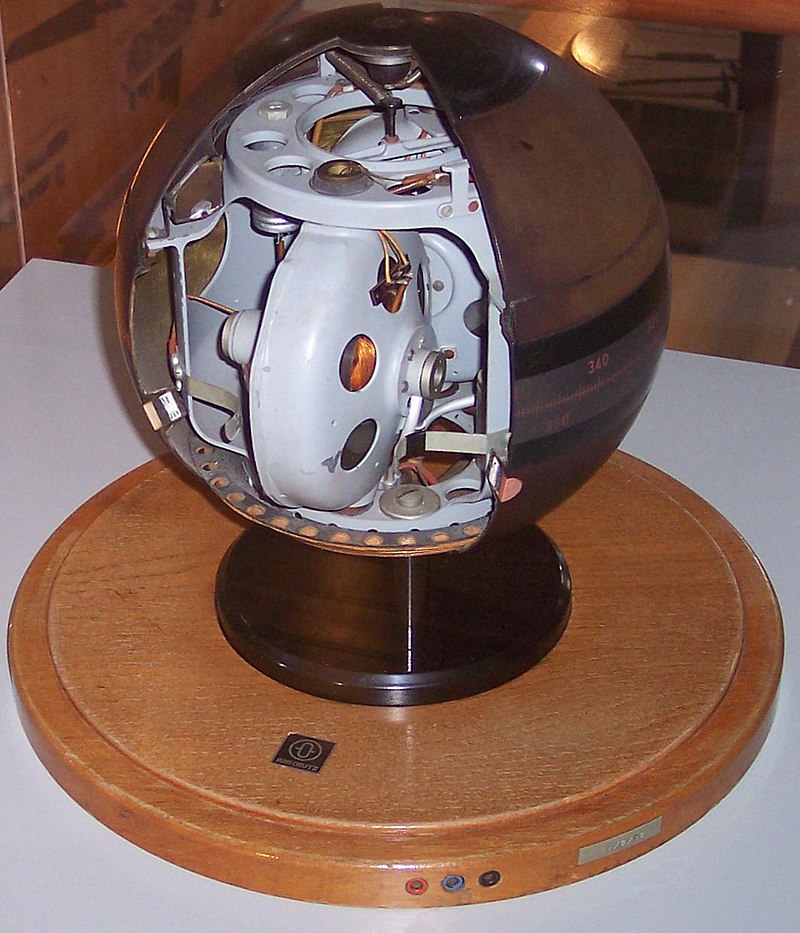
File:Kreiselkompass_Schnitt_Anschütz.jpg · Wikimedia Commons · See Wikimedia Commons
gyrocompass
Sign in to savethumb|Cutaway of an Anschütz gyrocompass thumb|A gyrocompass repeater
Wikidata facts
- Subclass of
- measuring instrument
- Image
- Kreiselkompass Schnitt Anschütz.jpg
Show 2 more facts
- Commons category
- Gyrocompasses
- different from
- Kompas
Sources (3)
via Wikidata · CC0
~19 min read
Encyclopedic overview
17 sectionsContents
- History
- Operation
- Errors
- Mathematical model
- First time-dependent rotation
- Second and third fixed rotations
- Constant translation
- Fourth time-dependent rotation
- Last time-dependent rotation
- Dynamics of the system
- Particular case: the poles
- The general and physically relevant case
- See also
- Notes
- References
- Bibliography
- External links
thumb|Cutaway of an Anschütz gyrocompass thumb|A gyrocompass repeater
A gyrocompass is a type of non-magnetic compass which is based on a fast-spinning disc and the rotation of the Earth (or another planetary body if used elsewhere in the universe) to find geographical direction automatically. A gyrocompass makes use of one of the seven fundamental ways to determine the heading of a vehicle. A gyroscope is an essential component of a gyrocompass, but they are different devices; a gyrocompass is built to use the effect of gyroscopic precession, which is a distinctive aspect of the general gyroscopic effect. Gyrocompasses, such as the fibre optic gyrocompass are widely used to provide a heading for navigation on ships. This is because they have two significant advantages over magnetic compasses: they find true north as determined by the axis of the Earth's rotation, which is different from, and navigationally more useful than, magnetic north, and they have a greater degree of accuracy because they are unaffected by ferromagnetic materials, such as in a ship's steel hull, which distort the magnetic field.
Excerpted from Wikipedia’s “gyrocompass” article, available under the CC BY-SA 4.0 licence.