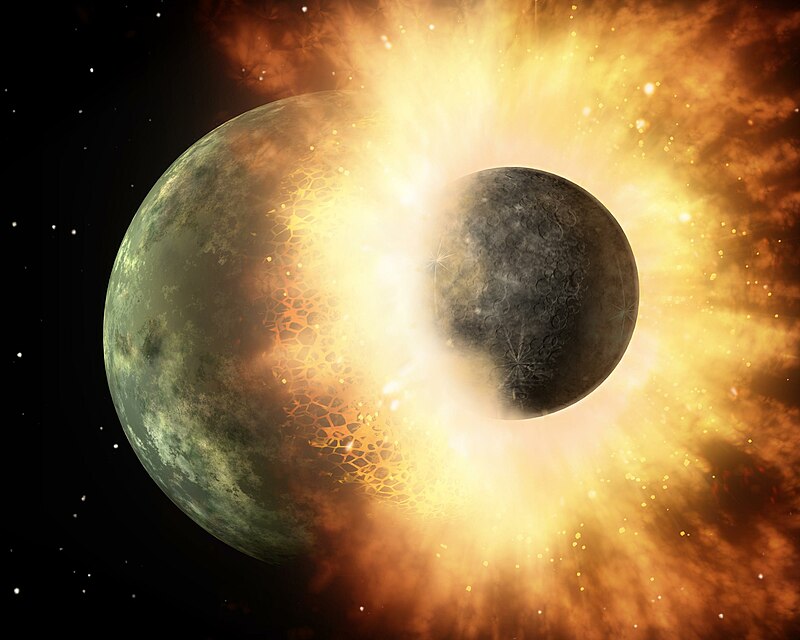
File:Artist's_concept_of_collision_at_HD_172555.jpg · Wikimedia Commons · See Wikimedia Commons
Hadean
Sign in to saveAlso known as Priscoan Period, Priscoan, Pre-Archean, Pre-Archean period, Pre-Archaean, Pre-Archaean period, Hadean Eon
The Hadean ( ) is the first and oldest of the four geologic eons of Earth's history, starting with the planet's formation about 4.6 Ga (estimated 4567.30 ± 0.16 Ma set by the age of the oldest solid material in the Solar System—protoplanetary disk dust particles—found as chondrules and calcium–aluminium-rich inclusions in some meteorites about 4.567 Ga), and ending 4.031 Ga, the age of the oldest known intact rock formations on Earth as recognized by the International Commission on Stratigraphy. The interplanetary collision that created the Moon occurred early in this eon. The H
The Hadean is Earth's oldest geologic eon, beginning with the planet's formation approximately 4.6 billion years ago and ending about 4 billion years ago with the oldest known intact rock formations. This eon is significant because it encompasses Earth's earliest history, including the giant collision that created the Moon, though our direct knowledge of this period is limited by the scarcity of surviving rock records from that time.
AI-generated from the Wikipedia summary — may contain errors.
Key facts
- Geologic timespan.color
- Hadean
- Geologic timespan.top_bar
- all time
- Geologic timespan.image_map
- Artist's concept of collision at HD 172555.jpg
- Geologic timespan.caption_map
- Artist depiction of the hypothetical planet Theia colliding into Early Earth
- Geologic timespan.image_art
- Earearth.png
- Geologic timespan.caption_art
- Artist illustration of Earth and the Moon towards the middle/end of the Hadean eon
- Geologic timespan.timeline
- Eons
- Geologic timespan.synonym1
- Priscoan Period
- Geologic timespan.synonym1_coined
- Harland et al., 1989
- Geologic timespan.celestial_body
- earth
- Geologic timespan.usage
- Global (ICS)
- Geologic timespan.chrono_unit
- Eon
- Geologic timespan.strat_unit
- Eonothem
- Geologic timespan.proposed_by
- Preston Cloud, 1972
- Geologic timespan.timespan_formality
- Formal
- Geologic timespan.lower_boundary_def
- Age of the oldest solid material in the Solar System's protoplanetary disk (4567.30 ± 0.16) Ma
- Geologic timespan.upper_boundary_def
- Ten oldest U-Pb zircon ages
- Geologic timespan.upper_gssa_location
- Along the Acasta River, Northwest Territories, Canada
via Wikipedia infobox
Wikidata facts
Show 6 more facts
- start time
- 4567300000
- end time
- 4031000000
- Commons category
- Hadean
- sRGB color hex triplet
- AE027E
- named by
- Preston Cloud
- topic's main category
- Category:Hadean
via Wikidata · CC0
~10 min read
Encyclopedic overview
11 sectionsContents
- Etymology
- Rock dating
- Atmosphere
- Oceans
- Plate tectonics
- Continents
- Possible life
- See also
- References
- Further reading
- External links
The Hadean ( ) is the first and oldest of the four geologic eons of Earth's history, starting with the planet's formation about 4.6 Ga (estimated 4567.30 ± 0.16 Ma set by the age of the oldest solid material in the Solar System—protoplanetary disk dust particles—found as chondrules and calcium–aluminium-rich inclusions in some meteorites about 4.567 Ga), and ending 4.031 Ga, the age of the oldest known intact rock formations on Earth as recognized by the International Commission on Stratigraphy. The interplanetary collision that created the Moon occurred early in this eon. The Hadean eon was succeeded by the Archean eon, with the Late Heavy Bombardment hypothesized to have occurred at the Hadean-Archean boundary.
Hadean rocks are very rare, largely consisting of granular zircons from one locality (Jack Hills) in Western Australia. Hadean geophysical models remain controversial among geologists: plate tectonics and the growth of cratons into continents may have started in the Hadean, but there is still uncertainty.
Excerpted from Wikipedia’s “Hadean” article, available under the CC BY-SA 4.0 licence.
Gallery (11)
On the map
3 mapped locations
Available in 68 languages
- Español
- Français
- Deutsch
- 中文
- 日本語
- Русский
- Português
- Italiano
- العربية
- हिन्दी
- Afrikaans
- Azerbaijani
- Bahasa Indonesia
- Bangla
- Basque
- Belarusian
- Breton
- Bulgarian
Show 49 more
- Catalan
- Croatian
- Czech
- Danish
- Estonian
- Filipino
- Finnish
- Galician
- Greek
- Hebrew
- Hungarian
- Icelandic
- Irish
- Kannada
- Kara-Kalpak
- Kazakh
- Kotava
- Kurdish
- Latin
- Lingua Franca Nova
- Lithuanian
- Low German
- Malay
- Nederlands
- Northern Frisian
- Norwegian Nynorsk
- Occitan
- Polski
- Romanian
- Scots
- Serbian
- Serbian (Latin)
- simple
- Sinhala
- Slovak
- Slovenian
- Somali
- Sundanese
- Svenska
- Tamil
- Tiếng Việt
- Türkçe
- Ukrainian
- Welsh
- Wu Chinese
- zh_yue
- فارسی
- ไทย
- 한국어
via Wikidata sitelinks · CC0