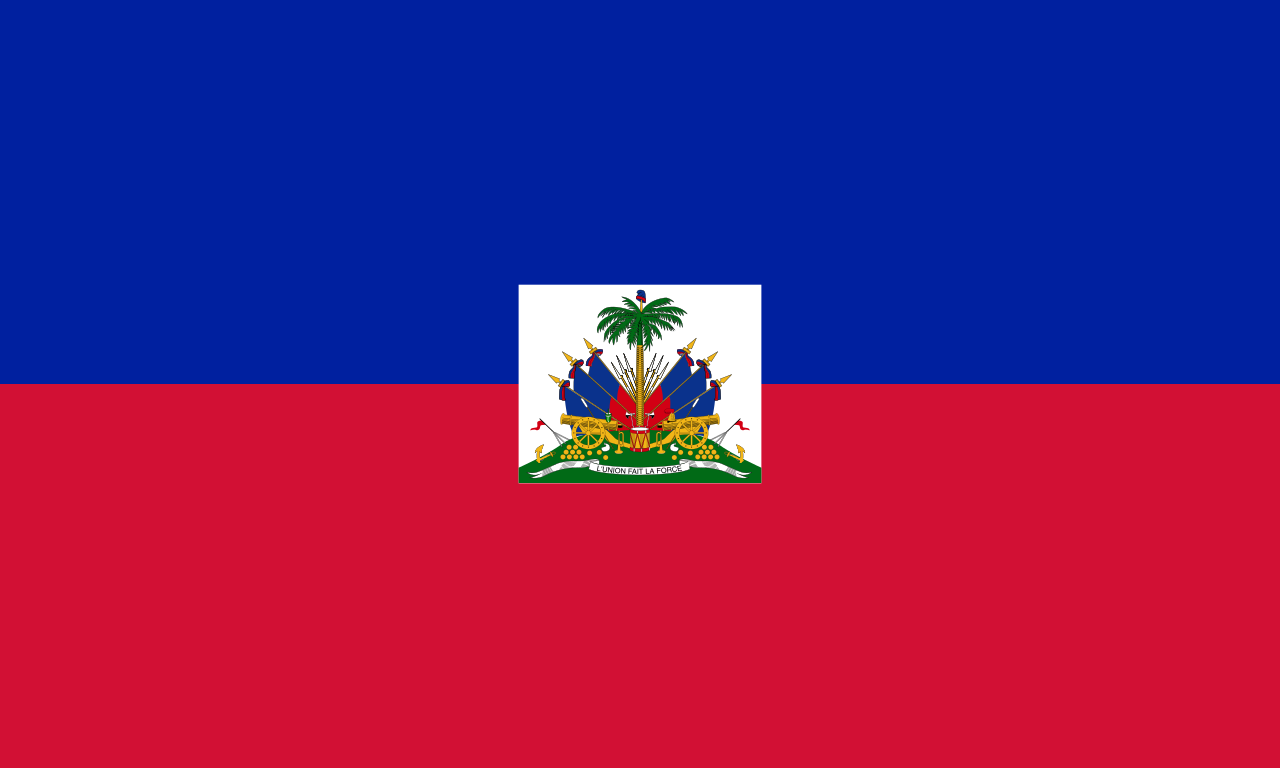
Haiti
Sign in to saveAlso known as Republic of Haiti, ht, Hayti, HT, Haitian Republic, Ayiti, HAI
Haiti, officially the Republic of Haiti, is a country in the Caribbean on the island of Hispaniola in the Caribbean Sea, east of Cuba and Jamaica and south of the Bahamas. It occupies the western side of the island, which it shares with the Dominican Republic. Haiti is the third largest country in the Caribbean by area, and with an estimated population of 11.4 million, it is the most populous Caribbean country. The capital and largest city is Port-au-Prince.
OverviewAI-generated
Haiti, officially the Republic of Haiti, is a sovereign island country in the Caribbean subregion of the Americas. It shares borders with the Dominican Republic, the United States, and the Turks and Caicos Islands. The capital is Port-au-Prince, and the official languages are French and Haitian Creole. The nation uses the gourde as its currency and has the top-level Internet domain .ht. Its highest point is Pic la Selle.
The country has a population of approximately 11.8 million people and covers an area of 27,750 square kilometers. Haiti became independent in 1804, following Saint-Domingue. It is a member of the United Nations, World Trade Organization, Caribbean Community, and International Bank for Reconstruction and Development. The national anthem is La Dessalinienne, and the motto is L'Union fait la force. The telephone country code is 509.
Synthesized by Vinony from 68 facts across 9 sources: Wikidata, REST Countries, Openweathermap, Open Meteo, World Bank, OpenStreetMap, PubMed, Vinony graph, Geo. Generated from structured data (not the Wikipedia text) and checked against those facts — may still contain errors.
Weather now
7-day forecast
via Open-Meteo
Country
- Capital
- Port-au-Prince
- Population
- 11,867,032
- Region
- Americas · Caribbean
- Demonym
- Haitian
- Currencies
- HTG (G)
- Languages
- French, Haitian Creole
- Calling code
- +509
- Drives on
- Right
- Gini
- 41.1 (2012)
- FIFA code
- HAI
- TLD
- .ht
- Timezones
- UTC-05:00
- Borders
- DOM
via REST Countries
Indicators · World Bank
- GDP
- $25.2B(2024)
- Population
- 11,772,557(2024)
- Life expectancy
- 65.1 yrs(2024)
- Unemployment
- 14.9 %(2025)
- Urban population
- 55 %(2024)
- Internet users
- 47.9 %(2024)
- Forest area
- 12.3 %(2023)
- Renewable energy
- 76.7 %(2021)
via World Bank Open Data · CC BY 4.0
Place details
- Locality
- Commune de Verrettes
- Region
- Département de l'Artibonite
- Country
- Ayiti
via OpenStreetMap · GeoNames
Wikipedia views (30d)
145,215 totalvia Wikimedia Pageviews API
Key facts
- Country.conventional_long_name
- Republic of Haiti
- Country.common_name
- Haiti
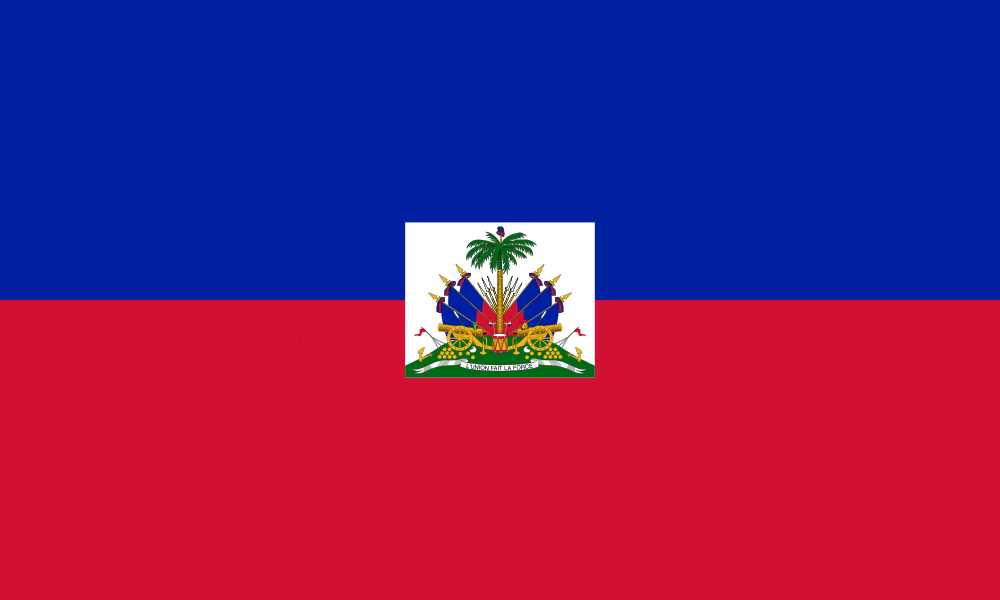
- Country.image_flag
- Flag of Haiti.svg
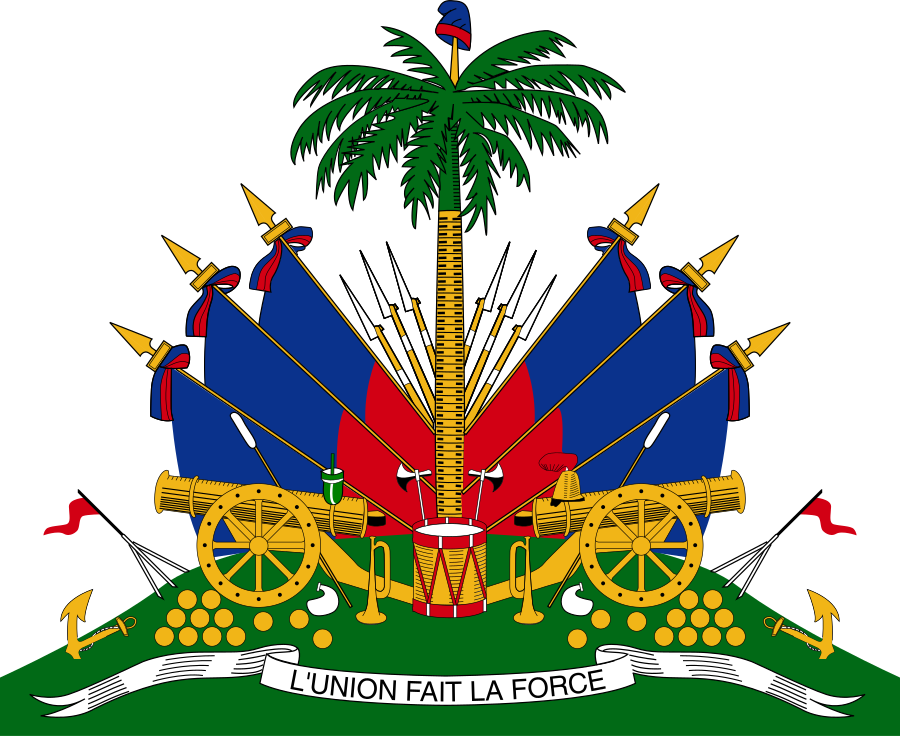
- Country.image_coat
- Coat of arms of Haiti.svg
- Country.national_motto
- ''L'union fait la force'' (French) "Inite se fòs" (Haitian Creole)"Union makes strength"
- Country.national_anthem
- La Dessalinienne"The Dessaline"
- Country.capital
- Port-au-Prince
- Country.largest_city
- Port-au-Prince
- Country.ethnic_groups
- 95% African5% other
- Country.religion_year
- 2020
- Country.demonym
- Haitian
- Country.government_type
- Unitary semi-presidential republic
- Country.leader_title1
- President
- Country.leader_name1
- Vacant
- Country.leader_title2
- Prime Minister
- Country.leader_name2
- Alix Didier Fils-Aimé (acting)
- Country.legislature
- National Assembly (vacant)
- Country.upper_house
- Senate
via Wikipedia infobox
Research
5,709 papers- Cholera in Haiti.The Lancet. Global health · 2020Henrys JH, Lerebours G, Achille MA et al.DOI: 10.1016/S2214-109X(20)30450-2
- Cholera in Haiti.The Lancet. Global health · 2020Rebaudet S, Gaudart J, Piarroux RDOI: 10.1016/S2214-109X(20)30430-7
- Haiti's health woes intensify.Lancet (London, England) · 2021Daniels JPDOI: 10.1016/S0140-6736(21)01851-1
- Global Dialysis Perspective: Haiti.Kidney360 · 2022Exantus JDOI: 10.34067/KID.0007592021
- Toward Cholera Elimination, Haiti.Emerging infectious diseases · 2021Rebaudet S, Dély P, Boncy J et al.DOI: 10.3201/eid2711.203372
- Haiti's food and drinking water: a review of toxicological health risks.ReviewClinical toxicology (Philadelphia, Pa.) · 2013Schwartzbord JR, Emmanuel E, Brown DLDOI: 10.3109/15563650.2013.849350
- Vector-borne diseases in Haiti: a review.ReviewTravel medicine and infectious disease · 2015Ben-Chetrit E, Schwartz EDOI: 10.1016/j.tmaid.2015.02.003
- Haiti.Department of State publication. Background notes series · 1987United States. Department of State. Bureau of Public Affairs
via PubMed
Wikidata facts
- Instance of
- country
- Part of
- Latin America
- Official name
- la République d’Haïti
- Demonym
- Háítíoch
- Country
- Haiti
- Contains
- Artibonite
- Continent
- North America
- Capital
- Port-au-Prince
- Official language
- Haitian Creole
- Population
- 10981229
- Area
- 27750.0
- Head of government
- Alix Didier Fils-Aimé
- Head of state
- Transitional Presidential Council
- Legislature
- Parliament of Haiti
- Anthem
- La Dessalinienne
- Shares border with
- Turks and Caicos Islands
- Highest point
- Pic la Selle
- Follows
- Saint-Domingue
- Official website
- primature.gouv.ht
- Image
- ISS020-E-43300 - View of Haiti.jpg
- Life expectancy
- 64
- Nominal GDP
- 20253551885
- Unemployment rate
- 7
- Calling code
- +509
Show 59 more facts
- Licence plate code
- RH
- Mains voltage
- 110
- Motto
- Profa fo!
- Flag
- flag of Haiti
- Coat of arms
- Coat of Arms of Haiti
- top-level Internet domain
- .ht
- Commons category
- Haiti
- topic's main category
- Category:Haiti
- inception
- 1804-01-01
- topic's main Wikimedia portal
- Portal:Haiti
- category for people who died here
- Category:Deaths in Haiti
- category for films shot at this location
- Category:Films shot in Haiti
- category of associated people
- Category:Haitian people
- located in/on physical feature
- Caribbean
- diplomatic relation
- Dominican Republic
- history of topic
- history of Haiti
- IPA transcription
- hɑˈɪtɪ
- lowest point
- Caribbean Sea
- mobile country code
- 372
- category for people born here
- Category:Births in Haiti
- driving side
- right
- geography of topic
- geography of Haiti
- compulsory education (minimum age)
- 6
- compulsory education (maximum age)
- 11
- marriageable age
- 18
- short name
- Гаити
- office held by head of state
- President of Haiti
- office held by head of government
- Prime Minister of Haiti
- total fertility rate
- 3.033
- maritime identification digits
- 336
- maintained by WikiProject
- WikiProject Caribbean
- Unicode character
- 🇭🇹
- central bank
- Bank of the Republic of Haiti
- native label
- Ayiti
- language used
- Haitian Creole
- culture
- culture of Haiti
- VAT rate
- 10
- BTI Status Index
- 3.34
- BTI Governance Index
- 2.94
- replaces
- Second Empire of Haiti
- economy of topic
- economy of Haiti
- demographics of topic
- demographics of Haiti
- P8168
- Galaxie 500
- Democracy Index
- 4.22
- Human Development Index
- 0.535
- P11012
- São Martinho da Cortiça
- hashtag
- Haiti
- Gini coefficient
- 41.1
- Happy Planet Index score
- 38.2
- Inequality-adjusted Human Development Index
- 0.327
- P12749
- Bremen
- birth rate
- 23.146
- male population
- 5738710
- death rate
- 8.48
- rural population
- 4770701
- female population
- 5846285
- urban population
- 6814295
Sources (15)
via Wikidata · CC0
Travel guide
Understand
It is extremely helpful when traveling in Haiti to have a local contact, through a church, a hotel, or just through making friends with someone. Experiences like dining locally, riding on a tap-tap, or strolling through one of the insanely crowded outdoor markets are great fun and very worth doing but are much safer and easier if you have a trusted Haitian to go along as a guide and interpreter.
Much of Haiti is struggling. It is the poorest country in the Western hemisphere, long beset by government corruption, and now imperiled by violent criminal gangs. Hurricanes are fairly frequent and there are some earthquakes.
Get in
thumb|450px|Visa policy of Haiti
See
thumb|300px|Ruins of Sans Souci Palace Port-au-Prince has some landmarks, structures and statues, such as a large pair of hands holding the earth. Many of these are close to the airport. This city is the largest in Haiti and was the most affected by the earthquake. You will still see evidence of the disaster, such as crumbling buildings, but much reconstruction has taken place. When you go a short distance outside of the city, you will have a better idea of the devastation. There are still people living in the "tent village," which extends for about two miles and is made up of small tarps draped over sticks stuck in the ground. As you go on, you may pass one of the mass graves dug after the earthquake, but you probably will not realize it is a grave. It's on the side of a small mountain, and the grass has grown over the turned earth. There are no markings but you will sometimes see people there or flowers placed in memory.
Haiti has beautiful scenery if you know where to find it. If you are travelling or staying with someone who knows the area well, ask if there are any nice beaches or mountainous areas nearby. St. Marc, along with some other cities, has a beautiful mountain range that can be hiked. At the top of these mountains are some historical artifacts, structures and incredible views of the ocean.
The severe impact of earthquakes in 2010 left Haiti's economy in ruin. However, there are several erected memorials in memory of the thousands of victims who lost their liv…
Do
Champs-de-Mars was once the most beautiful park in Haiti but is now covered in tents housing people made homeless by the earthquake. It was a public place where people went to relax, before the quake. It is located near the National Palace.
Eat
thumb|Haitian dishes; rice and beans (diri kole ak pwa), pink salad (with potato and beets), baked macaroni, fried plantains, fried chicken and pork (griot), green salad, sauce and piklis (similar to coleslaw) Haitian cuisine is typical of Caribbean métissage, a wonderful mix of French and African culinary traditions. It is similar to its Spanish Caribbean neighbors yet unique in its strong presence of spices. Roast goat called 'kabrit', morsels of fried pork 'griot', poultry with a Creole sauce 'poulet creole', rice with wild mushroom 'du riz jonjon' are all wonderful and tasty dishes.
Along the coast, fish, lobster and conch are readily available. Haiti has a very fine collection of fruit including guava, pineapple, mango (Haiti's most prized fruit), banana, melons, breadfruit, as well as mouthwatering sugarcane cut and peeled to order on the streets. Restaurants in the bigger cities provide safe and delicious meals, and precautions are taken with the food and water to keep things safe.
However, even in resorts with purified water, it is not always safe to assume that raw vegetables (such as lettuce and tomatoes) have been properly washed. In smaller or more humble venues make sure to eat fruit and vegetables that can be skinned or peeled, drink bottled drinks only, make sure any ice is from a clean water source, and make sure any meat is well-cooked.
When bottled water or boiled water is not available, a freshly opened coconut provides water and electrolytes with minima…
Drink
Haitian rum is well-known. Barbancourt 5 star is a top drawer drink. Clairin is the local firewater made from sugarcane that can be bought on the street, often flavored with various herbs that can be seen stuffed into the bottle. Prestige is the national beer, and is of good quality and excellent taste. Also be sure to try the Papye drink, a sort of papaya milkshake that is deliciously refreshing beyond words on a hot day. Cremas is a tasty, creamy alcoholic beverage that is derived from coconut milk.
Sleep
There are many guest houses throughout Haiti. However, these are quite hard to find while overseas. Many of these guest houses cost about 25 to 35 dollars a night and include 2 to 3 meals a day. Sometimes these houses are associated with orphanages (such as Saint Joseph's Home for Boys).
Saint Joseph's Home for Boys is in Delmas 91, near Petionville. Fondwa Guest House is at the bottom of the hill from Anbatonèl (a small village halfway between Léogâne and Jacmel).
Camping is a high-risk activity in certain parts of Haiti and is not recommended.
Stay safe
Since the assassination of its president in 2021, Haiti has once again devolved into complete lawlessness. Several governments advise against all travel to Haiti. Violent crime and civil unrest are serious problems. Kidnapping is also a risk. In case of trouble, help from the outside world will be extremely limited.
Do not unnecessarily carry valuables or more cash than needed, or walk late at night in dark streets. Women should not walk alone. The number of people that fled the country after the 2010 earthquake is unknown, but the atmosphere has changed some people. Even when women walk with other men, Haitian men may still utter remarks. They are not afraid to maintain eye contact, and their stares may make one uneasy. It is best to be polite, but be engaged in your immediate group.
Stay healthy
Sanitary conditions in Haiti are poor and medical care is woefully inadequate. If you get ill or injured whilst in Haiti, you may need to leave or be evacuated.
Tap water should be avoided. Drink bottled water only. Washing oneself with water from places such as creeks or lakes is not recommended due to the risk of water-borne diseases. Several diseases can cause dehydration, as can sweating a lot because of the hot climate. Hydration requirements can be fulfilled by preparing one of the many water purifying systems as if one were going camping, or by buying bottled water once in Haiti; it is widely available and inexpensive by western standards.
Various mosquito-borne diseases are a concern in Haiti, and precautions against mosquitoes are strongly recommended. Malaria is common and most travellers will need anti-malarial drugs. Dengue fever is also fairly common. Zika fever is also a concern, especially for women who are or may become pregnant. Check with your doctor, a tropical medicine specialist, or a local hospital or clinic, preferably at least 6 weeks before your trip, to find out what immunizations and anti-malarial prophylaxis they would suggest. There is now an oral cholera vaccine which also gives partial immunity to various causes of travellers' diarrhea; that may be a good idea for Haiti, although cholera does not typically affect tourists. The US government Center for Disease Control (CDC) has a page with advice for travellers to Haiti.
Depending on your itin…
Respect
thumb|Street view in the capital One thing visitors to Haiti learn very quickly is that Haitians are a very friendly and down-to-earth people, despite all they have had to endure. There are some beggars and peddlars in the cities, but they are the exception not the rule. Expect no kow-towing. Impoverished Haitians will always accept gifts, but they will almost always stand straight, look you in the eye, and repay you with a sincere "Mesi" (thanks).
Haiti is a nation of fairly conservative norms. Modest dress when exploring Haiti's cities is advised, especially for women. The smart visitor should look people in the eye, wave hello, and treat them with friendship and respect, as equals, no matter how poor or desperate their living conditions may seem.
Try to learn some basic words of Haitian Creole.
Ask permission before taking pictures of locals (they often ask you for money). Never walk about sticking your camera in people's faces or taking pictures randomly. Do not solely take pictures of the piles of trash you may see in some of the bigger cities (such as Cap-Haïtien or Port-au-Prince) or anything else that Haitians are not proud of as it is offensive. However, people have no problem with foreigners taking pictures of beautiful scenery, cultural events or historical sites.
Carry a few gourdes in your pockets for the kids who carry your luggage/shine your shoes/hail your tap-tap at the airport (but be alert for pickpockets).
Sometimes visitors to Haiti walk about handin…
Travel guide from Wikivoyage (CC BY-SA 4.0)
~40 min read
Encyclopedic overview
67 sectionsContents
- Etymology
- History
- Pre-Columbian era
- Colonial era
- Spanish rule (1492–1625)
- French rule (1625–1804)
- Haitian Revolution (1791–1804)
- Independent Haiti
- First Empire (1804–1806)
- State of Haiti, Kingdom of Haiti and the Republic (1806–1820)
- Unification of Hispaniola (1821–1844)
- Loss of the eastern portion of the island
- Second Empire (1849–1859)
- Late 19th century–early 20th century
- United States occupation (1915–1934)
- Post-occupation era (1934–1957)
- Duvalier dynasty (1957–1986)
- Post-Duvalier era (1986–2004)
- Post-Aristide era (2004–present)
- Geography
- Climate
- Geology
- Environment
- Biodiversity
- Government and politics
- Administrative divisions
- Military and law enforcement
- Law and crime
- Economy
- Foreign aid
- Trade
- Energy
- Personal income
- Real estate
- Agriculture
- Currency
- Tourism
- Caracol Industrial Park
- Transportation
- Airports
- Bus service
- Communications
- Water supply and sanitation
- Demographics
- Largest cities
- Racial discrimination
- Languages
- Religion
- Education
- Health
- Culture
- National holidays and festivals
- Architecture
- Museums
- Art
- Music and dance
- Literature
- Folklore and mythology
- Cinema
- Cuisine
- Sports
- See also
- Notes
- References
- Sources
- Further reading
- External links
Haiti, officially the Republic of Haiti, is a country in the Caribbean on the island of Hispaniola in both Caribbean Sea and North Atlantic Ocean, east of Cuba and Jamaica and south of The Bahamas. It occupies the western side of the island, which it shares with the Dominican Republic. Haiti is the third largest country in the Caribbean by area, and with an estimated population of 11.4 million, it is the most populous Caribbean country. The capital and largest city is Port-au-Prince.
Haiti was originally inhabited by Indigenous peoples. In 1492, Christopher Columbus established the first European settlement in the Americas, La Navidad, on its northeastern coast. The island was part of the Spanish Empire until 1697, when the western portion was ceded to France and became Saint-Domingue, dominated by sugarcane plantations worked by enslaved Africans. The 1791–1804 Haitian Revolution made Haiti the first sovereign state in the Caribbean, the second republic in the Americas, the first country in the Americas to officially abolish slavery, and the only country in history established by a slave revolt. The independent state began as an empire, later splitting into two nations before reunifying in 1820; a second empire was established under Faustin Soulouque before the return of the republic in 1859. The 19th century also saw political instability, international isolation, a crippling debt to France, and failed invasions of the Dominican Republic, including a costly war. U.S. forces occupied Haiti from 1915 to 1934, followed by the dictatorial rule of the Duvalier family (1957–1986). Following a coup d'état in 1991, a U.S.-led multinational force intervened in 1994; a second coup in 2004 was followed by a United Nations intervention. In the 2010s, a catastrophic earthquake and a large-scale cholera outbreak devastated the country.
Excerpted from Wikipedia’s “Haiti” article, available under the CC BY-SA 4.0 licence.
Gallery (59)
On the map
6 mapped locations
Available in 233 languages
- Español
- Français
- Deutsch
- 中文
- 日本語
- Русский
- Português
- Italiano
- العربية
- हिन्दी
- Abkhazian
- Afrikaans
- Albanian
- Albanian
- Amharic
- ami
- Angika
- Aragonese
Show 214 more
- Armenian
- Arpitan
- Asturian
- Aymara
- azb
- Azerbaijani
- Bahasa Indonesia
- Balinese
- Bambara
- Bangla
- Banjar
- Bashkir
- Basque
- bat_smg
- Bavarian
- be_x_old
- Belarusian
- Betawi
- Bhojpuri
- Bikol
- Bishnupriya
- Bislama
- Bosnian
- Breton
- Bulgarian
- Buriat
- Burmese
- Catalan
- cbk_zam
- cdo
- Cebuano
- Central Kurdish
- Chechen
- Chuvash
- Cornish
- Corsican
- Crimean Tatar
- Croatian
- Czech
- dag
- Danish
- Divehi
- dty
- Egyptian Arabic
- Erzya
- Esperanto
- Estonian
- Ewe
- Extremaduran
- Faroese
- Fiji Hindi
- Filipino
- Finnish
- fiu_vro
- Friulian
- Fula
- Gagauz
- Galician
- Georgian
- Gilaki
- Goan Konkani
- Greek
- Guarani
- Gujarati
- Haitian Creole
- Hakka Chinese
- Hausa
- Hawaiian
- Hebrew
- Hungarian
- Icelandic
- Ido
- Iloko
- Inari Sami
- Interlingua
- Interlingue
- Irish
- Jamaican Creole English
- Javanese
- Kabyle
- Kannada
- Kara-Kalpak
- Karachay-Balkar
- Kashubian
- Kazakh
- Kikuyu
- Kinyarwanda
- Komi
- Kongo
- Kotava
- Kurdish
- Kyrgyz
- Ladino
- Latin
- Latvian
- Ligurian
- Limburgish
- Lingala
- Lingua Franca Nova
- Lithuanian
- lld
- Lombard
- Low German
- Lower Sorbian
- Luxembourgish
- Macedonian
- Madurese
- Malagasy
- Malay
- Malayalam
- Maltese
- Manipuri
- Manx
- Māori
- map_bms
- Marathi
- Mari
- Mazanderani
- Minangkabau
- Mingrelian
- Moksha
- Mongolian
- Moroccan Arabic
- nds_nl
- Nederlands
- Nepali
- Newari
- Nigerian Pidgin
- Northern Frisian
- Northern Sami
- Norwegian
- Norwegian Nynorsk
- Novial
- Occitan
- Old English
- olo
- Oromo
- Ossetic
- Pampanga
- Papiamento
- Pashto
- Picard
- Piedmontese
- Polski
- Punjabi
- Quechua
- Romanian
- Rusyn
- Samoan
- Santali
- Sardinian
- Scots
- Scottish Gaelic
- Serbian
- Serbian (Latin)
- Shan
- Shona
- Sicilian
- Silesian
- simple
- Sindhi
- Sinhala
- Slovak
- Slovenian
- Somali
- Sundanese
- Svenska
- Swahili
- Swati
- szy
- Tachelhit
- Tajik
- Talysh
- Tamil
- Taroko
- Tatar
- tay
- Telugu
- Tetum
- Tibetan
- Tiếng Việt
- Toki Pona
- Tongan
- Türkçe
- Udmurt
- Ukrainian
- Upper Sorbian
- Urdu
- Uyghur
- Uzbek
- Venetian
- Veps
- Volapük
- Walloon
- Waray
- Welsh
- Western Frisian
- Western Mari
- Western Panjabi
- Wolof
- Wu Chinese
- Xhosa
- Yakut
- Yiddish
- Yoruba
- Zaza
- Zeelandic
- zh_classical
- zh_min_nan
- zh_yue
- Zhuang
- فارسی
- ไทย
- 한국어
via Wikidata sitelinks · CC0