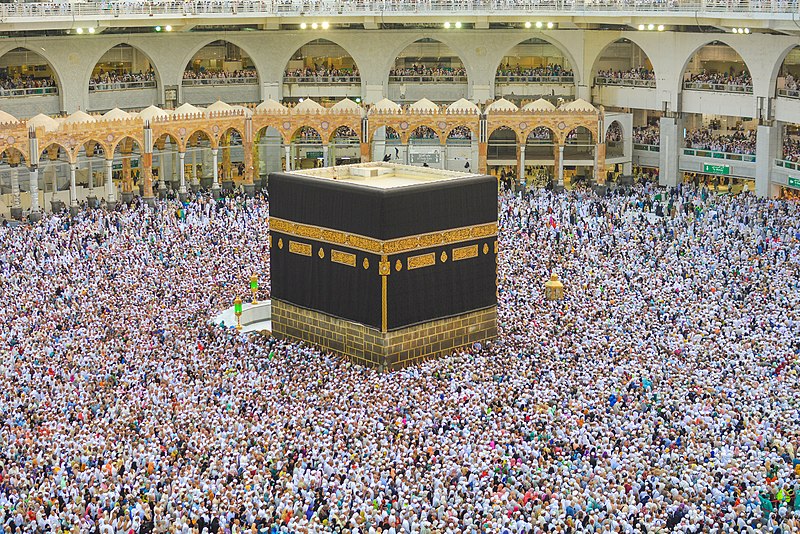
File:The_Kaaba_during_Hajj.jpg · Wikimedia Commons · See Wikimedia Commons
Hajj
Sign in to saveAlso known as Hadj, Hadji, Haj, AlHajj
Hajj (; also spelled Hadj or Haj) is an annual Islamic pilgrimage to Mecca, Saudi Arabia, the holiest city for Muslims. Hajj is a mandatory religious duty for capable Muslims that must be carried out at least once in their lifetime by all adult Muslims who are physically and financially capable of undertaking the journey, and of supporting their family during their absence from home.
Hajj is an annual pilgrimage to Mecca, Saudi Arabia, that represents the holiest city in Islam. It is a mandatory religious duty that every able-bodied adult Muslim is expected to complete at least once in their lifetime, provided they have the physical health and financial means to make the journey.
AI-generated from the Wikipedia summary — may contain errors.
Key facts
- Recurring event.name
- Hajj
- Recurring event.native_name
- حَجّ
- Recurring event.native_name_lang
- ar
- Recurring event.logo_size
- 1px
- Recurring event.image
- The Hajj kicks into full gear - Flickr - Al Jazeera English (8).jpg
- Recurring event.image_size
- 250px
- Recurring event.caption
- Pilgrims at the Masjid al-Haram performing Tawaf during Hajj
- Recurring event.status
- Active
- Recurring event.genre
- Religious pilgrimage
- Recurring event.begins
- 8th day of Dhu al-Hijja
- Recurring event.ends
- 12th or 13th day of Dhu al-Hijja
- Recurring event.frequency
- Annual
- Recurring event.location
- Mecca
- Recurring event.country
- Saudi Arabia
- Recurring event.participants
- Muslims
- Recurring event.attendance
- 1,845,045 (2023)
- Recurring event.organised
- Ministry of Hajj and Umrah
via Wikipedia infobox
Wikidata facts
- Instance of
- Fard
- Subclass of
- pilgrimage
- Part of
- Five Pillars of Islam
- Religion
- Islam
- Country
- Saudi Arabia
- Image
- Al-Haram mosque - Flickr - Al Jazeera English.jpg
- Participant
- Muslim
Show 9 more facts
- significant place
- Mount Arafat
- Stack Exchange tag
- islam.stackexchange.com/tags/hajj
- Commons category
- Hajj
- topic's main category
- Category:Hajj
- on focus list of Wikimedia project
- Wikipedia:Vital articles/Level/4
- destination point
- Mecca
- has effect
- Hajji
- history of topic
- history of Hajj
- native label
- الحج
Sources (7)
via Wikidata · CC0
~37 min read
Encyclopedic overview
42 sectionsContents
- Etymology
- History
- Timing of Hajj
- Rites
- ''Ihram''
- ''Tawaf'' and ''sa'ay''
- First day of Hajj: 8th Dhu al-Hijjah (Tarwiyah Day)
- Mina
- Second day: 9th Dhu al-Hijjah (Arafah Day)
- Arafat
- Muzdalifah
- Third day: 10th Dhu al-Hijjah (Qurban Day)
- Ramy al-Jamarat
- Animal sacrificing
- Hair removal
- Tawaf Ziyarat/Ifadah
- Fourth day: 11th Dhu al-Hijjah
- Fifth day: 12th Dhu al-Hijjah
- Last day at Mina: 13th Dhu al-Hijjah
- Tawaf al-Wadaa
- Journey to Medina
- Significance
- Differences between Hajj and Umrah
- Arrangement and facilities
- Technology solutions
- Visa requirements
- Makkah Route Initiative
- Transportation
- Sustainability
- Green Hajj Camp
- Incidents
- Crowd-control problems
- COVID-19
- Hajj and the Saudi economy
- Number of pilgrims per year
- Gallery
- See also
- References
- Notes
- Citations
- Further reading
- External links
Hajj (; also spelled Hadj or Haj) is an annual Islamic pilgrimage to Mecca, Saudi Arabia, the holiest city for Muslims. Hajj is a mandatory religious duty for capable Muslims that must be carried out at least once in their lifetime by all adult Muslims who are physically and financially capable of undertaking the journey, and of supporting their family during their absence from home.
In Islamic terminology, Hajj is a pilgrimage made to the Kaaba, the "House of Allah", in the sacred city of Mecca in Saudi Arabia. It is one of the Five Pillars of Islam, alongside (oath that one believes there is no god but Allah), (prayer), (almsgiving), and (fasting during Ramadan). The Hajj is an annual practice when Muslim brotherhood is on display and their solidarity with fellow Muslim people and submission to God (Allah) is fulfilled. The Hajj is taken by Muslims to cleanse their souls of all worldly sins, which connotes both the outward act of a journey after death and the inward act of good intentions. The rites of pilgrimage are performed over five to six days, extending from the 8th to the 12th or 13th of Dhu al-Hijjah, the last month of the Islamic calendar. Because the Islamic calendar is lunar and the Islamic year is about eleven-twelve days shorter than the Gregorian year, the Gregorian date of Hajj changes from year to year. In 2024 AD (1445 AH), Dhu al-Hijjah extended from 7 June to 6 July and in 2025 AD (1446 AH), Dhu al-Hijjah was from 28 May to 25 June. In 2026 AD (1447 AH), Dhu al-Hijjah will extend from 18 May to 15 June; and in 2027 AD (1448 AH), Dhu al-Hijjah will extend from 24 May to 22 June.
Excerpted from Wikipedia’s “Hajj” article, available under the CC BY-SA 4.0 licence.
Gallery (25)
On the map
2 mapped locations
Available in 130 languages
- Español
- Français
- Deutsch
- 中文
- 日本語
- Русский
- Português
- Italiano
- العربية
- हिन्दी
- Achinese
- Afrikaans
- Albanian
- Aragonese
- Armenian
- Assamese
- Asturian
- Avaric
Show 111 more
- Azerbaijani
- Bahasa Indonesia
- Bangla
- Banjar
- Bashkir
- Basque
- be_x_old
- Belarusian
- Bhojpuri
- Bikol
- Bosnian
- Bulgarian
- Catalan
- Central Kurdish
- Chechen
- Crimean Tatar
- Croatian
- Czech
- dag
- Danish
- Divehi
- Egyptian Arabic
- Esperanto
- Estonian
- Filipino
- Finnish
- Georgian
- gpe
- Greek
- Gujarati
- Hausa
- Hebrew
- Hungarian
- Icelandic
- Ido
- Ingush
- Interlingua
- Irish
- Javanese
- Kabyle
- Kannada
- Kara-Kalpak
- Kashmiri
- Kazakh
- kge
- Kurdish
- Kyrgyz
- Latin
- Latvian
- lbe
- Lithuanian
- Lombard
- Luxembourgish
- Macedonian
- Madurese
- Malagasy
- Malay
- Malayalam
- Marathi
- Minangkabau
- Moroccan Arabic
- N’Ko
- Nederlands
- Nepali
- Norwegian
- Norwegian Nynorsk
- nup
- Occitan
- Odia
- Pashto
- Picard
- Polski
- Punjabi
- roa_rup
- Romanian
- Scots
- Serbian
- Serbian (Latin)
- simple
- Sindhi
- Sinhala
- skr
- Slovak
- Slovenian
- Somali
- Sundanese
- Svenska
- Swahili
- syl
- Tajik
- Tamil
- Tatar
- Telugu
- Tiếng Việt
- Toki Pona
- Türkçe
- Turkmen
- Ukrainian
- Urdu
- Uzbek
- Waray
- Welsh
- Western Panjabi
- Wolof
- Wu Chinese
- Yiddish
- Yoruba
- zh_yue
- فارسی
- ไทย
- 한국어
via Wikidata sitelinks · CC0