Encyclopedia of Life · EOL (see source)
Halobacteriales
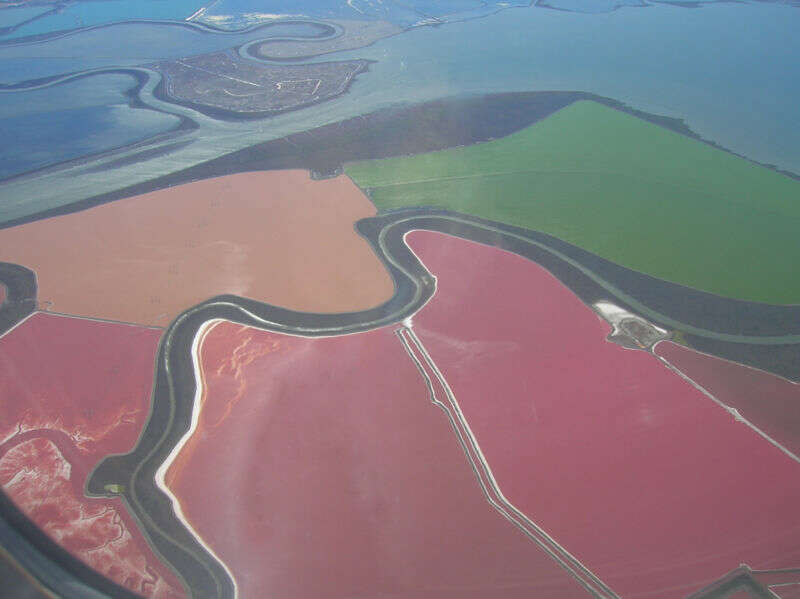
Sign in to saveHalobacteriales, from Ancient Greek ἅλς (háls), meaning "salt", and "bacterium", are an order of the Halobacteria, found in water saturated or nearly saturated with salt. They are also called halophiles, though this name is also used for other organisms which live in somewhat less concentrated salt water. They are common in most environments where large amounts of salt, moisture, and organic material are available. Large blooms appear reddish, from the pigment bacteriorhodopsin. This pigment is used to absorb light, which provides energy to create ATP. Halobacteria also possess a second pigmen
Species
ハロバクテリウム目
ORDER
- KingdomArchaea
- PhylumHalobacteriota
- ClassHalobacteria
- OrderHalobacteriales
Halobacteria in San Francisco Bay Salt PondsHalobacteria in San Francisco Bay Salt PondsFrom Wikimedia CommonsOctober 2005
via GBIF
Research
5,162 papers- Trehalose/2-sulfotrehalose biosynthesis and glycine-betaine uptake are widely spread mechanisms for osmoadaptation in the Halobacteriales.The ISME journal · 2014
- A multilocus sequence analysis approach to the phylogeny and taxonomy of the Halobacteriales.International journal of systematic and evolutionary microbiology · 2011
- Evolution of the RNA polymerase B' subunit gene (rpoB') in Halobacteriales: a complementary molecular marker to the SSU rRNA gene.Molecular biology and evolution · 2004
- Fructans of the saline world.Biotechnology advances · 2018
- Tissue-like multicellular development triggered by mechanical compression in archaea.Science (New York, N.Y.) · 2025
via PubMed
Wikidata facts
- Instance of
- taxon
- Parent taxon
- Halobacteria
- Image
- Halobacteria.jpg
Show 6 more facts
- taxon rank
- order
- taxon name
- Halobacteriales
- topic's main category
- Category:Halobacteriales
- taxonomic type
- Halobacterium
- Commons category
- Halobacteriales
Sources (1)
via Wikidata · CC0
~5 min read
Encyclopedic overview
9 sectionsContents
- Ecology
- Habitats
- Current taxonomy
- Phylogeny
- See also
- References
- Further reading
- Journals
- Books
Halobacteriales, from Ancient Greek ἅλς (háls), meaning "salt", and "bacterium", are an order of the Halobacteria, found in water saturated or nearly saturated with salt. They are also called halophiles, though this name is also used for other organisms which live in somewhat less concentrated salt water. They are common in most environments where large amounts of salt, moisture, and organic material are available. Large blooms appear reddish, from the pigment bacteriorhodopsin. This pigment is used to absorb light, which provides energy to create ATP. Halobacteria also possess a second pigment, halorhodopsin, which pumps in chloride ions in response to photons, creating a voltage gradient and assisting in the production of energy from light. The process is unrelated to other forms of photosynthesis involving electron transport; however, and halobacteria are incapable of fixing carbon from carbon dioxide.
Halobacteria can exist in salty environments because although they are aerobes they have a separate and different way of creating energy through photosynthesis. Parts of the membranes of halobacteria are purplish in color. These parts conduct photosynthetic reactions with retinal pigment rather than chlorophyll. This allows them to create a proton gradient across the membrane of the cell which can be used to create ATP for their own use. Some species in this order are used as model organisms to study how some microorganisms can survive in hypersaline environments, understand cellular processes and to research their physiology.
Excerpted from Wikipedia’s “Halobacteriales” article, available under the CC BY-SA 4.0 licence.