Encyclopedia of Life · EOL (see source)
Hamamelis
Sign in to saveAlso known as the Witch-hazels
Witch-hazels or witch hazels (Hamamelis) are a genus of flowering plants in the family Hamamelidaceae, with three species in North America (H. ovalis, H. virginiana, and H. vernalis), and one each in Japan (H. japonica) and China (H. mollis). The North American species are occasionally called winterbloom.
Species
GENUS
- KingdomPlantae
- PhylumTracheophyta
- ClassMagnoliopsida
- OrderSaxifragales
- FamilyHamamelidaceae
Zaubernuss (Hamamelis) ist eine Pflanzengattung innerhalb der Familie der Zaubernussgewächse (Hamamelidaceae). Die Gattung Hamamelis besitzt ein disjunktes Areal; von den nur fünf Arten kommen drei im östlichen Nordamerika und zwei im östlichen Asien vor.
via GBIF · Kew POWO
Research
168 papers- Hamamelis Virginica.Atlanta medical and surgical journal · 1867
- Hamamelis virginiana L. in Skin Care: A Review of Its Pharmacological Properties and Cosmetological Applications.Molecules (Basel, Switzerland) · 2025
- Hamamelis Virginica.British medical journal · 1887
- Hamamelis virginiana L. Leaf Extracts Inhibit the Growth of Antibiotic-Resistant Gram-Positive and Gram-Negative Bacteria.Antibiotics (Basel, Switzerland) · 2023
- Hamamelis virginiana L. extract presents antimicrobial and antibiofilm effects, absence of cytotoxicity, anti-inflammatory action, and potential to fight infections through the nitric oxide production by macrophages.Anais da Academia Brasileira de Ciencias · 2024
via PubMed
Wikidata facts
- Image
- Hamamelis virginiana - Köhler–s Medizinal-Pflanzen-070.jpg
Show 5 more facts
- Commons category
- Hamamelis
- taxon name
- Hamamelis
- Commons gallery
- Hamamelis
- taxon common name
- nepozebnik
Sources (2)
via Wikidata · CC0
~9 min read
Article
12 sectionsContents
- Description
- Etymology
- Species
- Cultivation
- Garden shrubs
- Phytochemicals and hamamelis water
- Topical ointment
- Folk medicine
- History
- Gallery
- References
- Further reading
Witch-hazels or witch hazels (Hamamelis) are a genus of flowering plants in the family Hamamelidaceae, with three species in North America (H. ovalis, H. virginiana, and H. vernalis), and one each in Japan (H. japonica) and China (H. mollis). The North American species are occasionally called winterbloom.
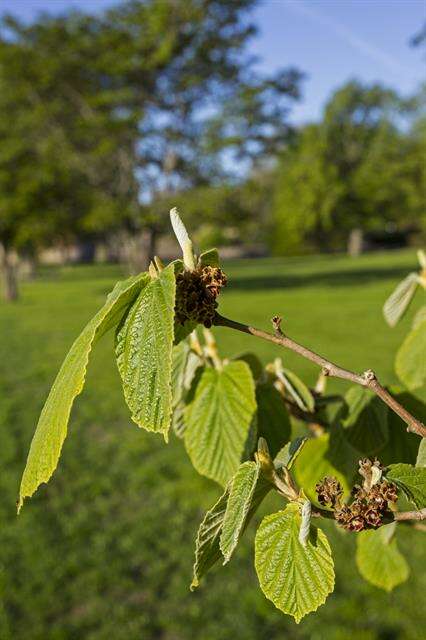
==Description== The witch-hazels are deciduous shrubs or (rarely) small trees growing to 3 to 7.5 m tall, even more rarely to 12 m tall. The leaves are alternately arranged, oval, 5 to 15 cm long, and 2.5 to 10 cm wide, with a smooth or wavy margin. The genus name, Hamamelis, means "together with fruit", referring to the simultaneous occurrence of flowers with the maturing fruit from the previous year. H. virginiana blooms in September–November while the other species bloom from January–March. Each flower has four slender strap-shaped petals 1 to 2 cm long, pale to dark yellow, orange, or red. The fruit is a two-part capsule 1 cm long, containing a single 0.6 cm glossy black seed in each of the two parts; the capsule splits explosively at maturity in the autumn about eight months after flowering, ejecting the seeds with sufficient force to fly for distances of up to , thus another alternative name "snapping hazel".