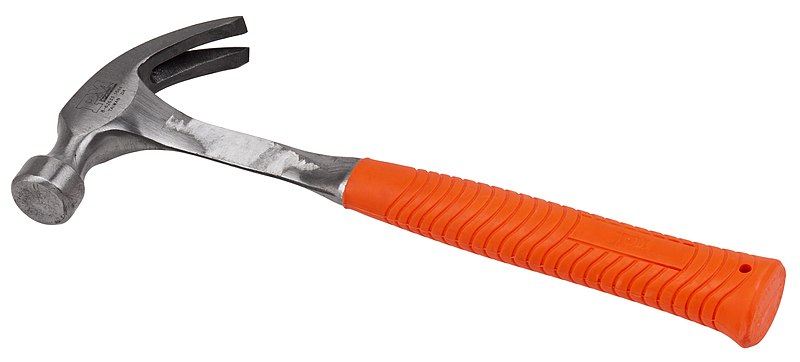
File:Claw-hammer.jpg · Wikimedia Commons · See Wikimedia Commons
hammer
Sign in to savethumb|right|upright=1.3|A modern claw hammer suited to drive and remove nails thumb|Cartwheel mallets with heads of felt held between steel washers for use with [[timpani drums]] thumb|Detail of the head of a war hammer thumb|right|A geologist's hammer used to break up rocks, as seen in [[archaeology and prospecting]]
A hammer is a hand tool with a weighted head attached to a handle, primarily used to drive nails into or remove them from surfaces. Hammers have various specialized designs—such as claw hammers for carpentry, mallets for percussion instruments, war hammers for historical combat, and geological hammers for breaking rocks—making them useful across many different trades and activities.
AI-generated from the Wikipedia summary — may contain errors.
Wikidata facts
- Subclass of
- archaeological artefact
- Image
- Claw-hammer.jpg
- Has use
- masonry
Show 9 more facts
- Unicode character
- 🔨
- Commons category
- Hammers
- topic's main category
- Category:Hammers
- Commons gallery
- Hammer
- MCN code
- 8467.29.93
- has characteristic
- mass
- different from
- Hammer
- P8168
- Negrileşti
- on focus list of Wikimedia project
- Wikipedia:Vital articles/Level/4
Sources (3)
via Wikidata · CC0
~19 min read
Encyclopedic overview
18 sectionsContents
- History
- Construction and materials
- Designs and variations
- Hand-powered
- Mechanically powered
- Associated tools
- Physics
- As a force amplifier
- Effect of the head's mass
- Effect of the handle
- Effect of gravity
- Ergonomics and injury risks
- War hammers
- Symbolism
- Image gallery
- See also
- References
- External links
thumb|right|upright=1.3|A modern claw hammer suited to drive and remove nails thumb|Cartwheel mallets with heads of felt held between steel washers for use with [[timpani drums]] thumb|Detail of the head of a war hammer thumb|right|A geologist's hammer used to break up rocks, as seen in [[archaeology and prospecting]]
A hammer is a tool, most often a hand tool, consisting of a weighted "head" fixed to a long handle that is swung to deliver an impact to a small area of an object. This can be, for example, to drive nails into wood, to shape metal (as with a forge), or to crush rock. Hammers are used for a wide range of driving, shaping, breaking and non-destructive striking applications. Traditional disciplines include carpentry, blacksmithing, warfare, and percussive musicianship (as with a gong).
Excerpted from Wikipedia’s “hammer” article, available under the CC BY-SA 4.0 licence.
Gallery (30)
Available in 133 languages
- Español
- Français
- Deutsch
- 中文
- 日本語
- Русский
- Português
- Italiano
- العربية
- हिन्दी
- Afrikaans
- Albanian
- Amharic
- Aragonese
- Aramaic
- Armenian
- Asturian
- azb
Show 114 more
- Azerbaijani
- Bahasa Indonesia
- Bangla
- Banjar
- Basque
- bat_smg
- be_x_old
- Belarusian
- Bikol
- Bislama
- Bosnian
- Breton
- Bulgarian
- Burmese
- Catalan
- Central Kurdish
- Cheyenne
- Chuvash
- Croatian
- Czech
- Danish
- Egyptian Arabic
- Esperanto
- Estonian
- Filipino
- Finnish
- Galician
- Georgian
- Gilaki
- Greek
- Haitian Creole
- Hausa
- Hebrew
- Hungarian
- Icelandic
- Ido
- Ingush
- Irish
- Javanese
- Kannada
- Kara-Kalpak
- Kashmiri
- Kazakh
- Kurdish
- Kyrgyz
- Latin
- Latvian
- Lingua Franca Nova
- Lithuanian
- Lombard
- Low German
- Luxembourgish
- Macedonian
- Malagasy
- Malay
- Malayalam
- Marathi
- Minangkabau
- Mongolian
- Nederlands
- Nepali
- Newari
- Northern Frisian
- Norwegian
- Norwegian Nynorsk
- nrm
- Occitan
- Old English
- olo
- Pampanga
- Pashto
- Piedmontese
- Polski
- Punjabi
- Quechua
- Romanian
- Rusyn
- Santali
- Saterland Frisian
- Scots
- Serbian
- Serbian (Latin)
- Shona
- Sicilian
- simple
- Sindhi
- Slovak
- Slovenian
- Somali
- Sundanese
- Svenska
- Swahili
- szy
- Tajik
- Tamil
- Telugu
- Tiếng Việt
- Türkçe
- Ukrainian
- Uyghur
- Uzbek
- Volapük
- Waray
- Welsh
- West Flemish
- Western Panjabi
- Wu Chinese
- Yakut
- Yiddish
- zh_min_nan
- zh_yue
- فارسی
- ไทย
- 한국어
via Wikidata sitelinks · CC0