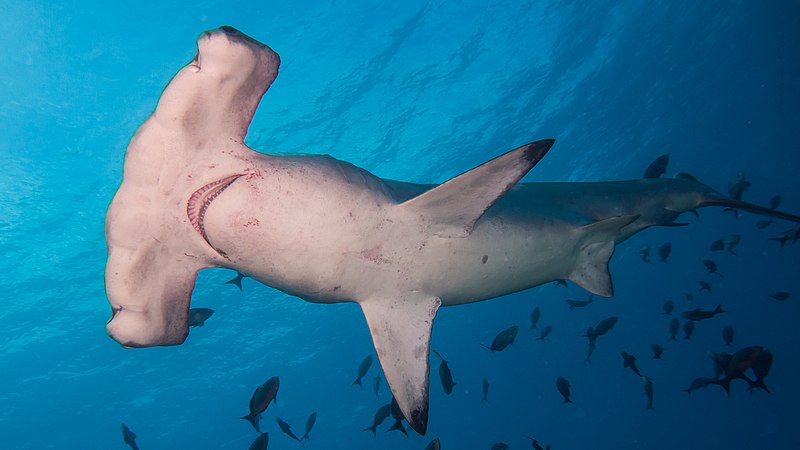
File:Scalloped_Hammerhead_Shark_Sphyrna_Lewini_(226845659).jpeg · Wikimedia Commons · See Wikimedia Commons
hammerhead sharks
Sign in to saveAlso known as hammerhead, hammerhead shark, hammerheads, Sphyrnidae
family of fishes
OverviewAI-generated
Sphyrnidae is a taxonomic family of sharks within the order Carcharhiniformes. This group belongs to the class Elasmobranchii and the phylum Chordata. The family name was established by Bonaparte in 1840, and its scientific status is accepted.
The lineage originated approximately 56 million years ago. These organisms inhabit marine and brackish environments. One common name associated with the family is bonnethead. The subject is included in the Wikipedia vital articles list at Level 4.
Synthesized by Vinony from 19 facts across 3 sources: Wikidata, WoRMS, Vinony graph. Generated from structured data (not the Wikipedia text) and checked against those facts — may still contain errors.
Species
bonnethead
Family
- PhylumChordata
- ClassElasmobranchii
- OrderCarcharhiniformes
- FamilySphyrnidae
Hammerhai ist eine Weiterleitung auf diesen Artikel. Zu der Band siehe Hammerhai (Band). Die Hammerhaie (Sphyrnidae) sind eine Familie der Haie, die besonders durch die starke Verbreiterung ihres Kopfes zu einem sogenannten Cephalofoil gekennzeichnet sind; bei einigen Arten führt diese zur Bildung des namensgebenden „Hammers“. Die Familie umfasst zwei Gattungen mit insgesamt acht Arten, die sich vor allem in ihrer Größe sowie Form und Breite des Kopfes unterscheiden. Die größte Art ist der Große Hammerhai (Sphyrna mokarran) mit einer Maximallänge von 5,50 bis 6,10 Metern, während der Korona-Hammerhai (Sphyrna corona) als kleinste Art nur eine maximale Gesamtlänge von unter einem Meter erreicht. Hammerhaie leben weltweit vor allem in tropischen und subtropischen Küstengebieten. Sie sind in der Regel Einzelgänger, wobei einige Arten jedoch auch Gruppen von mehreren hundert bis mehreren tausend Individuen bilden können. Als Jäger erbeuten sie eine Vielzahl wirbelloser Tiere sowie Knochen- und Knorpelfische. Größere Individuen erbeuten auch andere Haie einschließlich kleinerer Vertreter der eigenen Art (Kannibalismus). Vor allem bodenlebende Beutetiere wie verschiedene Rochen werden du
via
Wikidata facts
- Instance of
- taxon
- Image
- Hammerhead Shark - Marko Dimitrijevic.jpg
Show 7 more facts
- Commons category
- Sphyrnidae
- taxon name
- Sphyrnidae
- taxon rank
- family
- topic's main category
- Category:Sphyrnidae
- exact match
- wordnet-rdf.princeton.edu/wn31/101497220-n
- start time
- 55800000-0
- on focus list of Wikimedia project
- Wikipedia:Vital articles/Level/4
Sources (2)
via Wikidata · CC0
~15 min read
Encyclopedic overview
The hammer-like shape of the head means that hammerhead sharks can sweep for prey more effectively.
The hammerhead sharks are a group of sharks that form the family Sphyrnidae, named for the unusual and distinctive form of their heads, which are flattened and laterally extended into a cephalofoil (a T-shape or "hammer"). The shark's eyes are placed one on each end of this T-shaped structure, with their small mouths directly centered and underneath. Most hammerhead species are placed in the genus Sphyrna, while the winghead shark is placed in its own genus, Eusphyra. Many different—but not necessarily mutually exclusive—functions have been postulated for the cephalofoil, including sensory reception, manoeuvering, and prey manipulation. The cephalofoil gives the shark superior binocular vision and depth perception, as well as increased surface area for electroreceptors.
Excerpted from Wikipedia’s “hammerhead sharks” article, available under the CC BY-SA 4.0 licence.
Gallery (13)
Available in 66 languages
- Español
- Français
- Deutsch
- 中文
- 日本語
- Русский
- Português
- Italiano
- العربية
- Afrikaans
- Asturian
- Azerbaijani
- Bahasa Indonesia
- Balinese
- Basque
- Belarusian
- Betawi
- Bulgarian
Show 47 more
- Catalan
- Cebuano
- Croatian
- Czech
- Danish
- Egyptian Arabic
- Esperanto
- Estonian
- Filipino
- Finnish
- Galician
- Georgian
- Greek
- Hebrew
- Hungarian
- Icelandic
- Ido
- Irish
- Javanese
- Kazakh
- Latin
- Lithuanian
- Malagasy
- Malay
- Navajo
- Nederlands
- Norwegian Nynorsk
- Polski
- Serbian
- simple
- Slovak
- Svenska
- Swahili
- Tamil
- Tatar
- Tibetan
- Tiếng Việt
- Türkçe
- Ukrainian
- Urdu
- Waray
- Welsh
- Western Panjabi
- zh_yue
- فارسی
- ไทย
- 한국어
via Wikidata sitelinks · CC0