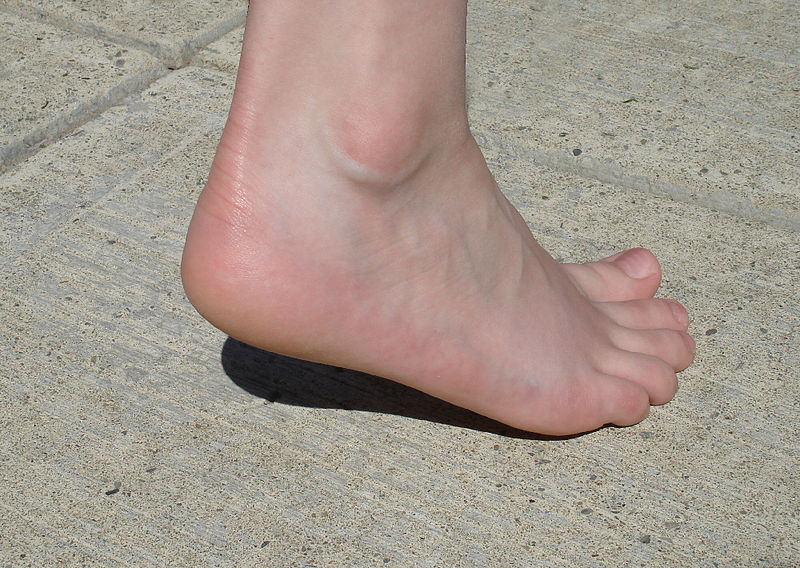
File:Girls_heel.jpg · Wikimedia Commons · See Wikimedia Commons
heel
Sign in to saveThe heel is the prominence at the posterior end of the foot. It is based on the projection of one bone, the calcaneus or heel bone, behind the articulation of the bones of the lower leg.
The heel is the rounded bump at the back of your foot, formed by a bone called the calcaneus that extends behind where your leg bones connect to your foot. This structure is important because it bears much of your body's weight when you walk and stand.
AI-generated from the Wikipedia summary — may contain errors.
Key facts
- Anatomy.Name
- Heel
- Anatomy.Latin
- calx
- Anatomy.Image
- Girls heel.jpg
- Anatomy.Caption
- A human heel
via Wikipedia infobox
Research
20,014 papersvia PubMed
Wikidata facts
- Part of
- foot
- Image
- Girls heel.jpg
Show 3 more facts
- described by source
- Explanatory Dictionary of the Living Great Russian Language
- Commons category
- Heels
- different from
- Pięta
via Wikidata · CC0
~3 min read
Encyclopedic overview
7 sectionsContents
- Structure
- Function
- Cracked heels
- Other animals
- See also
- Notes
- References
The heel is the prominence at the posterior end of the foot. It is based on the projection of one bone, the calcaneus or heel bone, behind the articulation of the bones of the lower leg.
== Structure == thumb|Sagittal section through the foot thumb|From above To distribute the compressive forces exerted on the heel during gait, and especially the stance phase when the heel contacts the ground, the sole of the foot is covered by a layer of subcutaneous connective tissue up to 2 cm thick (under the heel). This tissue has a system of pressure chambers that both acts as a shock absorber and stabilises the sole. Each of these chambers contains fibrofatty tissue covered by a layer of tough connective tissue made of collagen fibers. These septa ("walls") are firmly attached both to the plantar aponeurosis above and the sole's skin below. The sole of the foot is one of the most highly vascularized regions of the body surface, and the dense system of blood vessels further stabilize the septa.
Excerpted from Wikipedia’s “heel” article, available under the CC BY-SA 4.0 licence.
Gallery (7)
Available in 82 languages
- Español
- Français
- Deutsch
- 中文
- 日本語
- Русский
- Português
- Italiano
- العربية
- हिन्दी
- Aragonese
- Avaric
- Aymara
- Bahasa Indonesia
- Bangla
- Banjar
- Basque
- Bavarian
Show 63 more
- Betawi
- Bikol
- Breton
- Bulgarian
- Catalan
- cdo
- Chuvash
- Croatian
- Czech
- Divehi
- Erzya
- Esperanto
- Filipino
- Finnish
- Galician
- Guarani
- Haitian Creole
- Hakka Chinese
- Hebrew
- Icelandic
- Ido
- Inupiaq
- Irish
- Javanese
- Kannada
- Latin
- Latvian
- lbe
- Lingua Franca Nova
- Luxembourgish
- Macedonian
- Malay
- Mazanderani
- Nederlands
- Newari
- Nias
- Norwegian
- Polski
- Romanian
- Sanskrit
- Santali
- Serbian
- Shona
- Sindhi
- Sundanese
- Svenska
- Tatar
- Tiếng Việt
- Türkçe
- Ukrainian
- Urdu
- Uyghur
- Uzbek
- Waray
- Welsh
- Western Frisian
- Wu Chinese
- Yiddish
- Zaza
- zh_yue
- فارسی
- ไทย
- 한국어
via Wikidata sitelinks · CC0