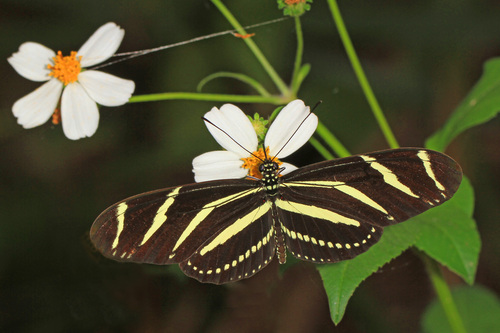
(c) Judy Gallagher, some rights reserved (CC BY) · cc-by
Heliconius
Sign in to saveHeliconius comprises a colorful and widespread genus of brush-footed butterflies commonly known as the longwings or heliconians. This genus is distributed throughout the tropical and subtropical regions of the New World, from South America as far north as the southern United States. The larvae of these butterflies eat passion flower vines (Passifloraceae). Adults exhibit bright wing color patterns which signal their distastefulness to potential predators.
Species
Zebra Longwing
GENUS
- KingdomAnimalia
- PhylumArthropoda
- ClassInsecta
- OrderLepidoptera
- FamilyNymphalidae
via GBIF
Museum specimens
- Specimen records
- 766
- With media
- 282
- Family
- Nymphalidae
- Collections
- IFIT-CP, MSU, VPI, UMNH, MNA, GMNH
- Recorded in
- Mexico, Panama, United States, Ecuador, Guatemala
Wikidata facts
- Instance of
- taxon
- Parent taxon
- Heliconiini
- Image
- Heliconius mimicry.png
Show 4 more facts
- Commons category
- Heliconius
- topic's main category
- Category:Heliconius
- taxon name
- Heliconius
- taxon rank
- genus
Sources (2)
via Wikidata · CC0
~16 min read
Encyclopedic overview
10 sectionsContents
- Model for evolutionary study
- Convergence
- Speciation
- Sexual selection of aposematic colors
- Sexual selection of pheromones
- Mating and offspring
- Cyanogenic glycosides as a defence
- Species
- Further reading
- External links
Heliconius comprises a colorful and widespread genus of brush-footed butterflies commonly known as the longwings or heliconians. This genus is distributed throughout the tropical and subtropical regions of the New World, from South America as far north as the southern United States. The larvae of these butterflies eat passion flower vines (Passifloraceae). Adults exhibit bright wing color patterns which signal their distastefulness to potential predators.
Brought to the forefront of scientific attention by Victorian naturalists, these butterflies exhibit a striking diversity and mimicry, both amongst themselves and with species in other groups of butterflies and moths. The study of Heliconius and other groups of mimetic butterflies allowed the English naturalist Henry Walter Bates, following his return from Brazil in 1859, to lend support to Charles Darwin, who had found similar diversity amongst the Galápagos finches.
Excerpted from Wikipedia’s “Heliconius” article, available under the CC BY-SA 4.0 licence.
Gallery (8)
Available in 21 languages
- Español
- Français
- 中文
- Русский
- Português
- العربية
- Asturian
- Bahasa Indonesia
- Belarusian
- Bikol
- Cebuano
- Egyptian Arabic
- Hebrew
- Hungarian
- Malay
- Nederlands
- Norwegian
- Svenska
Show 2 more
via Wikidata sitelinks · CC0