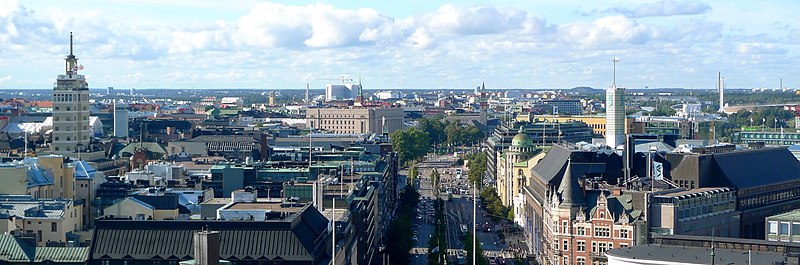
File:Helsingin_ydinkeskustaa_ja_Mannerheimintien_alkupäätä_Erottajan_paloaseman_tornista_(cropped).jpg · Wikimedia Commons · See Wikimedia Commons
Helsinki
Sign in to saveAlso known as Helsingfors, Helsingia, Helsingin kaupunki, Stadi, Hesa
Helsinki () is the capital and most populous city in Finland. It is on the shore of the Gulf of Finland and is the seat of southern Finland's Uusimaa region. About people live in the municipality, with million in the capital region and million in the metropolitan area. As the most populous urban area in Finland, it is the country's most significant centre for politics, education, finance, culture, and research. Helsinki is north of Tallinn, Estonia, east of Stockholm, Sweden, and west of Saint Petersburg, Russia.
OverviewAI-generated
Helsinki is a city and municipality in Finland, located in the Uusimaa region. It serves as the capital of Finland and has at various times been the capital of the Grand Duchy of Finland, the Finnish Democratic Republic, and the Finnish Socialist Workers' Republic. Founded in 1550 by Gustav I of Sweden, the city is also known by the nicknames Stadi and Hesa. Its official names include Helsingin kaupunki and Helsingfors stad.
The population of Helsinki is recorded as 694,392. It shares borders with Espoo, Vantaa, and Sipoo. The official languages are Finnish and Swedish. Helsinki is twinned with Prague, Saint Petersburg, Nuuk, and Sofia. The city operates in the Europe/Helsinki time zone, corresponding to UTC+02:00 and UTC+03:00. Its coat of arms is the coat of arms of Helsinki.
Synthesized by Vinony from 63 facts across 9 sources: Wikidata, Open Meteo, Openweathermap, OpenStreetMap, Firecrawl, GeoNames, ROR, Vinony graph, Geo. Generated from structured data (not the Wikipedia text) and checked against those facts — may still contain errors.
Weather now
cached 3h ago7-day forecast
via Open-Meteo
Place details
- Locality
- Helsinki
- Region
- Uusimaa
- Country
- Suomi / Finland
- Population
- 658,864
- Timezone
- Europe/Helsinki
via OpenStreetMap · GeoNames
Key facts
- Settlement.name
- Helsinki
- Settlement.nicknames
- Stadi (by city dwellers), Hesa (by other Finnish people), the Daughter of the Baltic, the Pearl of the Baltic Sea
- Settlement.settlement_type
- Capital city
- Settlement.image_flag
- Flag_of_Helsinki.svg
- Settlement.image_shield
- Helsinki.vaakuna.svg
- Settlement.shield_size
- 80x80px
- Settlement.image_blank_emblem
- 140px|class=skin-invert
- Settlement.blank_emblem_type
- Wordmark
- Settlement.image_map
- Helsinki uusimaa.png
- Settlement.mapsize
- 270px
- Settlement.map_caption
- Location (in red) within the Uusimaa region and the Helsinki sub-region (in yellow)
- Settlement.pushpin_map
- Finland#Europe
- Settlement.pushpin_map_caption
- Location within Finland##Location within Europe
- Settlement.pushpin_mapsize
- 250
- Settlement.pushpin_relief
- yes
- Settlement.mapframe
- yes
- Settlement.mapframe marker
- city
- Settlement.subdivision_type
- Country
via Wikipedia infobox
Research organization · ROR
- Type
- Funder, Government
- Location
- Helsinki, Finland
- Also known as
- Helsingfors Stad
- Status
- Active
ISNI 0000 0004 0409 9693
Official website
Etusivu | Helsingin kaupunki
Helsinki on Suomen pääkaupunki. Kaupungissa on noin 675 000 asukasta. Helsinki on tärkeä hallinnon, liike-elämän ja kulttuurin keskus.
hel.fi →Link to the official site · 10,047 chars · not written by Vinony
Described at
Link to a page describing this subject · 3,845 chars · not written by Vinony
Wikidata facts
- Instance of
- port city
- Has part
- East Helsinki
- Official name
- Гельсингфорс
- Demonym
- helsingiensi
- Award
- City of Design
- Located in
- Uusimaa Province
- Official language
- Swedish
- Population
- 694392
- Area
- 215.26
- Elevation
- 17
- Time zone
- UTC+03:00
- Body of water
- Vantaa River
- Head of government
- Daniel Sazonov
- Legislature
- Helsinki City Council
- Capital of
- Helsinki capital region
- Shares border with
- Sipoo
- Highest point
- Kivikko
- Founded by
- Gustav I of Sweden
- Legal form
- municipality of Finland
- Official website
- www.hel.fi/en
- Image
- Helsinki Lutheran Cathedral (panoraamanäköala)-2 (säätö).jpg
- Dialing code
- 09
- Coat of arms
- coat of arms of Helsinki
Show 27 more facts
- Commons category
- Helsinki
- inception
- 1550-06-12
- twinned administrative body
- Tórshavn
- topic's main category
- Category:Helsinki
- category for people born here
- Category:Births in Helsinki
- category for people who died here
- Category:Deaths in Helsinki
- category of associated people
- Category:People from Helsinki
- nickname
- Stadi
- native label
- Helsingfors
- Commons gallery
- Helsinki / Helsingfors
- category for films shot at this location
- Category:Films shot in Helsinki
- category for people buried here
- Category:Burials in Helsinki
- history of topic
- history of Helsinki
- owner of
- Helsinki City Museum
- streaming media URL
- balticlivecam.com/cameras/finland/helsinki/helsinki-view-klaus-k-hotel
- associated electoral district
- Helsinki
- P8168
- Guébling
- different from
- Helsinki
- described at URL
- id.worldcat.org/fast/1210194
- present in work
- Civilization V
- located in the statistical territorial entity
- Helsinki capital region
- postal code
- 00100–00990
- citizens' initiative URL
- www.kuntalaisaloite.fi/sv/sok?municipalities=91
- P12749
- Mexico City
- number of viewers/listeners
- 843710
- topic has template
- Template:Helsinki
Sources (15)
via Wikidata · CC0
Travel guide
Understand
thumb|300px|Helsinki's symbol, the Lutheran Cathedral (Tuomiokirkko)
Helsinki was established as a trading town by the Swedish Empire in 1550, but it wasn't until 1812, when the Russian Empire made it the capital of Finland, that it started growing. Today, this hustling and bustling city has 690,000 inhabitants and the capital area 1.36 million (2025). It is the northernmost capital of an EU member state. Helsinki metro is the northernmost subway in the world.
Get around
thumb|Metro (orange) and regional trains (2022); the airport connected with a train loop
All public transport within the Capital Region is coordinated by HSL. This means that all public transport, such as trains, trams, buses, ferries and the metro all use the same ticketing scheme. You only need to know which zones you will travel through (see below).
See
See #Districts for listings.
Surrounded by sea and a vast archipelago, Helsinki is at its best in the summer when the dialogue between the city and nature is at its fullest. Classical Helsinki's sights can be divided into an eclectic set of churches and a wide variety of museums. For a coastal amble past some of Helsinki's minor and major sights, see the itinerary A seaside stroll in Helsinki.
For the most part, Helsinki lacks the monumental historic architecture of Copenhagen and Stockholm. However, what sets it apart from other Nordic capitals is the Russian-influenced architecture from the 19th century, which resembles that of Saint Petersburg.
Buy
thumbnail|Aleksanterinkatu shopping street and Stockmann department store
See #Districts for listings.
Shopping in Helsinki is not cheap, but fans of Finnish and Nordic design will find plenty of things of interest. The frugal shopper can find some good bargains, particularly during the sale seasons in January and July. If you live outside the EU and spend more than €40 on a single receipt at any participating store, you can save a pretty penny by getting a refund for the hefty 24% VAT (ALV).
Since 2016, opening hours have been fully liberalized, but most large shops and department stores still have the normal hours: M–F 09:00–21:00, Sa 09:00–18:00, Su 12:00–18:00. A notable exception is the Asematunneli complex, underground adjacent to the Central Railway Station, most shops here are open daily until 22:00, except on a few holidays.
All S-markets are open until 22:00 daily. At least the major supermarkets K-Supermarket and Lidl in the Kamppi Center (see below) are open until 22:00, and the S-Market supermarket below Sokos, next to the railway station, is open around the clock. Small grocery stores and the R-Kioski convenience store chain are open until 22:00 or 23:00 (or later). A handful of small Alepa grocery stores are open 24 hours daily. In the centre you will also find small Delish and Pick A Deli convenience stores, open 24 hours daily, but more expensive than regular grocery stores. On holidays, many stores are closed, but at least the central S-supermarket (Soko…
Eat
See #Districts for listings.
thumb|250px|Restaurant Basilica in [[Ruoholahti]] Helsinki has by far the most cosmopolitan eating options in Finland, with eight Michelin-starred restaurants (Palace on Eteläranta got a second one in 2022), and is a good place to enjoy a good meal – if you can foot the bill, that is. As usual in Finland the best time to eat out if you are on a budget is lunch, when most restaurants offer lunch sets for €8–21. Lunch sets are typically served 10:30–14:00 or 11:00–15:00, but the times vary between venues. In the evening, only budget places are less than €10, while splurges cost well over €30 per head. Almost every place will have at least one vegetarian option.
A surprisingly large number of restaurants close down for a month or more in summer (July–August) to give their employees vacation, so call ahead to avoid disappointment.
Budget choices other than the lunch offers are largely limited to fast food, although there are a couple of workaday Finnish eateries in the mix. In addition to McDonald's and its Finnish imitators Hesburger/Carrols, Helsinki is also full of pizza and kebab places, where a meal typically costs around €7–8 (sometimes as low as €4, especially in Kallio).
For lunch, a good budget option is Unicafe, a chain of restaurants owned by the Helsinki University student union, which has around 10 outlets in central Helsinki and offers full meals from €5.70, including vegetarian options (some with longer hours). There are also many …
Sleep
See #Districts for listings.
thumb|300px|Grand Hotel Kämp by night
Accommodation is generally quite expensive, but of a high standard. Hotels are usually cheaper on weekends, when business travellers are away.
Stay safe
Helsinki is a safe city for its size.
Helsinki has problems with drug trafficking and use, although this seldom affects visitors. Violent crime targeting strangers seems to be on a rise, but severe incidents are few enough to often reach the headlines.
On weekend nights, intoxicated people wandering around city streets may be an annoyance, especially during summer festivals and on New Year's Eve and April 30, the eve of May Day, which is the most important beer-drinking festival in the Finnish calendar. Warm summer nights always gather a drunken crowd in the centre. Intoxicated Finns tend to be rather noisy (in stark contrast to sober Finns) and admittedly sometimes picking a fight with just about anyone. Just use your common sense, and steer clear of overly loud groups of young men.
There are rare health hazards, although the winter weather should be borne in mind by visitors, especially those planning outdoor activities (or being out late). In midwinter the temperature can even drop to −25°C (−13°F), though this is increasingly rare. If you forget to bring winter clothing, you may want to visit local shops for appropriate apparel. Also, watch out for slippery pavements; thousands of people slip and injure themselves every winter! There are slip preventers for sale in the shoe repair shops and elsewhere.
In emergencies, .
Respect
thumb|The seagull is a very common sight in Helsinki and it knows very well how to get its food there – by any means. When using escalators, people in Helsinki usually reserve the right side of the moving staircase for standing and the left side for people walking up or down the stairs. Standing still on the left side will certainly make people irritated and flag you as a tourist or a fool. It would be wise to use common sense when entering the metro car: do not block people when the doors open, but take one step back and let people get off first. Also, it is often customary to enter a tram from the right side of the doors while people exiting use their right side. Avoid walking in the cycle lane. Dedicated cycle paths are clearly marked, but sometimes run directly next to the sidewalk. Helsinki cyclists are subject to a comparatively hilly landscape and are unwilling to slow down and lose momentum. However, they are usually careful, signal clearly and use their bells, meaning that straying tourists most often are just sworn at. When waiting in lines, be patient and polite. Finns rarely cross queues but make sure you actually stand in the line. If you are not sure whether there is a queue, ask others. Finns usually do not address people who are doing things (in their opinion) wrong. They will just look at your foolish behavior and swear silently to themselves. You might embarrass yourself but addressing it will make an even bigger scene. Do not feed seagulls or pigeons (espec…
Go next
thumb|320px|Lake in Nuuksio
In Finland, the following make good day trips:
Nuuksio National Park in Espoo, a piece of untamed wilderness ca 25 km from Helsinki city centre. Accessible by bus from the city. Porvoo, the second oldest town in Finland is just 60 km away. It has a charming old town of wooden houses. Much more lively in the summer. Tampere, the second largest city region in Finland, and the birthplace of Finnish industry, boasting one of the last Lenin museums left in the world as well as a spy museum. 180 km north of Helsinki, one and a half to two hours by train. Hämeenlinna, 100 km to north is famous for the Häme castle, a large medieval castle, and the beautiful park area Aulanko. One hour by train. Turku, the oldest town in Finland, the main one into the 19th century, now third largest city region. The cathedral and the medieval castle are well worth visiting. Two hours by train. Hanko, the southernmost spot in Finland, 140 km west of Helsinki. This town of less than 10,000 people is famous for its summer activities, including sandy beaches, sailing, tennis, art, theatre, etc. Oulu, the biggest city in Northern Finland (as well as the whole Northern part of the Nordics). Known as the biking and IT capital of Finland and easily accessible from Helsinki, only an hour's flight away. Flights start from €30 if bought months in advance. The fastest day train takes 6 hours, from €25 if bought in advance, sleepers available in the overnight …
Travel guide from Wikivoyage (CC BY-SA 4.0)
~66 min read
Encyclopedic overview
47 sectionsContents
- Etymology
- History
- Early history
- Founding of Helsinki
- Twentieth century
- Geography
- Metropolitan area
- Climate
- Neighbourhoods and other subdivisions
- Cityscape
- Neoclassical and romantic nationalism trend
- Functionalism and modern architecture
- Statues and sculptures
- Government
- Demographics
- Population
- Language
- Immigration
- Religion
- Economy
- Education
- Research universities
- Other institutions of higher education
- Culture
- Museums
- Theatres
- Music
- Art
- Media
- Food
- Other
- Sports
- Transport
- Roads
- Intercity rail
- Aviation
- Sea transport
- Urban transport
- International relations
- Twin towns and sister cities
- Notable people
- Born before 1900
- Born after 1900
- See also
- Notes
- References
- External links
Helsinki () is the capital and most populous city in Finland. It is on the shore of the Gulf of Finland and is the seat of southern Finland's Uusimaa region. About people live in the municipality, with million in the capital region and million in the metropolitan area. As the most populous urban area in Finland, it is the country's most significant centre for politics, education, finance, culture, and research. Helsinki is north of Tallinn, Estonia, east of Stockholm, Sweden, and west of Saint Petersburg, Russia.
Together with the cities of Espoo, Vantaa and Kauniainen—and surrounding commuter towns, including the neighbouring municipality of Sipoo to the east—Helsinki forms a metropolitan area. This area is often considered Finland's only metropolis and is the world's northernmost metropolitan area with over one million inhabitants. Additionally, it is the northernmost capital of an EU member state. Helsinki is the third-largest municipality in the Nordic countries, after Stockholm and Oslo. Its urban area is the third-largest in the Nordic countries, after Stockholm and Copenhagen. Helsinki Airport, in the neighbouring city of Vantaa, serves the city with frequent flights to numerous destinations in Europe, North America, and Asia.
Excerpted from Wikipedia’s “Helsinki” article, available under the CC BY-SA 4.0 licence.
Gallery (53)
On the map
3 mapped locations
Available in 252 languages
- Español
- Français
- Deutsch
- 中文
- 日本語
- Русский
- Português
- Italiano
- العربية
- हिन्दी
- Abkhazian
- Achinese
- Adyghe
- Afrikaans
- Akan
- Albanian
- Albanian
- Amharic
Show 233 more
- Aragonese
- Aramaic
- Armenian
- Arpitan
- Asturian
- Atikamekw
- Avaric
- Awadhi
- Aymara
- azb
- Azerbaijani
- Bahasa Indonesia
- Balinese
- Bangla
- Bashkir
- Basque
- bat_smg
- Bavarian
- be_x_old
- Belarusian
- Betawi
- Bhojpuri
- Bikol
- Bislama
- Bosnian
- Breton
- Bulgarian
- Buriat
- Burmese
- Catalan
- cbk_zam
- cdo
- Cebuano
- Central Kurdish
- Chechen
- Cheyenne
- Church Slavic
- Chuvash
- Cornish
- Corsican
- Crimean Tatar
- Croatian
- Czech
- Danish
- Egyptian Arabic
- eml
- Erzya
- Esperanto
- Estonian
- Ewe
- Extremaduran
- Faroese
- Fiji Hindi
- Fijian
- Filipino
- Finnish
- fiu_vro
- Fula
- Gagauz
- Galician
- Ganda
- gcr
- Georgian
- Gilaki
- Goan Konkani
- Greek
- guw
- Haitian Creole
- Hakka Chinese
- Hausa
- Hawaiian
- Hebrew
- Hungarian
- hyw
- Icelandic
- Ido
- Igbo
- Iloko
- Inari Sami
- Interlingua
- Interlingue
- Inuktitut
- Irish
- Jamaican Creole English
- Javanese
- Kabyle
- Kannada
- Kanuri
- Kara-Kalpak
- Kashubian
- Kazakh
- Kikuyu
- Kinyarwanda
- Komi
- Komi-Permyak
- Kongo
- Kotava
- Kurdish
- Ladino
- Lao
- Latin
- Latvian
- Ligurian
- Limburgish
- Lingala
- Lingua Franca Nova
- Lithuanian
- lld
- Lojban
- Lombard
- Low German
- Lower Sorbian
- Luxembourgish
- Macedonian
- Madurese
- Maithili
- Malagasy
- Malay
- Malayalam
- Maltese
- Manx
- Māori
- map_bms
- Marathi
- Mari
- Mazanderani
- Minangkabau
- Mingrelian
- Mirandese
- Moksha
- Mongolian
- Moroccan Arabic
- Navajo
- nds_nl
- Nederlands
- Nepali
- Northern Frisian
- Northern Sami
- Northern Sotho
- Norwegian
- Norwegian Nynorsk
- Novial
- nrm
- Nyanja
- Obolo
- Occitan
- Odia
- Old English
- olo
- Oromo
- Ossetic
- Pali
- Papiamento
- Pashto
- Pennsylvania German
- Picard
- Piedmontese
- Polski
- Punjabi
- Quechua
- roa_rup
- Romanian
- Romansh
- Romany
- Rundi
- Rusyn
- Sango
- Sardinian
- Saterland Frisian
- Scots
- Scottish Gaelic
- Serbian
- Serbian (Latin)
- Shona
- Sicilian
- Silesian
- simple
- Sindhi
- Slovak
- Slovenian
- Somali
- Southern Sotho
- Sranan Tongo
- Sundanese
- Svenska
- Swahili
- Swati
- szy
- Tajik
- Talysh
- Tamil
- Tatar
- Telugu
- Tetum
- Tibetan
- Tiếng Việt
- Tongan
- Tulu
- Tumbuka
- Türkçe
- Turkmen
- Udmurt
- Ukrainian
- Upper Sorbian
- Urdu
- Uyghur
- Uzbek
- Venetian
- Veps
- Volapük
- Walloon
- Waray
- Welsh
- West Flemish
- Western Frisian
- Western Mari
- Western Panjabi
- Wolof
- Wu Chinese
- Xhosa
- Yakut
- Yiddish
- Yoruba
- Zaza
- Zeelandic
- zh_classical
- zh_min_nan
- zh_yue
- Zhuang
- Zulu
- فارسی
- ไทย
- 한국어
via Wikidata sitelinks · CC0