
Image by blenderfan on Pixabay · Pixabay License
Herodian
Sign in to saveAlso known as Herodianus
Herodian or Herodianus (), sometimes referred to as Herodian of Antioch (c. 170 – c. 240), was a minor Roman civil servant who wrote a colourful history in Greek titled History of the Empire from Marcus onwards (τῆς μετὰ Μάρκον βασιλείας ἱστορία) in eight books covering the years 180 to 238. His work is not considered entirely reliable, although his less biased account of Elagabalus may be more useful than that of Cassius Dio. The origin of Herodian is contested in scholarship, popular hypotheses being Syria, Alexandria in Egypt and Asia Minor. However, he appears to have lived for a considera
OverviewAI-generated
Herodian was a male historian and writer from the Roman Empire who lived between 170 and 250. Born in the Roman Empire, he spent significant time in Alexandria. He wrote in Ancient Greek and held citizenship in Ancient Rome during the Roman Empire period. His native name is recorded as Ἡρωδιανός, Herodianus.
He is described by sources including the Nordisk familjebok, Brockhaus and Efron Encyclopedic Dictionary, Encyclopædia Britannica 11th edition, and Pauly–Wissowa. His notable works include Herodian's Geschichte des römischen Kaiserthums seit Marc Aurel, Vita di dvodeci imperatori, Herodianou Historion biblia, Herodiani historiarum libri octo, and Herōdianou Historiōn Biblia 8. Open Library lists 87 works by him, while Europeana Sparql records 30 works.
Synthesized by Vinony from 17 facts across 3 sources: Wikidata, Open Library, Europeana Sparql. Generated from structured data (not the Wikipedia text) and checked against those facts — may still contain errors.
Person · Open Library
- Works
- 87
Top works
- Herodian's Geschichte des römischen Kaiserthums seit Marc Aurel
- Vita di dvodeci imperatori
- Herodianou Historion biblia
- Herodiani historiarum libri octo
- Herōdianou Historiōn Biblia 8.
via Open Library + Wikidata
Wikidata facts
- Instance of
- human
- Gender
- male
- Citizenship
- Ancient Rome
- Place of birth
- Roman Empire
- Occupation
- historian
- Languages spoken
- Ancient Greek
- Image
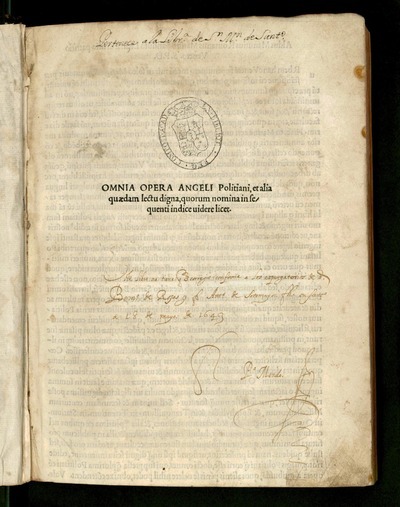
- Herodiani editio Aldina bilinguis 1524 titulus.jpg
Show 11 more facts
- date of birth
- 0170-00-00
- date of death
- 0250-00-00
- described by source
- Pauly–Wissowa
- time period
- Roman Empire
- Commons category
- Herodianus
- Commons Creator page
- Herodianus
- writing language
- Ancient Greek
- name in native language
- Herodianus
- different from
- Aelius Herodianus
- P13311
- 90 BC
- significant place
- Alexandria
via Wikidata · CC0
Works in European collections
30 objects attributed to Herodian, held across European museums, libraries & archives · via Europeana




~11 min read
Encyclopedic overview
7 sectionsContents
- Birth, life, and death
- Origin
- Occupation and social status
- The ''Roman History''
- References
- Bibliography
- External links
Herodian or Herodianus (), sometimes referred to as Herodian of Antioch (c. 170 – c. 240), was a minor Roman civil servant who wrote a colourful history in Greek titled History of the Empire from Marcus onwards (τῆς μετὰ Μάρκον βασιλείας ἱστορία) in eight books covering the years 180 to 238. His work is not considered entirely reliable, although his less biased account of Elagabalus may be more useful than that of Cassius Dio. The origin of Herodian is contested in scholarship, popular hypotheses being Syria, Alexandria in Egypt and Asia Minor. However, he appears to have lived for a considerable period of time in Rome, possibly without holding any public office. From his extant work, it seems that he was still living at an advanced age during the reign of Gordianus III, who ascended the throne in 238. Beyond this, nothing is known of his life.
Herodian writes (1.1.3; 2.15.7) that the events described in his history occurred during his lifetime. Photios I of Constantinople (Codex 99) gives an outline of the contents of this work and passes a flattering encomium on the style of Herodian, which he describes as clear, vigorous, agreeable, and preserving a happy medium between an utter disregard of art and elegance and a profuse employment of the artifices and prettinesses which were known under the name of Atticism, as well as between boldness and bombast. He appears to have used Thucydides as a model to some extent, both for style and for the general composition of his work, often introducing speeches wholly or in part imaginary.
Excerpted from Wikipedia’s “Herodian” article, available under the CC BY-SA 4.0 licence.