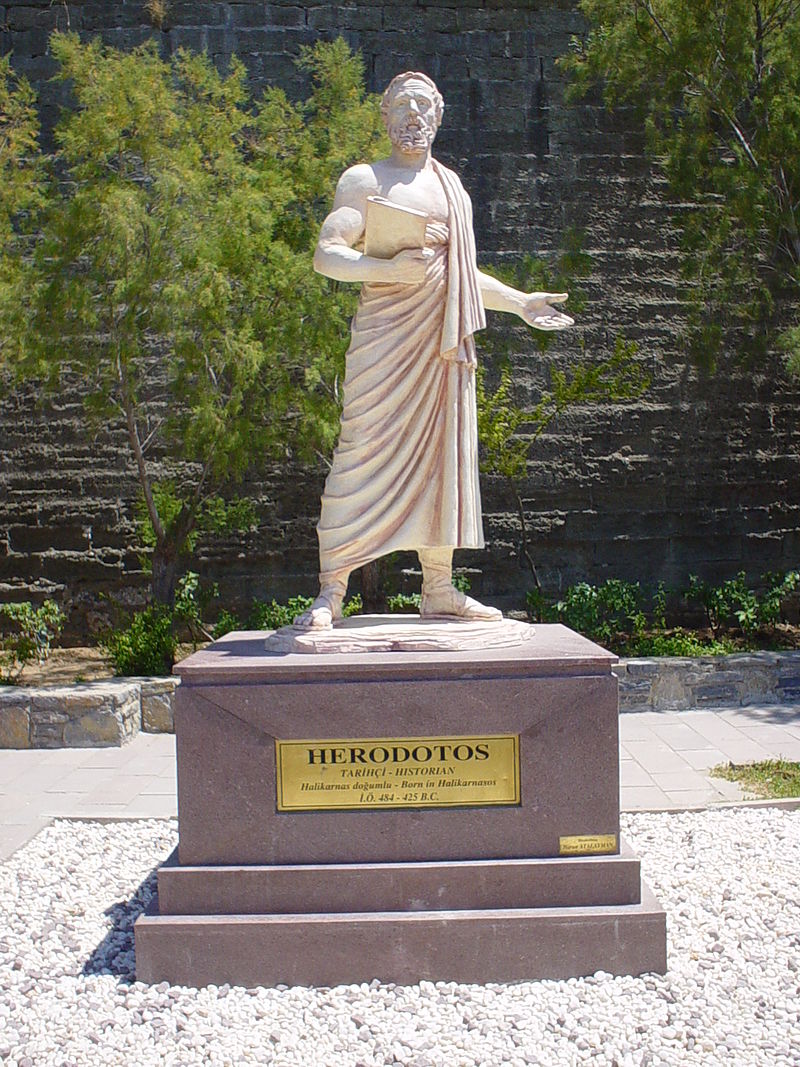
File:Herodotusstatue.JPG · Wikimedia Commons · See Wikimedia Commons
Heródoto
Sign in to saveAlso known as Herodotus of Halicarnassus, Father of History, Herodotos
Historiador grego considerado o "pai da história"
OverviewAI-generated
Herodotus was a male historian, writer, geographer, and politician of the Greek ethnic group. He was born in Halicarnassus in 484 BCE and died in Thurii or Pella in 425 BCE. He wrote in Ancient Greek and his name in his native language is Ἡρόδοτος Ἁλικαρνᾱσσεύς. His notable work is the Histories, and he also worked in the field of politics.
He resided in Halicarnassus and Thurii, and his work location was Ancient Greece. His works are held in the collection of the Stedelijk Museum Amsterdam. He is described by sources including the Brockhaus and Efron Encyclopedic Dictionary, the Encyclopædia Britannica 11th edition, The Nuttall Encyclopædia, and Pauly–Wissowa.
Synthesized by Vinony from 23 facts across 3 sources: Wikidata, Open Library, Europeana Sparql. Generated from structured data (not the Wikipedia text) and checked against those facts — may still contain errors.
Person · Open Library
- Works
- 21
via Open Library + Wikidata
Key facts
- Person.name
- Herodotus
- Person.native_name
- Ἡρόδοτος
- Person.native_name_lang
- grc
- Person.image
- Marble bust of Herodotos MET DT11742 (cropped).jpg
- Person.caption
- A Roman copy (2nd century AD) of a Greek bust of Herodotus from the first half of the 4th century BC
- Person.birth_place
- Halicarnassus, Caria, Asia Minor, Achaemenid Empire
- Person.death_date
- BC (aged approx. 59)
- Person.death_place
- Thurii, Calabria, or Pella, Macedon
- Person.occupation
- Historian
- Person.notable_works
- Histories
via Wikipedia infobox
Wikidata facts
- Instance of
- human
- Gender
- male
- Citizenship
- Halicarnassus
- Place of birth
- Halicarnassus
- Place of death
- Pella
- Occupation
- politician
- Languages spoken
- Ancient Greek
- Notable work
- Histories
- Image
- Marble bust of Herodotos MET DT11742 (cropped).jpg
Show 14 more facts
- Commons category
- Herodotus
- topic's main category
- Category:Herodotus
- date of birth
- 0484-01-01
- date of death
- 0425-01-01
- described by source
- Pauly–Wissowa
- name in native language
- Ἡρόδοτος Ἁλικαρνᾱσσεύς
- ethnic group
- Greeks
- writing language
- Ancient Greek
- Commons Creator page
- Herodotus
- has works in the collection
- Stedelijk Museum Amsterdam
- P8168
- ATC code C
- on focus list of Wikimedia project
- Wikipedia:Vital articles/Level/4
- P12749
- Claudia Crawford
- significant place
- Halicarnassus
Sources (7)
via Wikidata · CC0
Works in European collections
36 objects attributed to Heródoto, held across European museums, libraries & archives · via Europeana

Herodoti Halicarnassei Historiae Libri IX. Et De Vita Homeri Libellus

Herodotos. 2, Buch III und IV

Herodotos. 1, Buch I und II

Herodoti Musae sive historiarum libri IX. 8
Historiarvm Libri IX [Texto impreso] : IX Mvsarvm nominibus inscripti

Herodoti Historiae. 2

Herodotos. 2, Buch 3 und 4

Herodoti Halicarnassei Historia, siue Historiarvm Libri IX :qui inscribuntur Musae ; Ex velustis exemplaribus recogniti. Ctesiae Qvaedam = Herodotu Tu Halikarnasseōs Historia, ē Historiōn Logoi 9 : epigraphontai Musai

Herodotus of Halikarnaß story. 10

Hērodotu Historiēs apodexis. 4

Herodoti Musae sive historiarum libri IX. 5,1, Adnotationes : ad lib. I - II

Herodotu Halikarnesseos Historiōn logoi th '. 1
Roma, Biblioteca Angelica, Manoscritti greci, Ang. gr. 83

Herodotus

Herodotus

Herodotus

Herodotus

Herodoti Historia Laur. Valla interprete

Herodotus Laurentio Valla interprete
Herodoti Halicarnessei Historiarum libri IX [Texto impreso] ;]adiectus est libellus De vita Homeri ... : tomus I[-III]
Les histoires, mises en françois [Texto impreso]
Erodoto Alicarnasseo [Texto impreso] :]Tomo I [-Tomo II] : dedicato a s.e. il signor don Baldassare Odescalchi ...
Herodoti historiarum.. Libri IX
Les histoires [Printed text]

Herodotus history. 1

Herodoti historiarum libri novem :accedit libellus de vita Homeri et index historicus. 2

Herodotus history. 6.2, Larcher’s geographic dictionary

Herodotus of Halikarnaß story. 2

Herodotus of Halikarnaß story. 2

Herodoti Halicarnassei Orationes, conciones, sermocinationes et epistolae

Herodoti historiarum libri novem: accedit libellus de vita Homeri et index historicus. 3

Herodotos. 1,1, Buch 1 : Einleitung und Übersicht des Dialektes

Herodoti Musae sive historiarum libri IX. 6.1, Adnotationes: ad lib. V - VII

Herodoti Halicarnassei Historiarum Libri IX. 3

Herodoti Musae sive historiarum libri IX. 5,2, Adnotationes : ad lib. III - IV

The Muscles of the Herodotus of Halikarnassus. 1st, Clio
Article · Português
Heródoto (em grego, Ἡρόδοτος - Hēródotos, na transliteração) foi um historiador e geógrafo grego, continuador de Hecateu de Mileto, nascido no século V a.C. em Halicarnasso (hoje Bodrum, na Turquia). Foi o autor da história da invasão persa da Grécia, ocorrida no final do século V a.C., conhecida simplesmente como As histórias de Heródoto. Esta obra foi reconhecida como uma nova forma de literatura pouco depois de ser publicada. Antes de Heródoto, tinham existido crônicas e épicos, e também estes haviam preservado o conhecimento do passado, mas a maioria deles tratava apenas do passado em uma cidade ou região. Heródoto foi o primeiro a combinar essas narrativas locais para elaborar uma narrativa mais ampla sobre os fatos do passado e a mostrar como sua pesquisa poderia ser importante para a compreensão do presente. A sua criação fez com que lhe fosse concedido o título de "pai da história", pelo orador romano Cícero, embora criticasse o grego no mesmo texto por contar o que chamava de "histórias fabulosas". A palavra que utilizou para denominar sua obra, historie, que previamente tinha significado simplesmente "pesquisa", tomou a conotação atual de "história". Heródoto foi acusado, desde a Antiguidade, de ter inventado fatos que narra em sua obra e de não ter submetido as informações que recebeu de forma oral a um exame crítico e de plausibilidade. Contudo, o respeito pelo seu rigor tem aumentado desde a última metade do século XX, sendo atualmente reconhecido não apenas como pioneiro na história, mas também na geografia, etnografia e antropologia.
Abstract from DBpedia / Wikipedia · CC BY-SA
Gallery (7)
Available in 148 languages
- Español
- Français
- Deutsch
- 中文
- 日本語
- Русский
- Português
- Italiano
- العربية
- हिन्दी
- Afrikaans
- Albanian
- Albanian
- Amharic
- Angika
- Aragonese
- Armenian
- Arpitan
Show 129 more
- Asturian
- Awadhi
- azb
- Azerbaijani
- Bahasa Indonesia
- Bangla
- Bashkir
- Basque
- bat_smg
- be_x_old
- Belarusian
- Bhojpuri
- Bikol
- Bosnian
- Breton
- Bulgarian
- Burmese
- Catalan
- cdo
- Cebuano
- Central Kurdish
- Chechen
- Church Slavic
- Chuvash
- Cornish
- Corsican
- Croatian
- Czech
- Danish
- Egyptian Arabic
- Erzya
- Esperanto
- Estonian
- Extremaduran
- Filipino
- Finnish
- fiu_vro
- Galician
- Georgian
- Gilaki
- Greek
- Haitian Creole
- Hebrew
- Hungarian
- hyw
- Icelandic
- Ido
- Inari Sami
- Interlingua
- Irish
- Jamaican Creole English
- Javanese
- Kannada
- Karachay-Balkar
- Kazakh
- Kotava
- Kurdish
- Kyrgyz
- Ladino
- Latin
- Latvian
- Ligurian
- Limburgish
- Lingua Franca Nova
- Lithuanian
- lld
- Luxembourgish
- Macedonian
- Maithili
- Malagasy
- Malay
- Malayalam
- Manipuri
- Marathi
- Mazanderani
- Mingrelian
- Mongolian
- Nederlands
- Nepali
- Newari
- Northern Frisian
- Norwegian
- Norwegian Nynorsk
- Occitan
- Pashto
- Polski
- Punjabi
- Quechua
- roa_rup
- Romanian
- Rusyn
- Sanskrit
- Sardinian
- Scots
- Serbian
- Serbian (Latin)
- Sicilian
- Silesian
- simple
- Sindhi
- Sinhala
- Slovak
- Slovenian
- Svenska
- Swahili
- Tamil
- Tatar
- Telugu
- Tiếng Việt
- Toki Pona
- Türkçe
- Turkmen
- Ukrainian
- Urdu
- Uzbek
- Venetian
- Volapük
- Waray
- Welsh
- Western Frisian
- Western Panjabi
- Wu Chinese
- Zaza
- zh_classical
- zh_min_nan
- zh_yue
- فارسی
- ไทย
- 한국어
via Wikidata sitelinks · CC0