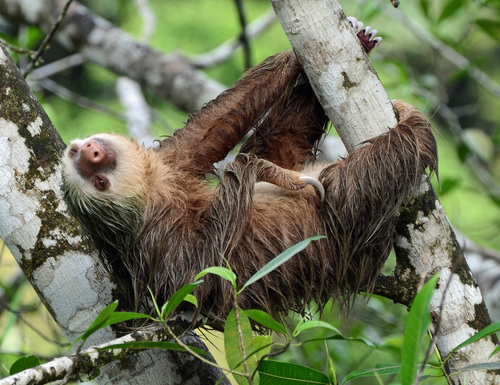
(c) Geoff Gallice, some rights reserved (CC BY) · cc-by
Hoffmann's Two-toed Sloth
Sign in to savespecies of two-toed sloth
OverviewAI-generated
Hoffmann's Two-toed Sloth, scientifically named *Choloepus hoffmanni*, is a species of mammal belonging to the genus *Choloepus*. It is also referred to by the common names Peresós didàctil de Hoffmann, Dovendyr, and Unau. The species has a recorded mass of 397 and a gestation period of 350, with a litter size of 1.
The taxon range for this sloth is listed as Buritis, while its habitat is identified as Ecuador. According to the IUCN Red List assessment from 2022, the species is classified as Least Concern. Observations of the animal have been recorded on iNaturalist, where it is categorized under the class Mammalia.
Synthesized by Vinony from 24 facts across 4 sources: Wikidata, iNaturalist, IUCN Red List, Vinony graph. Generated from structured data (not the Wikipedia text) and checked against those facts — may still contain errors.
Species
Least ConcernHoffmann's Two-toed Sloth
species
Maximum longevity: 37 years (captivity) Observations: A wild-caught male acquired in 1973 by San Antonio Zoo was still alive in 2009, making it at least 37 years of age (John Gramieri, pers. comm.).
via IUCN
Wikidata facts
Show 12 more facts
- taxon rank
- species
- IUCN conservation status
- Least Concern
- taxon name
- Choloepus hoffmanni
- Commons category
- Choloepus hoffmanni
- Commons gallery
- Choloepus hoffmanni
- taxon common name
- hoffmanov dvoprsti lenivec
- gestation period
- 350
- litter size
- 1
- habitat
- Ecuador
- sequenced genome URL
- www.ensembl.org/Choloepus_hoffmanni
- short name
- C. hoffmanni
- taxon range
- Buritis
Sources (2)
via Wikidata · CC0
~14 min read
Encyclopedic overview
Hoffmann's two-toed sloth climbing in a cage at Ueno Zoo (video)
The Hoffmann's two-toed sloth (Choloepus hoffmanni), also known as the northern two-toed sloth, is a species of sloth from Central and South America. It is a solitary, largely nocturnal and arboreal animal, found in mature and secondary rainforests and deciduous forests. The common name commemorates the German naturalist Karl Hoffmann, who discovered the Hoffmann sloth.
Excerpted from Wikipedia’s “Hoffmann's Two-toed Sloth” article, available under the CC BY-SA 4.0 licence.