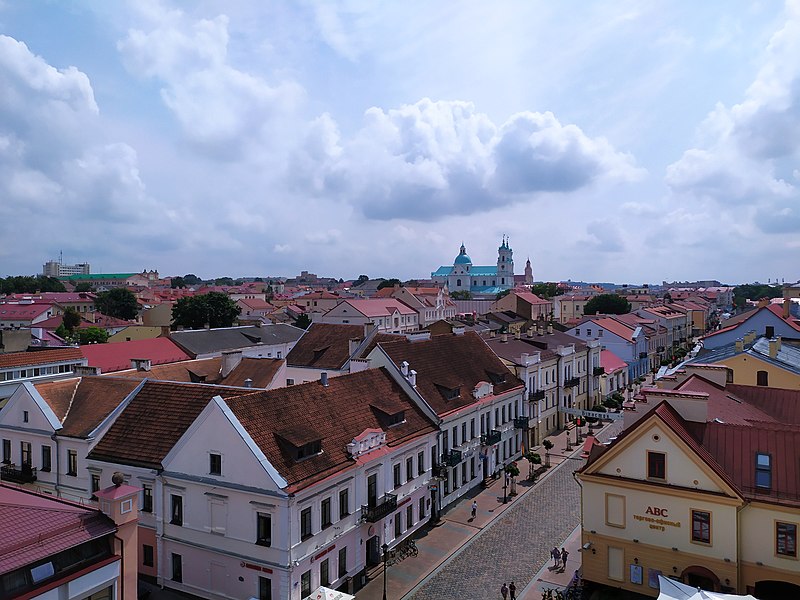
File:Horadnia_(Hrodna),_Vilienskaja._Горадня,_Віленская_(2021)_05.jpg · Wikimedia Commons · See Wikimedia Commons
Hrodna
Sign in to saveAlso known as Grodne, Gardinas, Garten, Hurodno, Horodne, Grodno
Grodno, or Hrodna, is a city in western Belarus. It is one of the oldest cities in Belarus. The city is located on the Neman River, from Minsk, about from the border with Poland, and from the border with Lithuania. Grodno serves as the administrative center of Grodno Region and Grodno District, though it is administratively separated from the district. the city has a population of 363,718.
Hrodna is an ancient city in western Belarus located on the Neman River, serving as the administrative center for Grodno Region and situated near the borders with Poland and Lithuania. With a population of 363,718, it is one of Belarus's oldest cities and an important regional hub.
AI-generated from the Wikipedia summary — may contain errors.
Key facts
- Settlement.name
- Grodno
- Settlement.native_name
- •
- Settlement.other_name
- Hrodna
- Settlement.settlement_type
- City
- Settlement.image_flag
- Flag of Hrodna.svg
- Settlement.image_shield
- Coat of arms of Hrodna.svg
- Settlement.flag_size
- 150
- Settlement.shield_size
- 75
- Settlement.mapsize
- 230px
- Settlement.map_caption
- Location of Grodno in Belarus
- Settlement.pushpin_map
- Belarus#Europe
- Settlement.pushpin_relief
- 1
- Settlement.subdivision_type
- Country
- Settlement.subdivision_name
- Belarus
- Settlement.subdivision_type1
- Region
- Settlement.subdivision_name1
- Grodno Region
- Settlement.leader_title
- Chairman
- Settlement.leader_name
- Andrei Khmel
via Wikipedia infobox
Wikidata facts
- Official name
- Hrodna
- Country
- Principality of Goroden
- Located in
- Belastok Region
- Contains
- Q4333150
- Population
- 364902
- Area
- 142
- Elevation
- 119
- Time zone
- UTC+03:00
- Body of water
- Neman
- Head of government
- Andrej Chmiel
- Capital of
- Grodno District
- Official website
- grodno.gov.by
- Image
- Horadnia (Hrodna), Vilienskaja. Горадня, Віленская (2021) 05.jpg
- Dialing code
- +375 152
- Licence plate code
- 4
- Coat of arms
- coat of arms of Grodno, Belarus
Show 15 more facts
- Commons category
- Hrodna
- twinned administrative body
- Haikou
- P6482
- Hrodna
- topic's main category
- Category:Grodno
- category for people born here
- Category:Births in Hrodna
- category for people who died here
- Category:Deaths in Grodno
- category of associated people
- Category:People from Grodno
- postal code
- 230000–230029
- Commons gallery
- Grodno
- inception
- 1000-00-00
- different from
- Grodno District
- romanization of Belarusian (2007 system)
- Hrodna
- native label
- Гродна
- time of earliest written record
- 1128-00-00
- P8168
- Karl Ehn
Sources (9)
via Wikidata · CC0
~36 min read
Encyclopedic overview
31 sectionsContents
- Other names
- History
- Early history
- Grand Duchy of Lithuania
- Polish–Lithuanian Commonwealth
- Late modern period
- World War I and interwar period
- World War II
- Byelorussian SSR and Republic of Belarus
- Jewish community
- Geography
- Climate
- Religion, education and culture
- Architecture
- Medieval
- Baroque
- Transport
- Sport
- Education
- Culture
- Visa-free entrance to Grodno
- Notable people
- International relations
- Twin towns - sister cities
- Significant depictions in popular culture
- See also
- Notes
- References
- Works cited
- Further reading
- External links
Grodno, or Hrodna, is a city in western Belarus. It is one of the oldest cities in Belarus. The city is located on the Neman River, from Minsk, about from the border with Poland, and from the border with Lithuania. Grodno serves as the administrative center of Grodno Region and Grodno District, though it is administratively separated from the district. the city has a population of 363,718.
The modern city of Grodno, founded in 1127, originated as a small fortress and trading outpost, on the extreme northern end of the deeply penetrated Slavic peninsula into the lands of the Baltic tribal union of the Yotvingians. It was also a home to the Dregoviches Slavic tribe. It was a significant city in Black Ruthenia and later part of the Grand Duchy of Lithuania, which joined the Polish-Lithuanian Union in 1385. Grodno faced numerous invasions, most notably by the Teutonic Knights. The city was an important trade, commerce, and cultural center in the Polish-Lithuanian Commonwealth, and one of its royal residences. The Kings of Poland and Grand Dukes of Lithuania allowed the creation of a Jewish commune in 1389, and the city received its charter in 1441. Grodno was the site of two battles during the Great Northern War.
Excerpted from Wikipedia’s “Hrodna” article, available under the CC BY-SA 4.0 licence.
Gallery (42)
On the map
3 mapped locations
Available in 90 languages
- Español
- Français
- Deutsch
- 中文
- 日本語
- Русский
- Português
- Italiano
- العربية
- Armenian
- Asturian
- Azerbaijani
- Bahasa Indonesia
- Basque
- bat_smg
- be_x_old
- Belarusian
- Breton
Show 71 more
- Bulgarian
- Catalan
- Cebuano
- Chechen
- Church Slavic
- Chuvash
- Crimean Tatar
- Croatian
- Czech
- Danish
- Egyptian Arabic
- Erzya
- Esperanto
- Estonian
- Finnish
- Galician
- Georgian
- Greek
- Hebrew
- Hungarian
- Ido
- Interlingue
- Kazakh
- Latin
- Latvian
- Lithuanian
- Lower Sorbian
- Macedonian
- Malagasy
- Mari
- Mazanderani
- Mongolian
- Nederlands
- Northern Frisian
- Norwegian
- Norwegian Nynorsk
- Ossetic
- Pashto
- Polski
- Romanian
- Scots
- Serbian
- Serbian (Latin)
- Silesian
- simple
- Sinhala
- Slovak
- Slovenian
- Svenska
- Tahitian
- Tajik
- Tatar
- Tiếng Việt
- Türkçe
- Ukrainian
- Upper Sorbian
- Urdu
- Uzbek
- Veps
- Volapük
- Waray
- Welsh
- Western Frisian
- Western Panjabi
- Wu Chinese
- Yakut
- Yiddish
- zh_yue
- فارسی
- ไทย
- 한국어
via Wikidata sitelinks · CC0