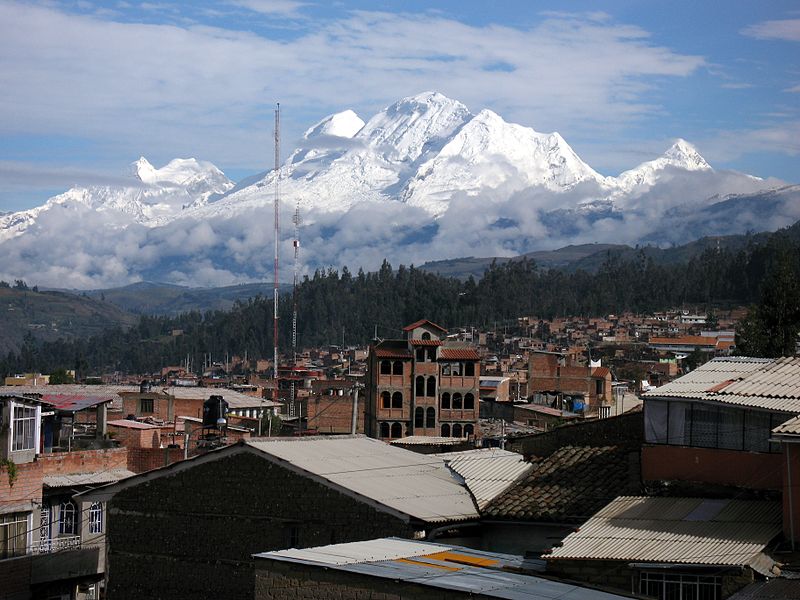
File:Huascaran_Huandoy_Chopicalqui_seen_from_Huaraz.JPG · Wikimedia Commons · See Wikimedia Commons
Huaraz
Sign in to saveHuaraz () (from Quechua: Waraq or Warash, "dawn"), formerly designated as San Sebastián de Huaraz, is a city in Peru. It is the capital of the Ancash Region (State of Ancash) and the seat of government of Huaraz Province. The urban area's population is distributed over the districts of Huaraz and Independencia. The city is located in the middle of the Callejon de Huaylas valley and on the right side of the Santa river. The city has an elevation of approximately 3050 meters above sea level. The built-up area covers 8 square kilometers and has a population of 120,000 inhabitants, making it the s
OverviewAI-generated
Huaraz is a city in Peru, situated within the Huaraz district and serving as the capital of the Huaraz province, Áncash Department, and Huaraz district. Established on January 20, 1574, the city has a population of 118,836 and covers an area of 370.03 square kilometers. It is located at an elevation of 3,052 meters above sea level and is positioned next to the Santa River. The local demonym for residents is huaracino.
Administratively, Huaraz is twinned with Cajamarca. The city uses the local dialing code 43 and the postal codes 02001 and 02002. Its territory overlaps with the Huaraz district and Independencia. The city is described in the Encyclopædia Britannica 11th edition and is referenced by 248 other encyclopedia articles.
Synthesized by Vinony from 50 facts across 7 sources: Wikidata, Open Meteo, Openweathermap, OpenStreetMap, GeoNames, Vinony graph, Geo. Generated from structured data (not the Wikipedia text) and checked against those facts — may still contain errors.
Weather now
7-day forecast
via Open-Meteo
Place details
- Locality
- Huaraz
- Region
- Ancash
- Country
- Perú
- Population
- 118,836
- Timezone
- America/Lima
via OpenStreetMap · GeoNames
Key facts
- Settlement.official_name
- Huaraz
- Settlement.other_name
- San Sebastián de Huaraz
- Settlement.type
- City
- Settlement.motto
- The noble and generous City, Capital of International Friendship, Natural Paradise of the World
- Settlement.image_flag
- Bandera de Huaraz.svg
- Settlement.image_shield
- Escudo de Huaraz.svg
- Settlement.image_caption
- Top: White mountain range, Second left: La Soledad neighborhood, Second right: Gamarra Avenue, Third left: Residential street in Huarupampa suburb, Third right: Building development, Bottom: Cultural Center and Municipal Theater
- Settlement.map_caption
- Location in Peru
- Settlement.pushpin_map
- Peru
- Settlement.subdivision_type
- Country
- Settlement.subdivision_type1
- Region
- Settlement.subdivision_name1
- Ancash
- Settlement.subdivision_type2
- Province
- Settlement.subdivision_name2
- Huaraz
- Settlement.government_type
- Democracy
- Settlement.leader_title
- Mayor
- Settlement.leader_name
- Eliseo Rori Mautino Ángeles(2019–2022)
- Settlement.established_title
- Founded
via Wikipedia infobox
Wikidata facts
- Instance of
- big city
- Demonym
- huaracino
- Country
- Peru
- Located in
- Huaraz district
- Population
- 99462
- Area
- 370.03
- Elevation
- 3052
- Body of water
- Santa River
- Capital of
- Huaraz district
- Image
- Huascaran Huandoy Chopicalqui seen from Huaraz.JPG
- Dialing code
- 43
Show 10 more facts
- Commons category
- Huaraz
- Commons gallery
- Huaraz
- topic's main category
- Category:Huaraz
- twinned administrative body
- Cajamarca
- inception
- 1574-01-20
- P8168
- Killermet Cove
- described by source
- Encyclopædia Britannica 11th edition
- P12749
- Farrukhabad
- territory overlaps
- Independencia
- postal code
- 02002
via Wikidata · CC0
Travel guide
Understand
Huaraz stands tall at 3100m; travellers from Lima might need a day or two to acclimatize to the change in atmosphere. See Altitude sickness for advice and more information.
July is a good time to visit the region; the temperature is perfect for walking and the sky is free from clouds and rain. It's also a good time as the July period has many of Peru's annual event celebration dates. The town puts on a tremendous night of entertainment each year for most of the days, featuring live music and more. Well worth a look if you are in the region.
A town of 100,000, it blends a mix of modern and native culture. The town has many markets and shops catering to tourist needs and local needs. The food markets are especially interesting and are a great starting point for getting supplies for expeditions. Be sure to shop about before purchasing/hiring (especially for mountaineering gear) as often a better price can be found elsewhere with a bit of bargaining.
The town has many places offering cheap internet access; although a bit slow, the connection is usually reliable. The town has a big post office and a few banks. Huaraz also has a mix of old and new restaurants offering a variety of dishes. Cuy (guinea pig) is a regional dish; perhaps something to say one has tried but not something to make a diet of! There are a few night clubs and many bars open late. Common sense would advise people not to travel alone at night, but one feels safe in the city where the locals were very willing …
Get around
In Huaraz, taxis are cheap and fast for getting about the town.
Be wary of dubious taxi drivers and cabs. Peru does have a problem with taxis in some places, and tourists have been known to be mugged or assaulted in them. Women should be careful not to travel alone, especially in taxis and especially at night. Huaraz is, however, a comparatively safe city — for men and women — and is easily maneuvered by the seasoned traveller, particularly those who can speak Spanish. However, just as in any part of Peru, staying aware of your surroundings and avoiding potentially dodgy situations is advised.
Also if you need to rent a car to go out of the city, are a variety of companies that make this service, the most prominent being Andes Renta Car Huaraz. www.archuaraz.com You can contact trough email [email protected] or call +51 43422423 or 943626780 in order to get information about the cars, trucks, prices, etc. Andean Rent a Car offers a good service with a drivers that know the routes.
See
Archeological Sites. Within walking distance of Huaraz is the Wari ruin of Wilcawain. Monumento Nacional Wilcahuaín is a small Wari tuin that dates bakes to 600 to 900 AD. This temple complex is virtually undamaged, providing a unique opportunity to see a complete pre-Columbian building in Peru. It is an imitation of the temple at Chavín, in the Tiahuanaco style. Wilcahuaín means 'grandson's house' in Quechua. The ruin was originally filled with mummies who were kept dry by using a sophisticated ventilation system. It is not only interesting in itself but can be visited on a great acclimatization hike that leaves right from town. It is easiest to take a combi there (uphill) and walk back via an old Incan trail (approximately 2 hours).
Huaraz is also the departure point for tours to see Chavín de Huántar, the center of a cultural and artistic revolution in Peru that took place between 600 and 300 BCE. Museums in Huaraz contain many fine examples of Chavin sculpture and older Cupinisque pottery.
The Museo Regional de Ancash, The Museo Regional de Ancash houses the largest collection of ancient stone sculptures in South America. It gives information about all the cultures that have inhabited the Cordillera Blanca region. It is small but interesting, it has a few mummies, some trepanned skulls (an ancient form of surgery involving cutting into the skull) and a garden of stone monoliths from the Recuay culture (400 BC to AD 600) and the Wari culture (AD 600 to 1000). A pottery c…
Do
Find the practical map guide in most of the bars or laundries.
Trekking - The region is a trekkers paradise; it features breath taking views and an escape from the hive of people seen in other famed trekking locations like the Inca trail. Although one could do it on ones own, it's advisable to get a guide and run it through a specialist company. There are many companies offering these services. The House of Guides (Casa de Guías) offers professional free information, and maps for a price. They have a check in/check out book which it's advisable to sign, especially if travelling without a guide. Explore Huascarán National Park: Visit nearby Laguna Churup, Laguna 69, Laguna Parón or complete the challenging, multi-day Santa Cruz Trek. A homestay in Vicos or Humacchuco, When you are interested in some alternative form of spending your trip in the region of Huaraz it is a very good idea to do a homestay in Vicos or Humacchuco. Vicos (1 hour from Huaraz) is an authentic rural community, which gives visitors the opportunity to learn about its Andean culture, livingin harmony with its environment. Vicos has seven guest houses next to the houses of host families who will assist you during all the activities. Possible activities are; helping the family with theirdaily activities like baking bread, harvesting honey, fishing or grazing with the animals, helping the family on their farming lands, visiting local craftsman, hiking through the fields while visiting the ruins of the Huari a…
Buy
At the Plaza de Armas there is an Artesania Market with a broad offer of nice souvenirs, bags, jewelry and clothing. Definitely worth a visit. Furthermore, there are some nice shops on the Av. Luzuriaga as well. The big market with food and a lot of small shops selling everything you can think of is situated at a street which goes parallel to the Av. Luzuriaga.
Eat
Mercado central. On the second floor you can indulge in a true Peruvian set meal of soup, rice and chicken and limonade. All for S/2.50. The first floor is good for stocking up for your trek. Second stair, try the Comedor vegetariano. Try a delicious and cheap (S/5) Ceviche in the restaurant Delfin, Gabino Uribe street near from the main plaza. A S/10 buffet to have lunch in the nice Cafe 13 Buhos, near from the Casa de guias. Tasty ice cream in Samuel's (S/1.5 the cornet), Luzurinaga street. Chifas, there are several in town. Their dishes are cheap and feed two. And in contrast to Peruvian cuisine they tend to sneak in some veggies. Chifa is a blend of Chinese and Peruvian fare, especially popular in Lima but widely available throughout the country for cheap. Buyer beware. Just make sure it's hot!! La Brasa Roja, Luzuriaga 919. Great place for meat lovers, highly recommended (and frequented) by locals. Slightly upscale. The roasted chicken (S/9.50) and the burgers (S/10) are best value for money. Large portions. Fuente de Salud. Very cheap, very tasty vegetarian food. Highly recommended for vegetarians and those who are feeling the effects of traveller's diarrhea. Siam de los Andes. A traditional Thai restaurant in the middle of small-town Peru, serves up delicious curry and stir fry dishes. S/15-50 per meal. Creperie Patrick, Av. Luzurriaga 422. A well-known restaurant that serves up many different styles of sweet or savory crêpes, Creperie Patrick is also known to be relat…
Drink
There are several bars clustered around José de la Mar and Cajamarca to still your thirst.
El Tambo, 2 blocks from Plaza Ginebra. Popular weekend club (slow on Thursday) that plays mostly salsa with short sets of house, reggaeton, and American music. It has a tree and wood theme. Cafe Andino, 2 blocks from the Plaza de Armas, closed Mondays and January/February. Delicious espresso and other coffee beverages. Can buy beans too. Excellent selection of books to borrow (with deposit), and good magazine selection to peruse while there. Loud, familiar music (Marley, Grateful Dead). Friendly, accommodating staff. Great atmosphere. Free WiFi. Expensive, but good and healthy gringo food. California Café, Jr. 28 de Julio, 568. Café with a big book exchange, also doubles as library. The Californian owner organizes ultimate frisbee matches every Friday. Just drop in at around 13:30 (Dry Season, April–November) or 10:00 (Rainy Season, December–March) if you're interested. One of the house specialties is their mixed fruit smoothie, called Surtido. This cafe also serves roasts its own coffees and is an ideal spot to hang for a few hours when first getting into town. Try their sandwiches, made to order with lots of variety. Also has free WiFi.
Sleep
El Tambo, Av. Confraternidad Oeste #122 (well hidden on the opposite the stadium: there's a little street, at the end turn right, go through a private looking gate, turn left: there's a high but small door to your right). Fine hostel close to the bus terminal and four blocks from the center. It offers free internet, laundry service, kitchen use, communal area with cable TV and DVD included in the price. Very very kind owner, happy to provide help in choosing tour operator, etc. Low-season price S/10 pppn.
Stay safe
Street dogs. Huaraz has a large and unchecked population of dogs, even by Peruvian standards. Packs of wild animals, some quite large, roam the streets and villages surrounding the city. They pay no attention to humans in the centre, but become more aggressive in the outskirts and certainly in the villages. Actual attacks are uncommon, but it is nevertheless an unpleasant experience to be surrounded by a pack of viciously barking mutts. It is inadvisable to walk around outside of the designated hiking trails (e.g. to the various lagunas), as many of the trails pass private properties (not indicated on any map) which are fiercely guarded by semi-domesticated and stray animals. If you find yourself under attack by one or more dogs: Stay calm and continue walking. Most of the dogs will merely escort you to the limit of their territory and leave you alone. Avoid eye contact. Take off reflective sunglasses as this seems to trigger the animals. Throwing stones, or even just pretending to, usually creates a respectful distance. If a dog starts biting, it will usually be from behind. In such cases, turn around to face the animal and seek an escape, but do not run. Keep your backpack or anything else you are carrying between you and the animals for protection. Calling out for help can be useful, as locals are so used to barking dogs that they rarely pay attention. In the rare case that you are bitten, seek medical attention and get a shot against rabies. This disease is fatal without …
Go next
Trujillo. At least 2 bus companies (Movil and Linea) provide overnight service to Trujillo. The trip takes about 7 hours. The busses may not be equipped with air-conditioning, so it may be a hot ride. It's a rocky, fast-paced trip through the mountains. Yungay Express (07:00), Turismo Huaraz & Huandoy (09:00) pass through Caraz 2 hours later & the spectacular Cañon del Pato to Chimbote terminal terrestre, where you can change for Trujillo. Caraz. Minibuses leave frequently and the trip takes about one hour.
Travel guide from Wikivoyage (CC BY-SA 4.0)
~14 min read
Encyclopedic overview
29 sectionsContents
- Etymology
- Geography
- Location
- Orography
- Layout
- Neighborhoods
- Climate
- History
- Pre-Columbian era
- Colonial era
- Contemporary times
- Demographics
- Economy
- Sports and recreation
- Sports
- Transportation
- Roads
- Public transportation
- Air transportation
- Tourism
- Culture
- Museum and the arts
- Cuisine
- Media
- Newspapers
- English language newspaper
- See also
- References
- External links
{{Infobox settlement | official_name = Huaraz | other_name = San Sebastián de Huaraz | type = City | native_name = | nickname = | motto = The noble and generous City, Capital of International Friendship, Natural Paradise of the World | image_flag = Bandera de Huaraz.svg | image_shield = Escudo de Huaraz.svg | image_skyline = | image_caption = Top: White mountain range, Second left: La Soledad neighborhood, Second right: Gamarra Avenue, Third left: Residential street in Huarupampa suburb, Third right: Building development, Bottom: Cultural Center and Municipal Theater | image_map = | map_caption = Location in Peru | pushpin_map = Peru | pushpin_label_position = | subdivision_type = Country | subdivision_name = | subdivision_type1 = Region | subdivision_name1 = Ancash | subdivision_type2 = Province | subdivision_name2 = Huaraz | government_type = Democracy | leader_title = Mayor | leader_name = Eliseo Rori Mautino Ángeles(2019–2022) | established_title = Founded | established_date = 20 January 1574 | area_magnitude = | area_footnotes = | area_total_km2 = 370.03 | pop_est_as_of = 2015 | pop_est_footnotes = | population_est = 127041 | population_as_of = 2017 census | population_footnotes = | population_note = | population_total = 118836 | population_density_km2 = auto | timezone = PET | utc_offset = -5 | timezone_DST = PET | utc_offset_DST = -5 | coordinates = | elevation_footnotes =
On 31 May 1970 the same reservoir dam burst during the Ancash earthquake, which had a moment magnitude of 7.9 and a maximum Mercalli intensity of VIII (Severe). Down the creek valley, again came an avalanche, eerily similar to that of 1941. In the prior four years or so, the suburb had begun to again be redeveloped: numerous residences were built atop the 1941 avalanche deposit within the at-risk creek valley. Within its duration of 45 seconds, virtually every structure of consequence in the city's center was destroyed. A few minutes later, the north half of the city, particularly in the creek valley, was obliterated by an avalanche of icy mud carrying boulders and other debris.
Excerpted from Wikipedia’s “Huaraz” article, available under the CC BY-SA 4.0 licence.
Gallery (38)
On the map
5 mapped locations