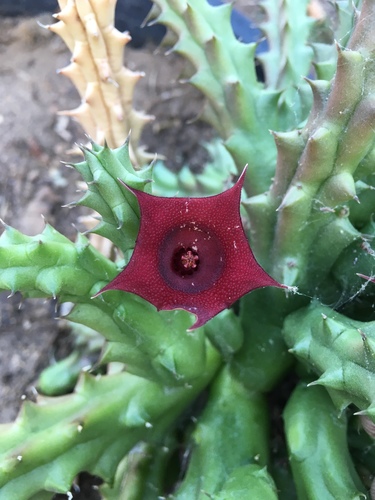
(c) ashleyvegaa9, all rights reserved
Huernia
Sign in to saveThe genus Huernia (family Apocynaceae, subfamily Asclepiadoideae) consists of perennial, stem succulents from Eastern and Southern Africa and Arabia, first described as a genus in 1810.
Species
GENUS
- KingdomPlantae
- PhylumTracheophyta
- ClassMagnoliopsida
- OrderGentianales
- FamilyApocynaceae
via GBIF · Kew POWO
Museum specimens
- Specimen records
- 89
- With media
- 25
- Family
- Apocynaceae
- Collections
- VT, MARY, UCR, MO, BPBM, MUSEU NACIONAL/UFRJ
- Recorded in
- United States, Ethiopia, Mozambique, Tanzania, Armenia, Brasil, South Africa, Saudi Arabia
Wikidata facts
- Instance of
- taxon
- Parent taxon
- Stapeliinae
- Image
- Huernia macrocarpa var penzigii.jpg
Show 7 more facts
- topic's main category
- Category:Huernia
- Commons category
- Huernia
- taxon name
- Huernia
- taxon rank
- genus
- Commons gallery
- Huernia
- taxon common name
- 星钟花属
Sources (1)
via Wikidata · CC0
~3 min read
Encyclopedic overview
3 sectionsContents
- Species
- References
- External links
The genus Huernia (family Apocynaceae, subfamily Asclepiadoideae) consists of perennial, stem succulents from Eastern and Southern Africa and Arabia, first described as a genus in 1810.
The flowers are five-lobed, usually somewhat more funnel- or bell-shaped than in the closely related genus Stapelia, and often striped vividly in contrasting colors or tones, some glossy, others matte and wrinkled depending on the species concerned. Frequently the flowers are colored a variation of red, yellow or brown. To pollinate, the flowers attract flies by emitting a scent similar to that of carrion. The genus is considered close to the genera Stapelia and Hoodia. Phylogenetic studies have shown the genus to be monophyletic, and most closely related to the genus Tavaresia, and to a widespread branch of stapeliads comprising the genera Orbea, Piaranthus and Stapelia.
Excerpted from Wikipedia’s “Huernia” article, available under the CC BY-SA 4.0 licence.
Gallery (3)
Available in 17 languages
- Español
- Français
- Deutsch
- 中文
- Русский
- العربية
- Cebuano
- Egyptian Arabic
- Nederlands
- Svenska
- Tiếng Việt
- Ukrainian
- Uzbek
- Waray
- Western Panjabi
- فارسی
via Wikidata sitelinks · CC0