
human tower (castell)
Sign in to saveAlso known as castell, castells, casteller, castellers, human tower
A castell (; literally "castle") is a human pyramid built traditionally at festivals in southern Catalonia (Spain), now also found in the rest of Catalonia, and in the Balearic Islands.
Key facts
- Performing art.name
- Castell
- Performing art.image
- Colla Vella dels Xiquets de Valls - Primer 2de9 amb folre i manilles descarregat de la història - Diada de Santa Úrsula 1994.jpg
- Performing art.caption
- Castell (2 de 9 amb folre i manilles) in Valls
- Performing art.medium
- Human towers
- Performing art.culture
- Catalan
- Performing art.era
- 18th century–present
- Intangible heritage.ICH
- Human towers
- Intangible heritage.State Party
- Spain
- Intangible heritage.ID
- 00364
- Intangible heritage.Region
- ENA
- Intangible heritage.Year
- 2010
- Intangible heritage.Session
- 5th
- Intangible heritage.List
- Representative
via Wikipedia infobox
Described at
Human towers - UNESCO Intangible Cultural Heritage
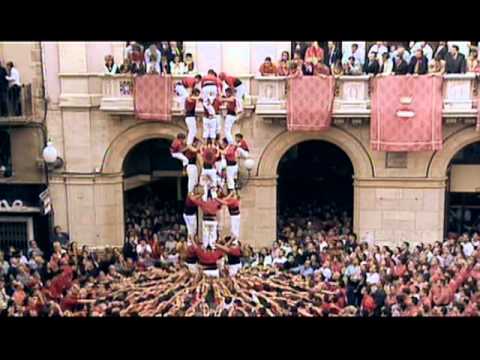
ich.unesco.org →Castells are human towers built by members of amateur groups, usually as part of annual festivities in Catalonian towns and cities. The traditional setting is the square in front of the town hall balcony. The human towers are formed by castellers standing on the shoulders of one another in a succession of stages (between six and ten). Each level of the tronc, the name given to the second level upwards, generally comprises two to five heavier built men supporting younger, lighter-weight boys or girls. The pom de dalt – the three uppermost levels of the tower – comprises young children. Anyone is welcome to form the pinya, the throng that supports the base of the tower. Each group can be identified by its costume, particularly the colour of the shirts, while the cummerbund serves to protect the back and is gripped by castellers as they climb up the tower. Before, during and after the performance, musicians play a variety of traditional melodies on a wind instrument known as a gralla, setting the rhythm to which the tower is built. The knowledge required for raising castells is traditionally passed down from generation to generation within a group, and can only be learned by practice. 1. SDG 11: Sustainable Cities and Communities (165) 2. SDG 16: Peace, Justice and Strong Institutions (665) 1. Performing arts (411) 2. Social practices, rituals and festive events (584)
Excerpt from a page describing this subject · 6,977 chars · not written by Vinony
Wikidata facts
- Instance of
- tradition
- Subclass of
- human tower
- Country of origin
- Spain
- Image
- 3d10 fm de vilafranca.jpg
- Motto
- Força, equilibri, valor i seny
Show 5 more facts
- Commons category
- Castellers
- topic's main category
- Category:Castellers
- Commons gallery
- Casteller
- intangible cultural heritage status
- Representative List of the Intangible Cultural Heritage of Humanity
- described at URL
- ich.unesco.org/es/RL/00364
Sources (2)
via Wikidata · CC0
~19 min read
Encyclopedic overview
17 sectionsContents
- Origin
- The Castell
- Attire
- Structure
- Safety
- Terminology
- ''Castell'' nomenclature
- Examples
- ''Castellers'' and parts of a castell
- The Human Tower Museum of Catalonia in Valls
- ''Colles castelleres''
- In Catalonia and Catalan-speaking regions
- Colles castelleres universitàries (teams of college castellers)
- ''Colles exteriors'' (outside the Catalan-speaking region)
- See also
- References
- External links
A castell (; literally "castle") is a human pyramid built traditionally at festivals in southern Catalonia (Spain), now also found in the rest of Catalonia, and in the Balearic Islands.
At these festivals, several colles castelleres (teams that build towers) attempt to build and then dismantle a tower's structure. On 16 November 2010, castells were declared by UNESCO to be amongst the Masterpieces of the Oral and Intangible Heritage of Humanity.
Excerpted from Wikipedia’s “human tower (castell)” article, available under the CC BY-SA 4.0 licence.