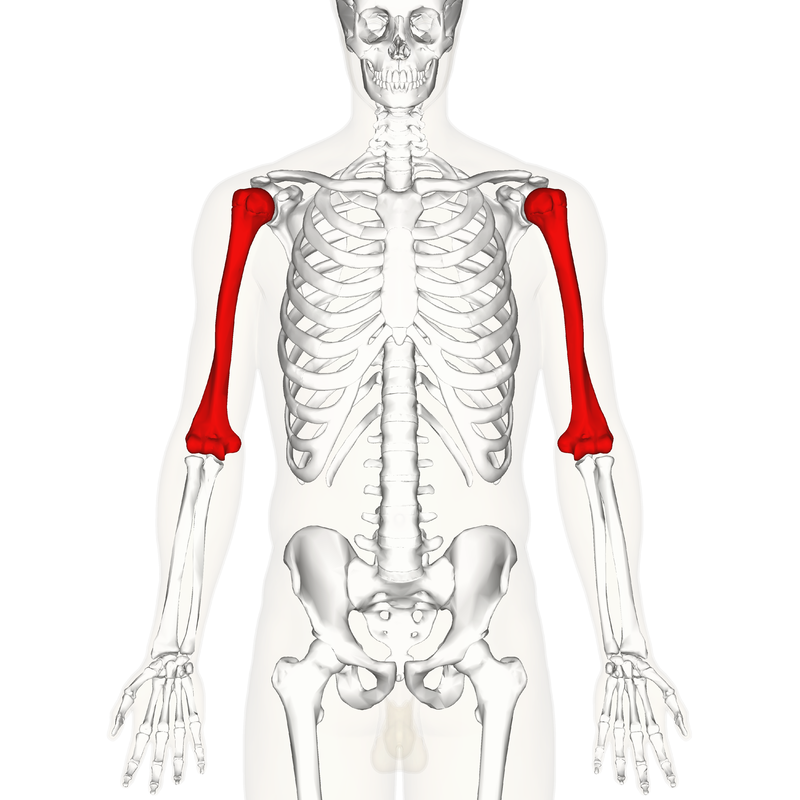
File:Humerus_-_anterior_view.png · Wikimedia Commons · See Wikimedia Commons
humerus
Sign in to saveAlso known as bone bone
The humerus (; : humeri) is a long bone in the arm that runs from the shoulder to the elbow. It connects the scapula and the two bones of the lower arm, the radius and ulna, and consists of three sections. The humeral upper extremity consists of a rounded head, a narrow neck, and two short processes (tubercles, sometimes called tuberosities). The shaft is cylindrical in its upper portion, and more prismatic below. The lower extremity consists of 2 epicondyles, 2 processes (trochlea and capitulum), and 3 fossae (radial fossa, coronoid fossa, and olecranon fossa). As well as its true anatomical
The humerus is the long bone in your upper arm that extends from your shoulder to your elbow, connecting the shoulder blade to the two bones of your forearm. It matters because it serves as a crucial structural link in your arm, enabling the connection between your shoulder and forearm bones while supporting the movement and function of your entire arm.
AI-generated from the Wikipedia summary — may contain errors.
Key facts
- Bone.Name
- Lower extremity of humerus
- Bone.Latin
- extremitas distalis humeri
- Bone.Image
- Gray207.png
- Bone.Caption
- Left humerus. Anterior view.
- Bone.Image2
- Gray208.png
- Bone.Caption2
- Left humerus. Posterior view.
via Wikipedia infobox
Research
28,445 papers- [Proximal humerus fractures; conservative or surgical treatment?].ReviewNederlands tijdschrift voor geneeskunde · 2019Frima H, Houwert RM, Beks RB et al.
- Decision-Making and Management of Proximal Humerus Nonunions.ReviewThe Orthopedic clinics of North America · 2021Tapscott DC, Paxton ESDOI: 10.1016/j.ocl.2021.05.008
- [Humerus fracture after an arm wrestling].ReviewLa Revue du praticien · 2019Peron L, Pecoul T, Ungari J
- [Torsional malalignment of the humerus].ReviewDer Unfallchirurg · 2018Hawi N, Razaeian S, Krettek C et al.DOI: 10.1007/s00113-017-0453-8
- Maximizing Exposure of the Distal Humerus.ReviewHand clinics · 2025France TJ, Smetana BSDOI: 10.1016/j.hcl.2025.06.003
- Supracondylar fractures of the humerus in children.Injury · 2021British Orthopaedic Association Trauma CommitteeDOI: 10.1016/j.injury.2020.12.001
- Management of Posttraumatic Avascular Necrosis of the Proximal Humerus.ReviewOrthopedics · 2021Ayyash AM, Bui TM, O'Brien MJ et al.DOI: 10.3928/01477447-20211001-02
- [Proximal humerus fractures].Der Unfallchirurg · 2011Lill H, Krettek CDOI: 10.1007/s00113-011-2051-5
via PubMed
Wikidata facts
- Image
- Humerus animation.gif
- Connects with
- radius
Show 6 more facts
- NCI Thesaurus ID
- C12731
- anatomical location
- upper arm
- Commons category
- Humerus
- topic's main category
- Category:Humerus
- described by source
- New International Encyclopedia
- described at URL
- www.physio-pedia.com/Humerus
via Wikidata · CC0
~21 min read
Encyclopedic overview
24 sectionsContents
- Etymology
- Structure
- Upper extremity
- Anatomical neck
- Surgical neck
- Greater tubercle
- Lesser tubercle
- Bicipital groove
- Shaft
- Distal humerus
- Articular surface
- Fossae
- Epicondyles
- Borders
- Articulations
- Nerves
- Function
- Muscular attachment
- Other animals
- Additional images
- Ossification
- See also
- References
- External links
The humerus (; : humeri) is a long bone in the arm that runs from the shoulder to the elbow. It connects the scapula and the two bones of the lower arm, the radius and ulna, and consists of three sections. The humeral upper extremity consists of a rounded head, a narrow neck, and two short processes (tubercles, sometimes called tuberosities). The shaft is cylindrical in its upper portion, and more prismatic below. The lower extremity consists of 2 epicondyles, 2 processes (trochlea and capitulum), and 3 fossae (radial fossa, coronoid fossa, and olecranon fossa). As well as its true anatomical neck, the constriction below the greater and lesser tubercles of the humerus is referred to as its surgical neck due to its tendency to fracture, thus often becoming the focus of surgeons.
==Etymology== The word "humerus" is derived from Late Latin , from Latin , meaning upper arm, shoulder, and is linguistically related to Gothic (shoulder) and Greek .
Excerpted from Wikipedia’s “humerus” article, available under the CC BY-SA 4.0 licence.
Gallery (52)
Available in 66 languages
- Español
- Français
- Deutsch
- 中文
- 日本語
- Русский
- Português
- Italiano
- العربية
- हिन्दी
- Albanian
- Armenian
- Azerbaijani
- Bahasa Indonesia
- Bangla
- Basque
- Bosnian
- Breton
Show 47 more
- Bulgarian
- Catalan
- Central Kurdish
- Chuvash
- Croatian
- Czech
- Danish
- Divehi
- Esperanto
- Filipino
- Finnish
- Galician
- Greek
- Hebrew
- Hungarian
- Icelandic
- Ido
- Latin
- Latvian
- Lingua Franca Nova
- Lithuanian
- Macedonian
- Nederlands
- Newari
- Norwegian
- Norwegian Nynorsk
- Polski
- Romanian
- Serbian
- Serbian (Latin)
- simple
- Slovak
- Slovenian
- Svenska
- Tamil
- Telugu
- Tiếng Việt
- Türkçe
- Ukrainian
- Uzbek
- Waray
- Wu Chinese
- zh_min_nan
- zh_yue
- فارسی
- ไทย
- 한국어
via Wikidata sitelinks · CC0