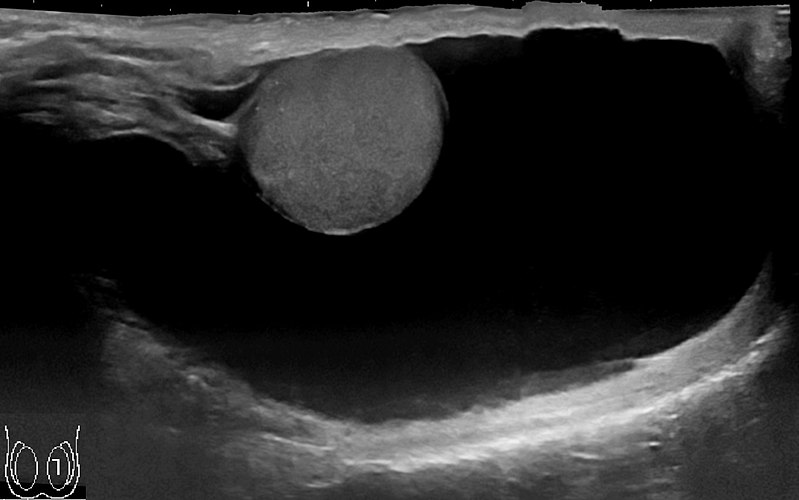
File:Ultrasonography_of_hydrocele.jpg · Wikimedia Commons · See Wikimedia Commons
hydrocele
Sign in to saveAlso known as hydrocoele, testicular hydrocele
A hydrocele is an accumulation of serous fluid in a body cavity. A hydrocele testis, the most common form of hydrocele, is the accumulation of fluids around a testicle. It is often caused by fluid collecting within a layer wrapped around the testicle, called the tunica vaginalis, which is derived from peritoneum. Provided there is no hernia present, it goes away without treatment in the first year. Although hydroceles usually develop in males, rare instances have been described in females in the canal of Nuck.
Key facts
- Medical condition (new).name
- Hydrocele
- Medical condition (new).synonyms
- hydrocoele
- Medical condition (new).image
- Ultrasonography of hydrocele.jpg
- Medical condition (new).caption
- Scrotal ultrasound of a 10 cm large hydrocele, with anechoic (dark) fluid surrounding the testicle
- Medical condition (new).field
- Urology
via Wikipedia infobox
Research
4,147 papers- A Review of Classification, Diagnosis, and Management of Hydrocele.Journal of ultrasound in medicine : official journal of the American Institute of Ultrasound in Medicine · 2024
- Hydrocele in Pediatric Population.Acta medica (Hradec Kralove) · 2020
- Abdominoscrotal hydrocele.European journal of pediatric surgery : official journal of Austrian Association of Pediatric Surgery ... [et al] = Zeitschrift fur Kinderchirurgie · 1997
- Abdominoscrotal hydrocele: A systematic review.Journal of pediatric surgery · 2016
- [Hydrocele].Nihon rinsho. Japanese journal of clinical medicine · 2002
via PubMed
Wikidata facts
- Subclass of
- male reproductive system disease
- Image
- Gray1148.png
Show 7 more facts
- Commons category
- Hydrocele
- exact match
- purl.obolibrary.org/obo/HP_0000034
- health specialty
- urology
- ICD-9-CM
- 603.9
- on focus list of Wikimedia project
- WikiProject Medicine
- ICPC 2 ID
- Y86
Sources (8)
via Wikidata · CC0
~9 min read
Encyclopedic overview
12 sectionsContents
- Presentation
- Complications
- Cause
- Primary hydroceles
- Secondary hydroceles
- Infantile hydroceles
- Congenital hydroceles
- Encysted hydrocele of the cord
- Diagnosis
- Treatment
- References
- External links
A hydrocele is an accumulation of serous fluid in a body cavity. A hydrocele testis, the most common form of hydrocele, is the accumulation of fluids around a testicle. It is often caused by fluid collecting within a layer wrapped around the testicle, called the tunica vaginalis, which is derived from peritoneum. Provided there is no hernia present, it goes away without treatment in the first year. Although hydroceles usually develop in males, rare instances have been described in females in the canal of Nuck.
Primary hydroceles may develop in adulthood, particularly in the elderly and in hot countries, by slow accumulation of serous fluid. This is presumably caused by impaired reabsorption, which appears to be the explanation for most primary hydroceles, although the reason remains obscure. A hydrocele can also be the result of a plugged inguinal lymphatic system caused by repeated, chronic infection of Wuchereria bancrofti or Brugia malayi, two mosquito-borne parasites of Africa and Southeast Asia, respectively. As such, the condition would be a part of more diffuse sequelae commonly referred to as elephantiasis, which also affects the lymphatic system in other parts of the body.
Excerpted from Wikipedia’s “hydrocele” article, available under the CC BY-SA 4.0 licence.