Hydrocotyle · Kew POWO · Kew Plants of the World Online
Hydrocotyle
Sign in to saveAlso known as Hydrocotile, pennywort, navelworts, pennyworts, water pennyworts, water pennywort, navelwort
Hydrocotyle, also called floating pennywort, water pennywort, dollar weed, marsh penny, thick-leaved pennywort and white rot, is a genus of prostrate, perennial aquatic or semi-aquatic plants formerly classified in the family Apiaceae, now in the family Araliaceae.
Species
pennyworts
GENUS
- KingdomPlantae
- PhylumTracheophyta
- ClassMagnoliopsida
- OrderApiales
- FamilyAraliaceae
via GBIF · Kew POWO
Museum specimens
- Specimen records
- 1,655
- With media
- 809
- Family
- Araliaceae
- Collections
- INECOL, FCF-UANL, UNICACH, CICY, IBUNAM, UJAT
- Recorded in
- Mexico, Colombia, China, Japan, United States
Wikidata facts
- Instance of
- taxon
- Parent taxon
- Hydrocotyloideae
- Image
- Starr 010424-9001 Hydrocotyle bowlesioides.jpg
Show 8 more facts
- Commons category
- Hydrocotyle
- taxon rank
- genus
- taxon name
- Hydrocotyle
- topic's main category
- Category:Hydrocotyle
- taxon common name
- 天胡荽属
- taxonomic type
- Hydrocotyle vulgaris
- Flora of the Hawaiian Islands URL
- naturalhistory2.si.edu/botany/hawaiianflora/genusdescr.cfm?genus=Hydrocotyle
Sources (2)
via Wikidata · CC0
~3 min read
Encyclopedic overview
6 sectionsContents
- Description
- Selected species
- Distribution
- Fossil record
- References
- External links
Hydrocotyle, also called floating pennywort, water pennywort, dollar weed, marsh penny, thick-leaved pennywort and white rot, is a genus of prostrate, perennial aquatic or semi-aquatic plants formerly classified in the family Apiaceae, now in the family Araliaceae.
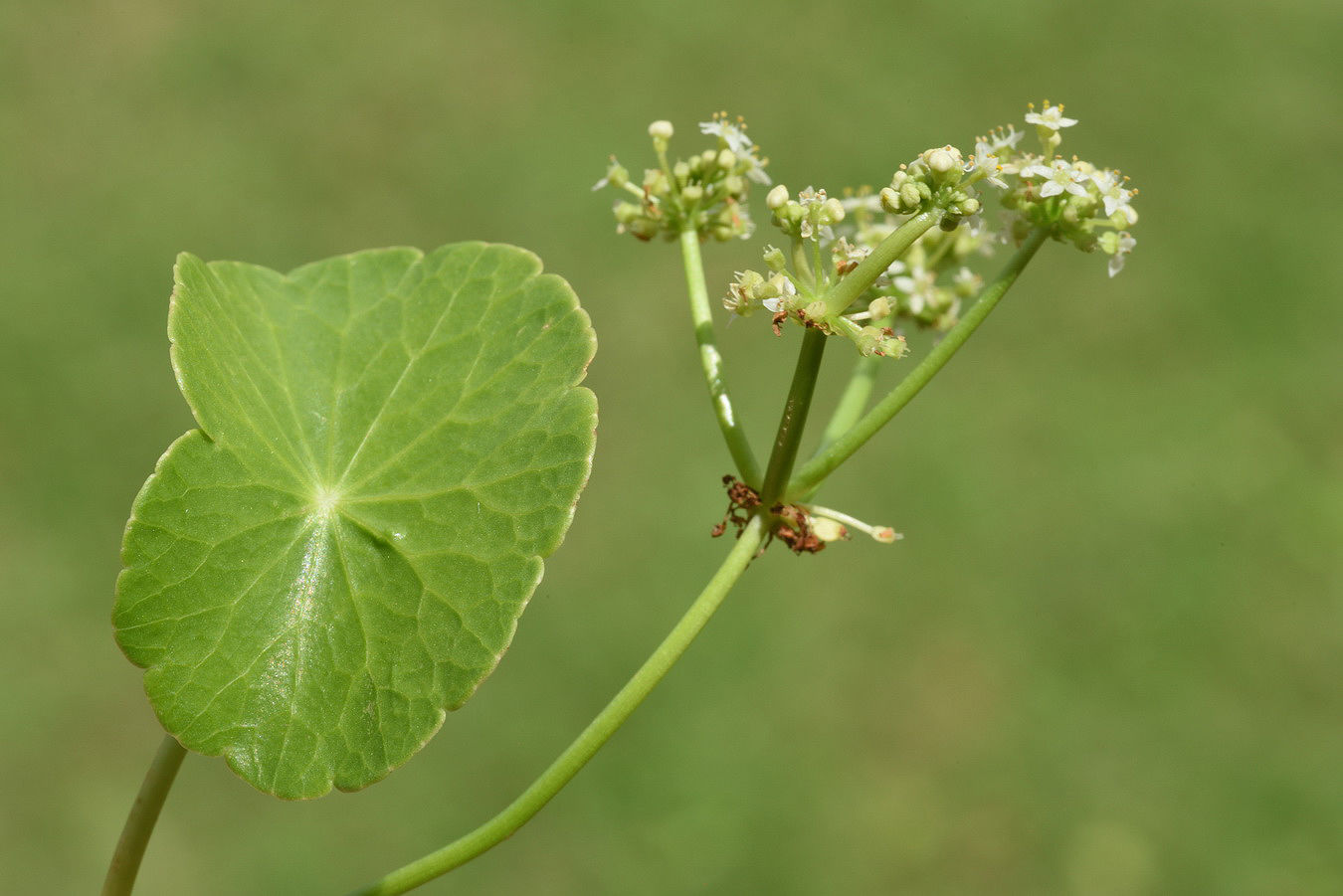
==Description== Water pennyworts, Hydrocotyles, are very common. They have long creeping stems that often form dense mats, often in and near ponds, lakes, rivers, and marshes, and some species in coastal areas by the sea. Leaves: Simple, with small leafy outgrowth at the base, kidney shaped to round. Leaf edges are scalloped. The leaf surfaces of Hydrocotyle are prime grounds for oviposition of many butterfly species, such as Anartia fatima. Flowers: Flower clusters are simple and flat-topped or rounded. Involucral bracts at the base of each flower. Indistinct sepals. File:Hydrocotyle leucocephala HannesWilms.jpg|Flowering Hydrocotyle leucocephala File:Hydrocotyle vulgaris kz24.jpg|Flowering Hydrocotyle vulgaris Fruits and reproduction: Elliptical to round with thin ridges and no oil tubes (vitta) which is characteristic in the fruit of umbelliferous plants. The prostrate plants reproduce by seed and by sending roots from stem nodes.
Excerpted from Wikipedia’s “Hydrocotyle” article, available under the CC BY-SA 4.0 licence.