File:HUP_100MB_1946_obverse.jpg · Wikimedia Commons · See Wikimedia Commons
hyperinflation
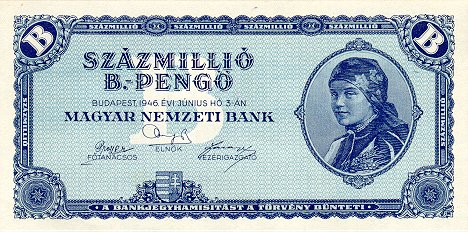
Sign in to savethumb|upright=1.8|100 quintillion (1020) Hungarian pengő|pengő, the largest denomination bill ever issued, Hungary, 1946. 1 sextillion pengő notes were printed but never issued. thumb|upright=1.8|Hyperinflation in Venezuela represented by the time it would take for money to lose 90% of its value (301-day [[rolling average, inverted logarithmic scale)]]
Hyperinflation is an extreme situation where the value of money drops so rapidly that prices skyrocket and currency becomes nearly worthless, as illustrated by Hungary's 1946 pengő notes and Venezuela's recent currency collapse. It matters because hyperinflation can devastate an economy, making everyday purchases unaffordable and wiping out people's savings and financial security.
AI-generated from the Wikipedia summary — may contain errors.
Wikidata facts
- Subclass of
- social issue
- Image
- 1923 gdansk 500mln.JPG
Show 4 more facts
- facet of
- economy
- Commons category
- Hyperinflation
- topic's main category
- Category:Hyperinflation
- Commons gallery
- Hyperinflation
via Wikidata · CC0
~53 min read
Encyclopedic overview
35 sectionsContents
- Definition
- Causes
- Money supply
- Supply shocks
- Effects
- Aftermath
- Currency
- Notable hyperinflationary periods
- Argentina
- Austria
- Bolivia
- Brazil
- China
- France
- Germany (Weimar Republic)
- Greece (German–Italian occupation)
- Hungary
- Iran
- Malaya and Singapore (Japanese occupation)
- North Korea
- Peru
- Poland
- Philippines
- Soviet Union
- Venezuela
- Vietnam
- Yugoslavia
- Zimbabwe
- Most severe hyperinflations in world history
- Units of inflation
- See also
- Notes
- References
- Further reading
- External links
thumb|upright=1.8|100 quintillion (1020) Hungarian pengő|pengő, the largest denomination bill ever issued, Hungary, 1946. 1 sextillion pengő notes were printed but never issued. thumb|upright=1.8|Hyperinflation in Venezuela represented by the time it would take for money to lose 90% of its value (301-day [[rolling average, inverted logarithmic scale)]]
In economics, hyperinflation is a very high and typically accelerating inflation. It quickly erodes the real value of the local currency, as the prices of all goods increase. This causes people to minimize their holdings in that currency as they usually switch to more stable foreign currencies. Effective capital controls and currency substitution ("dollarization") are the orthodox solutions to ending short-term hyperinflation; however, there are significant social and economic costs to these policies. Ineffective implementations of these solutions often exacerbate the situation. Many governments choose to attempt to solve structural issues without resorting to those solutions, with the goal of bringing inflation down slowly while minimizing social costs of further economic shocks; however, this can lead to a prolonged period of high inflation.
Excerpted from Wikipedia’s “hyperinflation” article, available under the CC BY-SA 4.0 licence.
Gallery (46)
Available in 63 languages
- Español
- Français
- Deutsch
- 中文
- 日本語
- Русский
- Português
- Italiano
- العربية
- हिन्दी
- Albanian
- Armenian
- Azerbaijani
- Bahasa Indonesia
- Bangla
- Basque
- be_x_old
- Belarusian
Show 44 more
- Breton
- Bulgarian
- Catalan
- Croatian
- Czech
- Danish
- Esperanto
- Estonian
- Finnish
- Georgian
- Greek
- Hebrew
- Hungarian
- Icelandic
- Javanese
- Kazakh
- Kyrgyz
- Latvian
- Lithuanian
- Macedonian
- Nederlands
- Norwegian
- Norwegian Nynorsk
- Pashto
- Polski
- Romanian
- Scots
- Serbian
- Serbian (Latin)
- simple
- Sinhala
- Slovak
- Slovenian
- Svenska
- Tamil
- Tiếng Việt
- Türkçe
- Ukrainian
- Uzbek
- Venetian
- zh_yue
- فارسی
- ไทย
- 한국어
via Wikidata sitelinks · CC0