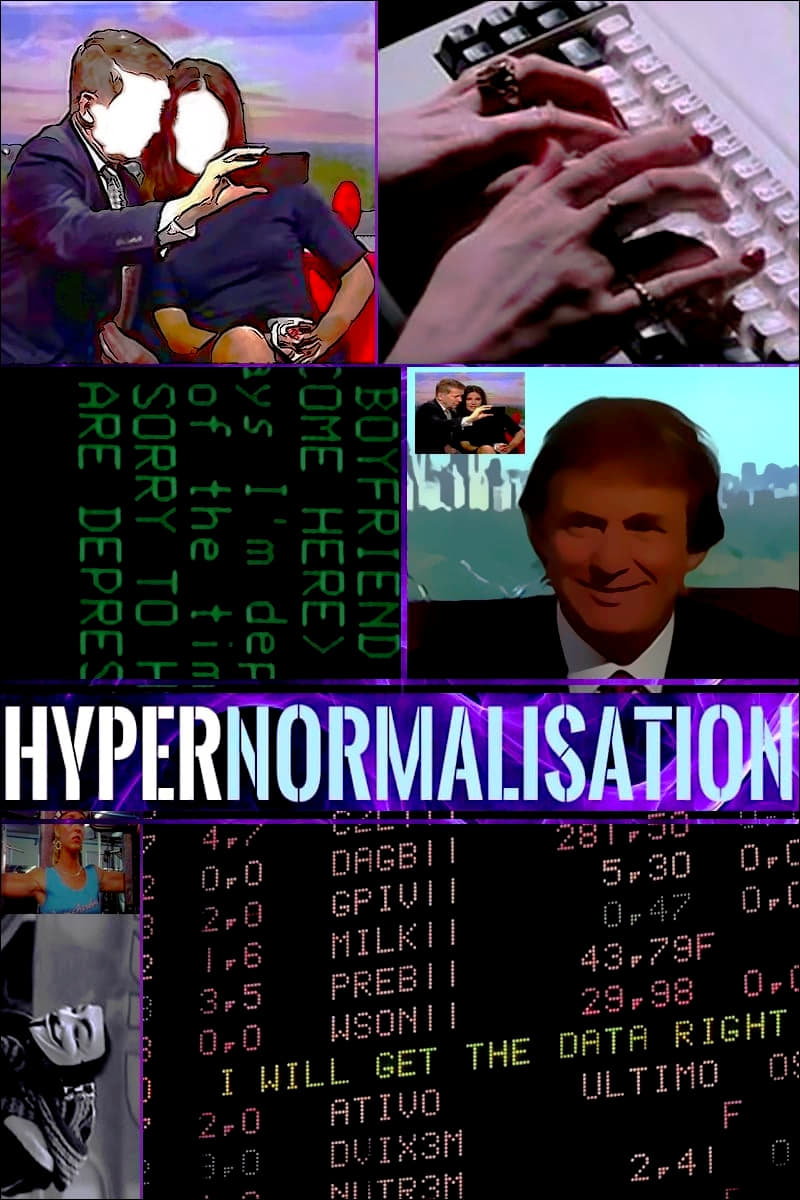
Poster from TMDB
HyperNormalisation
Sign in to saveHyperNormalisation is a 2016 BBC documentary by British filmmaker Adam Curtis. It argues that following the global economic crises of the 1970s, governments, financiers and technological utopians gave up on trying to shape the complex "real world" and instead established a simpler "fake world" for the benefit of multi-national corporations that is kept stable by neoliberal governments. The film was released on 16 October 2016 on BBC iPlayer.
Film · TMDB
7.5We live in a world where the powerful deceive us. We know they lie. They know we know they lie. They do not care. We say we care, but we do nothing, and nothing ever changes. It is normal. Welcome to the post-truth world. How we got to where we are now…
Cast
- Adam Curtis as Self - Narrator (voice)
- Donald Trump as Self (archive footage)
- Vladimir Putin as Self (archive footage)
- Ronald Reagan as Self (archive footage)
- Henry Kissinger as Self (archive footage)
- Gordon Brown as Self (archive footage)
Themes
- pop culture
- conspiracy theory
- power politics
- russian politics
- social documentary
- humanitarian
- political satire
- syria
- human behavior
- angry
This product uses the TMDB API but is not endorsed or certified by TMDB.
Wikidata facts
- Instance of
- television film
- Genre
- documentary film
- Country of origin
- United Kingdom
- Original language
- English language
- Director
- Adam Curtis
- Screenwriter
- Adam Curtis
- Production company
- BBC
- FilmAffinity ID
- 470504
Show 3 more facts
- publication date
- 2016-10-16
- title
- HyperNormalisation
- original broadcaster
- BBC
Sources (1)
via Wikidata · CC0
~14 min read
Encyclopedic overview
19 sectionsContents
- Etymology
- Chapters
- 1975
- The Human Bomb
- Altered States
- Acid Flashback
- The Colonel
- The Truth Is Out There
- Managed Outcomes
- A Cautionary Tale
- A World Without Power
- Music
- Clips
- Critical reception
- Awards and nominations
- See also
- Notes
- References
- External links
HyperNormalisation is a 2016 BBC documentary by British filmmaker Adam Curtis. It argues that following the global economic crises of the 1970s, governments, financiers and technological utopians gave up on trying to shape the complex "real world" and instead established a simpler "fake world" for the benefit of multi-national corporations that is kept stable by neoliberal governments. The film was released on 16 October 2016 on BBC iPlayer.
==Etymology== The word hypernormalisation was coined by Alexei Yurchak, a professor of anthropology who was born in Leningrad and later went to teach at the University of California, Berkeley. He introduced the word in his book Everything Was Forever, Until It Was No More: The Last Soviet Generation (2006), which describes paradoxes of Soviet life during the 1970s and 1980s. He says everyone in the Soviet Union knew the system was failing, but no one could imagine any alternative to the status quo, and politicians and citizens alike were resigned to maintaining the pretense of a functioning society. Over time, the mass delusion became a self-fulfilling prophecy, with everyone accepting it as the new norm rather than pretend, an effect Yurchak termed hypernormalisation. It has since gained further resonance in the social media era in 2025 in the U.S.
Excerpted from Wikipedia’s “HyperNormalisation” article, available under the CC BY-SA 4.0 licence.