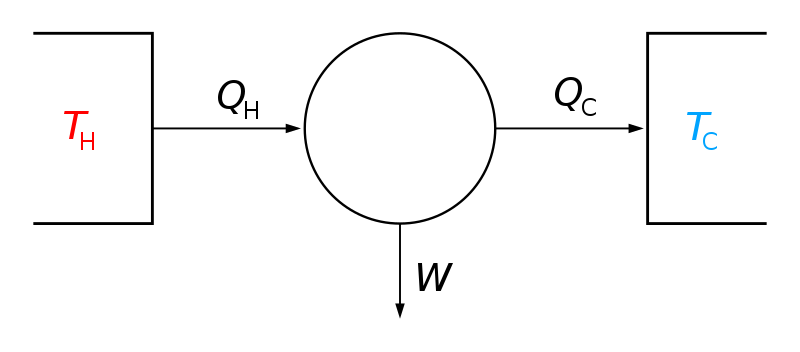
File:Carnot_heat_engine_2.svg · Wikimedia Commons · See Wikimedia Commons
ideal gas
Sign in to savetheoretical gas composed of many randomly moving point particles whose only interactions are perfectly elastic collisions
An ideal gas is a simplified theoretical model of a gas made up of countless tiny particles bouncing around randomly and colliding with each other in perfectly elastic ways, with no other forces between them. This model matters because it provides a useful starting point for understanding how real gases behave, even though actual gases are more complicated.
AI-generated from the Wikipedia summary — may contain errors.
Wikidata facts
- Instance of
- scientific model
- Subclass of
- gas
- Has use
- ideal gas law
Show 6 more facts
- studied by
- thermodynamics
- topic's main category
- Category:Ideal gas
- opposite of
- real gas
- Stack Exchange tag
- physics.stackexchange.com/tags/ideal-gas
- on focus list of Wikimedia project
- Wikipedia:Vital articles/Level/4
- maintained by WikiProject
- WikiProject Mathematics
Sources (3)
via Wikidata · CC0
~23 min read
Encyclopedic overview
System properties
Note: Conjugate variables in italics
Excerpted from Wikipedia’s “ideal gas” article, available under the CC BY-SA 4.0 licence.
Gallery (2)
Available in 70 languages
- Español
- Français
- Deutsch
- 中文
- 日本語
- Русский
- Português
- Italiano
- العربية
- हिन्दी
- Albanian
- Armenian
- Asturian
- Azerbaijani
- Bahasa Indonesia
- Bangla
- Basque
- be_x_old
Show 51 more
- Belarusian
- Bosnian
- Bulgarian
- Catalan
- Chuvash
- Croatian
- Czech
- Danish
- Esperanto
- Estonian
- Finnish
- Georgian
- Greek
- Gujarati
- Hebrew
- Hungarian
- Icelandic
- Irish
- Kazakh
- Kyrgyz
- Latvian
- Lithuanian
- Macedonian
- Malay
- Malayalam
- Nederlands
- Norwegian
- Norwegian Nynorsk
- Occitan
- Pashto
- Piedmontese
- Polski
- Romanian
- Serbian
- Serbian (Latin)
- simple
- Slovak
- Slovenian
- Svenska
- Tajik
- Tamil
- Tiếng Việt
- Türkçe
- Ukrainian
- Uzbek
- Wu Chinese
- zh_min_nan
- zh_yue
- فارسی
- ไทย
- 한국어
via Wikidata sitelinks · CC0