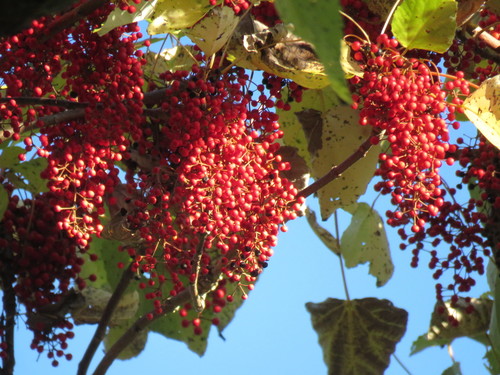
(c) 羅元甫, some rights reserved (CC BY-NC), uploaded by 羅元甫 · cc-by-nc
Idesia polycarpa
Sign in to saveIdesia as established by Scopoli is a suppressed name; see Diospyros.
Species
Wonder tree
SPECIES
- KingdomPlantae
- PhylumTracheophyta
- ClassMagnoliopsida
- OrderMalpighiales
- FamilySalicaceae
Trees, 8-21 m tall; bark grayish, not flaking; branchlets sparsely pubescent or glabrous. Petiole reddish, usually long, (4-)5-15 cm or more, glabrous, base slightly dilated; leaf blade deep green adaxially, broadly ovate, (6-)8-16(-20) × (4-)7-15(-20) cm, thinly leathery, abaxially pruinose, with a small dense patch of hairs at extreme base, elsewhere glabrous, sparsely hairy along veins or pubescent throughout, hairs (except in basal patch) mostly spreading, short, drying whitish or yellowish; adaxially usually glabrous, rarely sparsely hairy along midvein and main veins or throughout, lateral veins ca. 6 pairs, blade usually 5(-7)-veined from base, base cordate, often deeply so, less often rounded, margin serrate, usually coarsely so, apex gradually or more abruptly acuminate. Panicles (13-)20-30 cm; rachis sparsely to more densely pubescent. Flowers unisexual, yellowish green; pedicels 1-1.5 cm, densely pubescent, hairs appressed, yellowish brown, short; bracts lanceolate, 3-10 mm, reducing in size toward apex of rachis, papery, toothed or lobed. Staminate flowers: slightly larger than pistillate ones, 1.2-1.6 cm in diam.; sepals 5-6 × 2-3 mm, ovate to elliptic or slightly obov
via GBIF · Kew POWO
Museum specimens
- Specimen records
- 350
- With media
- 307
- Family
- Salicaceae
- Collections
- CM, CAS, MICH, NY, CHSC, UCR
- Recorded in
- United States, China, Japan, Taiwan, United Kingdom
Wikidata facts
Show 10 more facts
- taxon rank
- species
- taxon name
- Idesia polycarpa
- Commons category
- Idesia polycarpa
- Commons gallery
- Idesia polycarpa
- taxon common name
- Iigiri
- taxon range
- Guangdong
- short name
- I. polycarpa
- taxon author citation
- Maxim.
- foliage type
- deciduous plant
Sources (2)
via Wikidata · CC0
~2 min read
Encyclopedic overview
2 sectionsContents
- Cultivation and uses
- References
Idesia as established by Scopoli is a suppressed name; see Diospyros.
Idesia is a genus of flowering plants in the family Salicaceae (formerly placed in the family Flacourtiaceae), comprising the single species Idesia polycarpa. It is native to eastern Asia in China, Japan, Korea, and Taiwan.
Excerpted from Wikipedia’s “Idesia polycarpa” article, available under the CC BY-SA 4.0 licence.