Imperial Red Cross Easter Egg
Sign in to saveAlso known as Red Cross with Triptych egg, Red Cross Triptych Egg, Red Cross Egg with Resurrection Triptych
1915 Imperial Fabergé egg
Described at
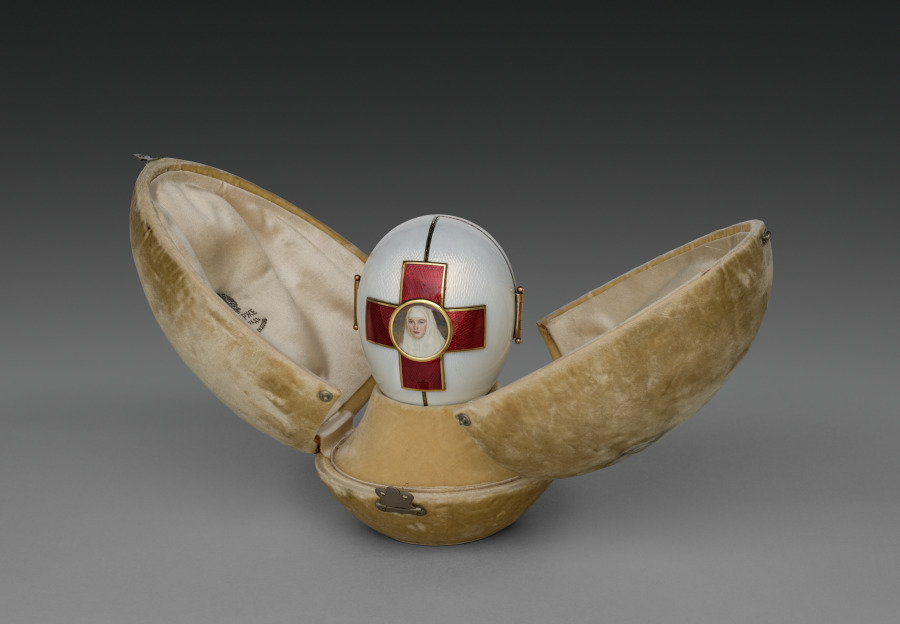
Imperial Red Cross Easter Egg | Cleveland Museum of Art
The House of Fabergé made two imperial Easter eggs in 1915 that honored the contributions of Tsarina Alexandra and her two eldest daughters, Olga and Tatiana, to the war effort as Red Cross Sisters of Mercy. Compared to other Fabergé eggs elaborately ornamented with jewels, the eggs reflected the mood of austerity in Russia during World War I. This version becomes an icon when opened, revealing miniatures of the patron saints of the tsarina’s daughters. After the Russian Revolution, this relic of the Tsarist past was sold by the Soviet government to raise needed cash for the treasury.
clevelandart.org →You can copy, modify, and distribute this work, all without asking permission. Learn more about CMA's Open Access Initiative. This egg was confiscated by the Bolsheviks during the Russian Revolution and sold by the government of Josef Stalin in the 1930s to raise money for the Soviet treasury. The House of Fabergé made two imperial Easter eggs in 1915 that honored the contributions of Tsarina Alexandra and her two eldest daughters, Olga and Tatiana, to the war effort as Red Cross Sisters of Mercy. Compared to other Fabergé eggs elaborately ornamented with jewels, the eggs reflected the mood of austerity in Russia during World War I. This version becomes an icon when opened, revealing miniatures of the patron saints of the tsarina’s daughters. After the Russian Revolution, this relic of the Tsarist past was sold by the Soviet government to raise needed cash for the treasury. The information about this object, including provenance, may not be currently accurate. If you notice a mistake or have additional information about this object, please fill out the appropriate request form linked below:
Excerpt from a page describing this subject · 6,123 chars · not written by Vinony
Wikidata facts
- Instance of
- exhibit
- Country
- Russian Empire
- Country of origin
- Russian Empire
- Material used
- vitreous enamel
- Creator
- Henrik Wigström
- Collection
- Cleveland Museum of Art
- Location
- Cleveland Museum of Art
- Manufacturer
- House of Fabergé
- Image
- Henrik wigström e adrian prachov per casa fabergé, uovo pasquale imperiale della croce rossa. 1915.jpg
- Height
- 8.6
- Width
- 6.35
Show 9 more facts
- inception
- 1915-01-01
- Commons category
- Red Cross with Triptych (Fabergé egg)
- inventory number
- 1963.673
- commissioned by
- Nicholas II of Russia
- title
- Imperial Red Cross Easter Egg
- described at URL
- clevelandart.org/art/1963.673
- price
- 4400
- capital cost
- 3600
- copyright status
- public domain
Sources (2)
via Wikidata · CC0