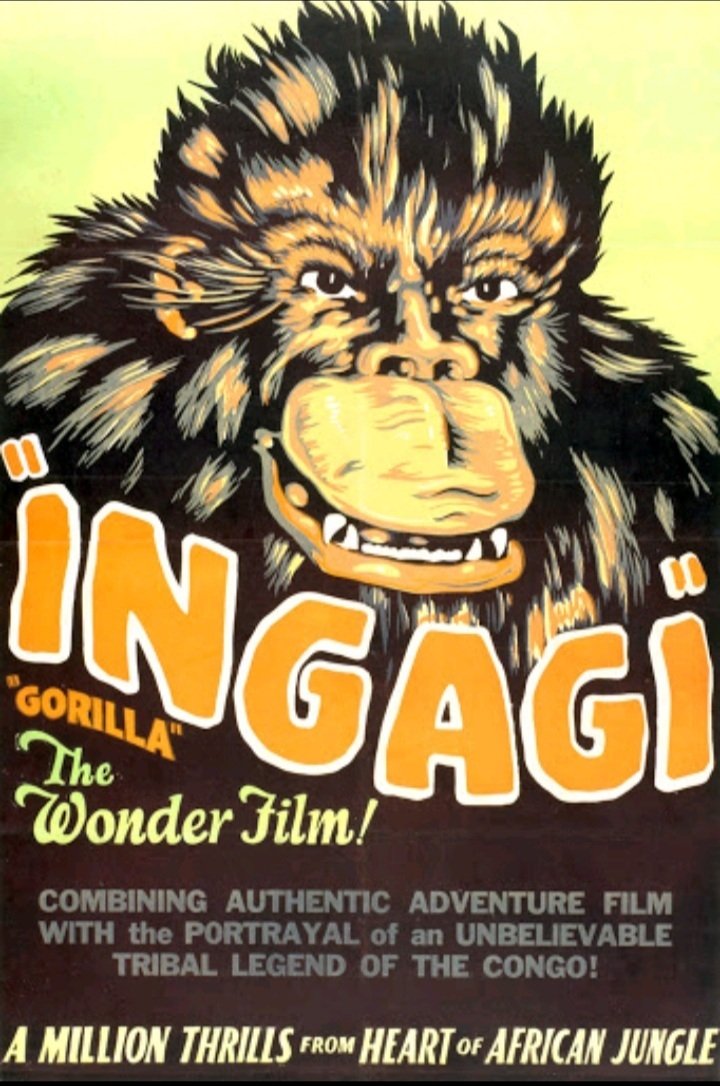
Poster from TMDB
Ingagi
Sign in to saveIngagi is a 1930 pre-Code pseudo-documentary exploitation film directed by William S. Campbell. It purports to be a documentary about "Sir Hubert Winstead" of London on an expedition to the Belgian Congo and depicts a tribe of gorilla-worshipping women encountered by the explorer.
In the Vinony graph
Vinony's link graph records 80 inbound references to Ingagi, and connects out to zoophilia, Motion Picture Association and Charles Gemora.
It sits within the topics 1930 adventure films, 1930 American films and 1930 English-language films.
Vinony links it to 5 Wikipedia language editions.
Film · TMDB
4.1An expedition enters an area of the Congo jungle to investigate reports of a gorilla-worshipping tribe.
Cast
- Sir Hubert Winstead as Explorer
- Daniel Swayne as Explorer
- Arthur Clayton as Explorer
- Louis Nizor as Explorer
- Charles Gemora as Ingagi (uncredited)
Themes
- virgin
- gorilla
- congo
- exploitation
- jungle
- pre-code
- found footage
- horror
- action
- adventure
This product uses the TMDB API but is not endorsed or certified by TMDB.
Wikidata facts
- Instance of
- film
- Genre
- exploitation film
- Country of origin
- United States
- Original language
- English language
- Movement
- Pre-Code Hollywood
- Director
- William Campbell
- Image
- Ingagi-movieposter-1930.jpg
Show 4 more facts
- publication date
- 1931-01-01
- title
- Ingagi
- color
- black-and-white
- Commons category
- Ingagi
Sources (1)
via Wikidata · CC0
~8 min read
Encyclopedic overview
10 sectionsContents
- Plot
- Production
- Release
- Critical reception
- Follow-ups
- See also
- References
- Notes
- Sources
- External links
Ingagi is a 1930 pre-Code pseudo-documentary exploitation film directed by William S. Campbell. It purports to be a documentary about "Sir Hubert Winstead" of London on an expedition to the Belgian Congo and depicts a tribe of gorilla-worshipping women encountered by the explorer.
The film claims to show a ritual in which African women are given over to gorillas as sex slaves, but in actuality was mostly filmed in Los Angeles, using American actresses in place of natives. It was produced and distributed by Nat Spitzer's Congo Pictures, which had been formed expressly for this production. Although marketed under the pretense of being ethnographic, the premise was a fabrication, leading the Motion Picture Producers and Distributors Association to retract any involvement.
Excerpted from Wikipedia’s “Ingagi” article, available under the CC BY-SA 4.0 licence.