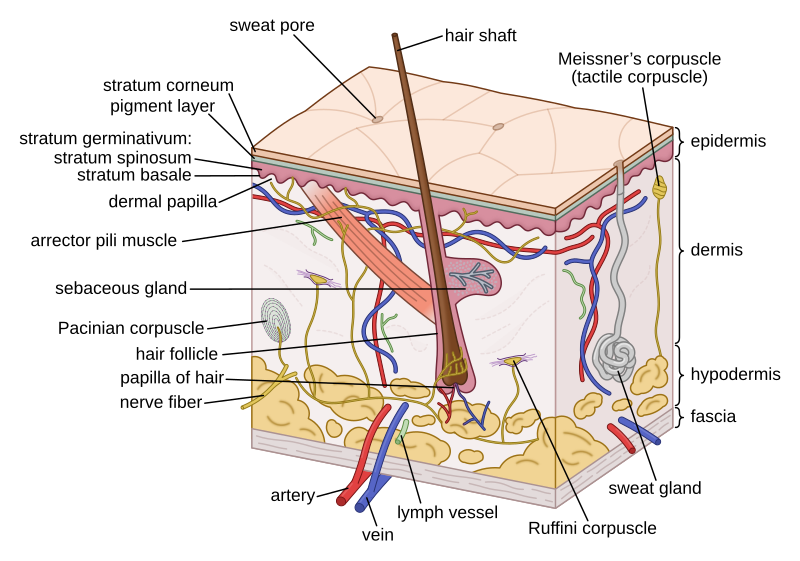
File:Human_skin_structure.svg · Wikimedia Commons · See Wikimedia Commons
integumentary system
Sign in to saveorgan system that protects the body comprising the skin and its appendages (including hair, scales, feathers, hooves, and nails)
The integumentary system is your body's protective covering, made up of your skin along with structures like hair, nails, and similar features. It acts as a barrier that shields your body from the environment and helps prevent damage and infection.
AI-generated from the Wikipedia summary — may contain errors.
Research
302,481 papers- The integumentary system and its microbiota between health and disease.ReviewJournal of biological regulators and homeostatic agents · 2021Inchingolo AD, Cazzolla AP, Di Cosola M et al.DOI: 10.23812/21-2supp1-30
- Basic histological structure and functions of facial skin.Clinics in dermatology · 2014Arda O, Göksügür N, Tüzün YDOI: 10.1016/j.clindermatol.2013.05.021
- The integumentary system: anatomy, physiology and function of skin.ReviewNursing standard (Royal College of Nursing (Great Britain) : 1987) · 2012McLafferty E, Hendry C, Alistair FDOI: 10.7748/ns2012.10.27.7.35.c9358
- Regulatory T cells in skin regeneration and wound healing.ReviewMilitary Medical Research · 2023Knoedler S, Knoedler L, Kauke-Navarro M et al.DOI: 10.1186/s40779-023-00484-6
- Aging integumentary system. Podiatric review.ReviewJournal of the American Podiatric Medical Association · 1990Muehlman C, Rahimi FDOI: 10.7547/87507315-80-11-577
- Connexins and pannexins in the integumentary system: the skin and appendages.ReviewCellular and molecular life sciences : CMLS · 2015Faniku C, Wright CS, Martin PEDOI: 10.1007/s00018-015-1969-0
- Wound healing.ReviewAdvances in dermatology · 1995Waldorf H, Fewkes J
- NRF2 in the Epidermal Pigmentary System.ReviewBiomolecules · 2022Ogawa T, Ishitsuka YDOI: 10.3390/biom13010020
via PubMed
Wikidata facts
- Subclass of
- organ system
- Part of
- human body
- Image
- Skin blank.jpg
Show 3 more facts
- Commons category
- Integumentary system
- topic's main category
- Category:Integumentary system
- on focus list of Wikimedia project
- Wikipedia:Vital articles/Level/4
via Wikidata · CC0
~11 min read
Encyclopedic overview
The integumentary system is the set of organs forming the outermost layer of an animal's body, comprising the skin, hair, scales, feathers, hooves, claws, and nails. It acts as a protective physical barrier between the external environment and the internal environment. Additionally, it maintains water balance, protects the deeper tissues, excretes waste, regulates body temperature, and contains the sensory receptors that detect pain, sensation, pressure, and temperature.
The skin (integument) is a composite organ, made up of at least two major layers of tissue: the outermost epidermis and the inner dermis, which are separated by a basement membrane (comprising basal lamina and reticular lamina). The epidermis comprises five layers: the stratum corneum, stratum granulosum, stratum spinosum and stratum basale. Where the skin is thicker, such as in the palms and soles, there is an extra layer of skin between the stratum corneum and the stratum granulosum known as the stratum lucidum. The dermis comprises two sections, the papillary and reticular layers, and contains connective tissues, blood vessels, glands, follicles, hair roots, sensory nerve endings, and muscular tissue. Between the integument and the deep body musculature there is a transitional subcutaneous zone, the hypodermis.
Excerpted from Wikipedia’s “integumentary system” article, available under the CC BY-SA 4.0 licence.
Gallery (3)
Available in 74 languages
- Español
- Français
- Deutsch
- 中文
- 日本語
- Русский
- Português
- Italiano
- العربية
- हिन्दी
- Albanian
- Aragonese
- Assamese
- Asturian
- Azerbaijani
- Bahasa Indonesia
- Bangla
- Basque
Show 55 more
- be_x_old
- Belarusian
- Bosnian
- Bulgarian
- Catalan
- Central Kurdish
- Croatian
- Czech
- Esperanto
- Filipino
- Finnish
- Galician
- Ganda
- Greek
- Hebrew
- Icelandic
- Ido
- Interlingua
- Irish
- Javanese
- Latin
- Latvian
- Limburgish
- Macedonian
- Malay
- Malayalam
- Nederlands
- Newari
- Norwegian Nynorsk
- Occitan
- Oromo
- Piedmontese
- Polski
- Romanian
- Serbian
- Serbian (Latin)
- simple
- Sinhala
- Slovak
- Slovenian
- Svenska
- Tamil
- Tiếng Việt
- Türkçe
- Turkmen
- Ukrainian
- Waray
- Welsh
- Western Panjabi
- Wu Chinese
- zh_min_nan
- zh_yue
- فارسی
- ไทย
- 한국어
via Wikidata sitelinks · CC0