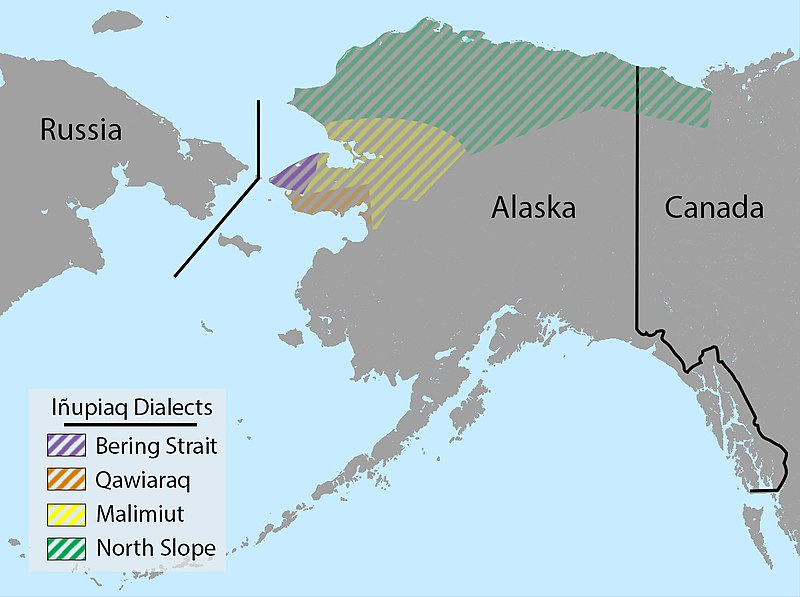
File:Iñupiaq_Dialects.jpg · Wikimedia Commons · See Wikimedia Commons
Iñupiaq
Sign in to saveAlso known as Inupiat language, Iñupiaq language, Inupiat, Iñupiat, Iñupiatun, Alaskan Inuit, Inupiaq
group of dialects of the Inuit language
Iñupiaq is a group of related dialects that make up part of the Inuit language family, primarily spoken in northern Alaska. It matters because it represents an important part of the cultural and linguistic heritage of Inuit peoples in that region.
AI-generated from the Wikipedia summary — may contain errors.
Wikidata facts
- Instance of
- modern language
- Subclass of
- Indigenous languages of the Americas
- Country
- Canada
Show 9 more facts
- linguistic typology
- ergative–absolutive language
- topic's main category
- Category:Inupiat language
- Wikimedia language code
- ik
- native label
- Iñupiatun
- number of speakers, writers, or signers
- 5580
- Commons category
- Iñupiaq language
- P10369
- Boeing
- indigenous to
- Alaska
via Wikidata · CC0
~30 min read
Encyclopedic overview
Iñupiaq or Inupiaq (/ɪ.ˈnuː.pi.æk/ ih-NOO-pee-ak, Inupiaq: [iɲupiaq]), also known as Iñupiat, Inupiat (/ɪ.ˈnuː.pi.æt/ ih-NOO-pee-at), Iñupiatun or Alaskan Inuit, is an Inuit language, or perhaps group of languages, spoken by the Iñupiat people in northern and northwestern Alaska, as well as a small adjacent part of the Northwest Territories of Canada. The Iñupiat language is a member of the Inuit–Yupik–Unangan language family, and is closely related and, to varying degrees, mutually intelligible with other Inuit languages of Canada and Greenland. There are roughly 2,000 speakers. Iñupiaq is considered to be a threatened language, with most speakers at or above the age of 40. Iñupiaq is an official language of the State of Alaska, along with several other indigenous languages.
The major varieties of the Iñupiaq language are the North Slope Iñupiaq and Seward Peninsula Iñupiaq dialects.
Excerpted from Wikipedia’s “Iñupiaq” article, available under the CC BY-SA 4.0 licence.
Gallery (12)
Available in 55 languages
- Español
- Français
- Deutsch
- 中文
- 日本語
- Русский
- Português
- Italiano
- العربية
- हिन्दी
- Asturian
- azb
- Azerbaijani
- Bahasa Indonesia
- Basque
- Catalan
- Central Kurdish
- Czech
Show 36 more
- Egyptian Arabic
- Erzya
- Esperanto
- Estonian
- Fiji Hindi
- Filipino
- Finnish
- Galician
- Inupiaq
- Kabardian
- Komi-Permyak
- Latvian
- Lezghian
- Limburgish
- Lithuanian
- Malayalam
- Mazanderani
- Moksha
- Nederlands
- Northern Frisian
- Norwegian
- Norwegian Nynorsk
- Piedmontese
- Polski
- Santali
- simple
- Svenska
- Tamil
- Türkçe
- Udmurt
- Ukrainian
- Veps
- Western Mari
- wikifunctions
- فارسی
- 한국어
via Wikidata sitelinks · CC0