File:Sample_of_iodine.jpg · Wikimedia Commons · See Wikimedia Commons
iodine
Sign in to saveAlso known as I, element 53, ₅₃I
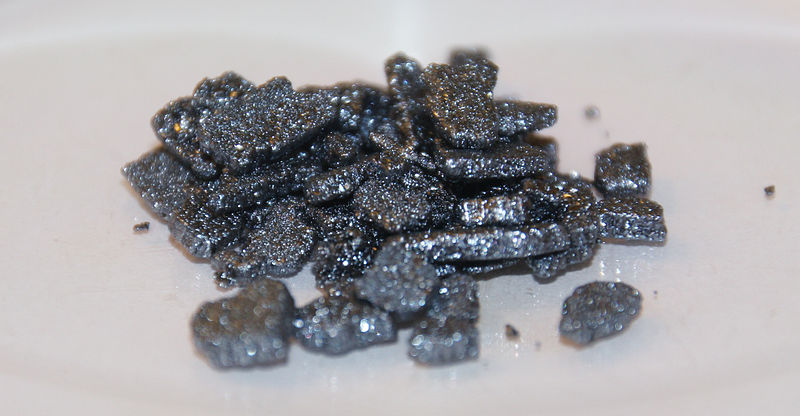
Iodine is a chemical element; it has symbol I and atomic number 53. The heaviest of the stable halogens, it exists at standard conditions as a semi-lustrous, non-metallic solid that melts to form a deep violet liquid at , and boils to a violet gas at . The element was discovered by the French chemist Bernard Courtois in 1811 and was named two years later by Joseph Louis Gay-Lussac, after the Ancient Greek , meaning 'violet'.
OverviewAI-generated
Iodine is a chemical element with the symbol I and atomic number 53. Its electron configuration is [Kr] 5s² 4d¹⁰ 5p⁵. The element has a mass of 126.90447 and an electronegativity of 3. Its ionization energy is 9.40, and its ionic radius is 2.20. The electric dipole moment is 0.
Iodine melts at 113.7 and boils at 184.4. It was discovered on 1811-01-01. The Unicode character for iodine is "碘". In academic literature, the query "iodine" yields a count of 151,682 results in PubMed. Additionally, the subject is referenced by 2,307 other encyclopedia articles.
Synthesized by Vinony from 17 facts across 3 sources: Wikidata, PubMed, Vinony graph. Generated from structured data (not the Wikipedia text) and checked against those facts — may still contain errors.
Key facts
- Iodine.engvar
- en-GB
via Wikipedia infobox
Research
151,682 papers- Iodine(III) reagents for oxidative aromatic halogenation.ReviewOrganic & biomolecular chemistry · 2022Segura-Quezada LA, Torres-Carbajal KR, Juárez-Ornelas KA et al.DOI: 10.1039/d2ob00741j
- Iodine deficiency disorders in Europe.ReviewBulletin of the World Health Organization · 1989Delange F, Bürgi H
- The Iodine Rush: Over- or Under-Iodination Risk in the Prophylactic Use of Iodine for Thyroid Blocking in the Event of a Nuclear Disaster.ReviewFrontiers in endocrinology · 2022Calcaterra V, Mameli C, Rossi V et al.DOI: 10.3389/fendo.2022.901620
- Iodine Species Quantification and Transformation during Chlorination in the Presence of Ammonia.Environmental science & technology · 2025Xu S, Liu R, Zhao L et al.DOI: 10.1021/acs.est.5c06645
- Iodine(III)-Mediated Fluorination/Semipinacol Rearrangement Cascade of 2-Alkylidenecyclobutanol Derivatives: Access to β-Monofluorinated Cyclopropanecarbaldehydes.The Journal of organic chemistry · 2021Feng SX, Yang S, Tu FH et al.DOI: 10.1021/acs.joc.1c00578
- Standard Radio-Iodine Labeling Protocols Impaired the Functional Integrity of Mesenchymal Stem/Stromal Cell Exosomes.International journal of molecular sciences · 2024Yang CT, Lai RC, Phua VJX et al.DOI: 10.3390/ijms25073742
- Iodine derivatives of chemically modified gum Arabic microspheres.Carbohydrate polymers · 2015Ganie SA, Ali A, Mazumdar NDOI: 10.1016/j.carbpol.2015.04.044
- Occurrence of Iodophenols in Aquatic Environments and the Deiodination of Organic Iodine with Ferrate(VI).Environmental science & technology · 2022Wang XS, Liu YL, Li M et al.DOI: 10.1021/acs.est.2c00857
via PubMed
Wikidata facts
- Instance of
- lithophile
- Part of
- halogens
- Named after
- violet
- Mass
- 126.90447
- Image
- Iodine'.JPG
- Has use
- iodine in medicine
Show 19 more facts
- electron configuration
- 1s² 2s² 2p⁶ 3s² 3p⁶ 4s² 3d¹⁰ 4p⁶ 5s² 4d¹⁰ 5p⁵
- element symbol
- I
- Commons category
- Iodine
- topic's main category
- Category:Iodine
- atomic number
- 53
- discoverer or inventor
- Bernard Courtois
- time of discovery or invention
- 1811-01-01
- location of discovery
- Paris
- Commons gallery
- Iodine
- ionization energy
- 9.40
- described by source
- Brockhaus and Efron Encyclopedic Dictionary
- electronegativity
- 3
- Unicode character
- 碘
- melting point
- 113.7
- different from
- diiodine
- ionic radius
- 0.53
- boiling point
- 184.4
- on focus list of Wikimedia project
- Wikipedia:Vital articles/Level/4
- electric dipole moment
- 0
via Wikidata · CC0
~47 min read
Encyclopedic overview
33 sectionsContents
- History
- Properties
- Isotopes
- Chemistry and compounds
- Charge-transfer complexes
- Hydrogen iodide
- Other binary iodine compounds
- Iodine halides
- Iodine oxides and oxoacids
- Polyiodine compounds
- Organoiodine compounds
- Occurrence and production
- Applications
- X-ray imaging
- Biocide
- Optical polarising films
- Co-catalyst
- Nutrition
- Others
- Spectroscopy
- Chemical analysis
- Biological role
- Dietary recommendations and intake
- Deficiency
- Precautions
- Toxicity
- Occupational exposure
- Reaction to iodinated contrast media
- US DEA List I status
- Notes
- References
- Bibliography
- External links
Iodine is a chemical element; it has symbol I and atomic number 53. The heaviest of the stable halogens, it exists at standard conditions as a semi-lustrous, non-metallic solid that melts to form a deep violet liquid at , and boils to a violet gas at . The element was discovered by the French chemist Bernard Courtois in 1811 and was named two years later by Joseph Louis Gay-Lussac, after the Ancient Greek , meaning 'violet'.
Iodine occurs in many oxidation states, including iodide (I−), iodate (), and the various periodate anions. As the heaviest essential mineral nutrient, iodine is required for the synthesis of thyroid hormones. Iodine deficiency affects about two billion people and is the leading preventable cause of intellectual disabilities.
Excerpted from Wikipedia’s “iodine” article, available under the CC BY-SA 4.0 licence.
Gallery (36)
Available in 159 languages
- Español
- Français
- Deutsch
- 中文
- 日本語
- Русский
- Português
- Italiano
- العربية
- हिन्दी
- abstract
- Afrikaans
- Albanian
- Amharic
- Angika
- Aragonese
- Armenian
- Asturian
Show 140 more
- azb
- Azerbaijani
- Bahasa Indonesia
- Balinese
- Bangla
- Bashkir
- Basque
- be_x_old
- Belarusian
- Bhojpuri
- Bikol
- Bislama
- Bosnian
- Breton
- Bulgarian
- Burmese
- Catalan
- cdo
- Cebuano
- Central Kurdish
- Chuvash
- Cornish
- Corsican
- Croatian
- Czech
- Danish
- Divehi
- Egyptian Arabic
- Erzya
- Esperanto
- Estonian
- Faroese
- Fiji Hindi
- Filipino
- Finnish
- Friulian
- Galician
- Gan Chinese
- Ganda
- Georgian
- Greek
- Gujarati
- Haitian Creole
- Hakka Chinese
- Hebrew
- Hungarian
- Icelandic
- Ido
- Interlingua
- Irish
- Javanese
- Kalmyk
- Kannada
- Kashmiri
- Kazakh
- kbp
- Komi
- Kurdish
- Kyrgyz
- Lao
- Latin
- Latvian
- Ligurian
- Limburgish
- Lithuanian
- lld
- Lojban
- Lombard
- Low German
- Luxembourgish
- Macedonian
- Malagasy
- Malay
- Malayalam
- Manx
- Marathi
- Mongolian
- Moroccan Arabic
- Nederlands
- Newari
- Northern Frisian
- Norwegian
- Norwegian Nynorsk
- Novial
- Occitan
- Odia
- olo
- Ossetic
- Papiamento
- Pashto
- Piedmontese
- Polski
- Punjabi
- Quechua
- roa_rup
- Romanian
- Sanskrit
- Sardinian
- Saterland Frisian
- Scottish Gaelic
- Serbian
- Serbian (Latin)
- Sicilian
- simple
- Sindhi
- skr
- Slovak
- Slovenian
- Somali
- Sundanese
- Svenska
- Swahili
- Tajik
- Tamil
- Tatar
- Telugu
- Tibetan
- Tiếng Việt
- Türkçe
- Tuvinian
- Ukrainian
- Urdu
- Uyghur
- Uzbek
- Veps
- Waray
- Welsh
- Western Mari
- Western Panjabi
- Wu Chinese
- Yiddish
- Yoruba
- Zaza
- zh_classical
- zh_min_nan
- zh_yue
- Zulu
- فارسی
- ไทย
- 한국어
via Wikidata sitelinks · CC0