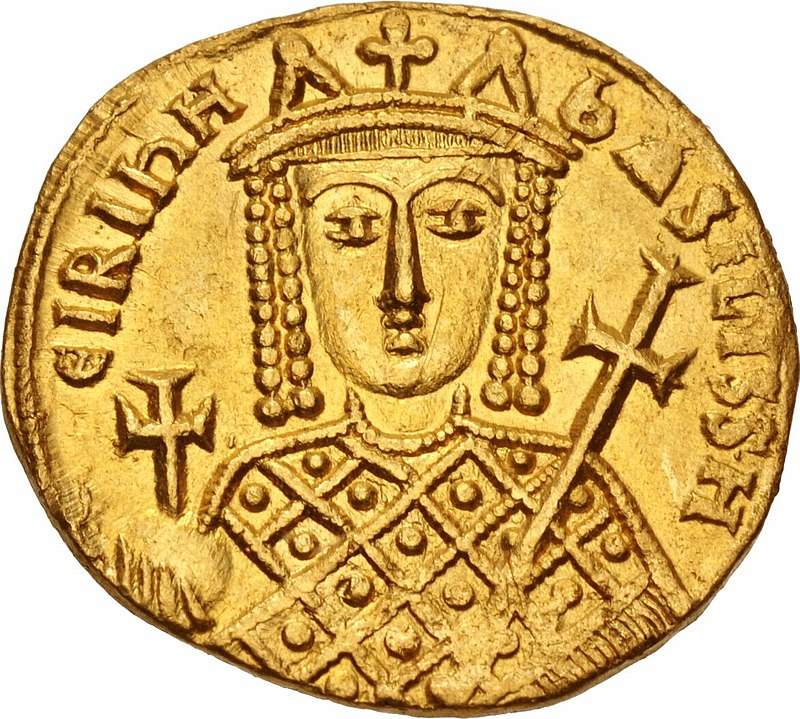
Irene of Athens
Also known as Eirene, Irene, Sarantapechaina, Eirene Sarantapechaina, Irene Sarantapechaina, Irene of Bulgaria
empress of Byzantine Empire (752-803)
AI overview
Irene of Athens was a Byzantine empress who ruled from 752 to 803 and is notable for being one of the few women to hold supreme power in the Byzantine Empire. She is historically significant for her role in religious policy, particularly regarding the veneration of religious images, which was a major theological and political issue of her time.
AI-generated from the Wikipedia summary — may contain errors.
Recent publications · Crossref
5 total works indexed
- Superior Thermal Conductivity of Single-Layer Graphene
· 2008 · cited 12,753x
- NCBI GEO: archive for functional genomics data sets—update
· 2012 · cited 8,251x
- MDS clinical diagnostic criteria for Parkinson's disease
· 2015 · cited 6,755x
- 2021 ESC Guidelines on cardiovascular disease prevention in clinical practice
· 2021 · cited 5,551x
- Worldwide trends in body-mass index, underweight, overweight, and obesity from 1975 to 2016: a pooled analysis of 2416 population-based measurement studies in 128·9 million children, adolescents, and adults
~37 min read
Article
v t e
Irene of Athens (Greek: Εἰρήνη, Eirḗnē; 750/756 – 9 August 803), surname Sarantapechaena (Greek: Σαρανταπήχαινα, Sarantapḗchaina), was Byzantine empress consort to Emperor Leo IV from 775 to 780, regent during the childhood of their son Constantine VI from 780 until 790, co-ruler from 792 until 797, and finally empress regnant and sole ruler of the Eastern Roman Empire from 797 to 802. A member of the politically prominent Sarantapechos family, she was selected as Leo IV's bride for unknown reasons in 768. Even though her husband was an iconoclast, she harbored iconophile sympathies. During her regency, in 787, she called the Second Council of Nicaea which condemned iconoclasm as heretical and brought an end to the first iconoclast period (730–787). Irene's concluding five years of sole rule were unprecedented in Roman and Byzantine history. Her public figure in this period was polarizing, due to the setbacks faced by the Empire and her iconophilic stances, often attributed to her gender and the influence of her retinue.