File:Academ_Reflections_with_parallel_axis_on_wallpaper.svg · Wikimedia Commons · See Wikimedia Commons
isometry
Sign in to saveAlso known as congruence, congruent transformation
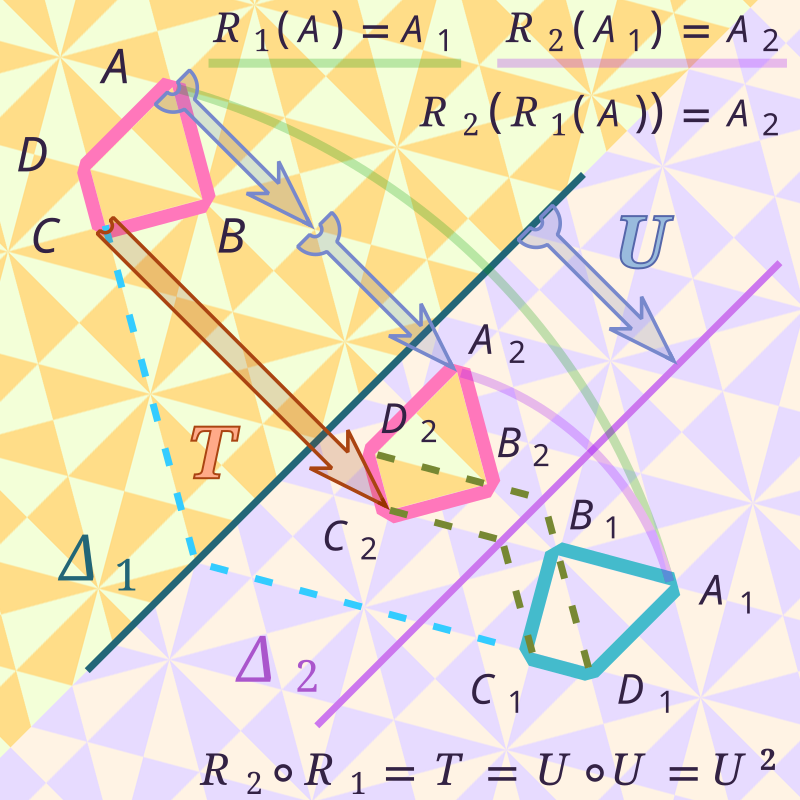
thumb|upright=1.4|A Function composition|composition of two opposite isometries is a direct isometry. A reflection in a line is an opposite isometry, like (reflection w.r.t the center diagonal line) or (reflection w.r.t the right diagonal line) on the image. Translation is a direct isometry: a rigid motion.
Wikidata facts
- Subclass of
- coordinates transformation
Show 2 more facts
- different from
- geometric motion
- maintained by WikiProject
- WikiProject Mathematics
Sources (2)
via Wikidata · CC0
~9 min read
Encyclopedic overview
12 sectionsContents
- Introduction
- Definition
- Isometries between normed spaces
- Linear isometry
- Manifold
- Definition
- Properties
- Generalizations
- See also
- Footnotes
- References
- Bibliography
thumb|upright=1.4|A Function composition|composition of two opposite isometries is a direct isometry. A reflection in a line is an opposite isometry, like (reflection w.r.t the center diagonal line) or (reflection w.r.t the right diagonal line) on the image. Translation is a direct isometry: a rigid motion.
In mathematics, an isometry (or congruence, or congruent transformation) is a distance-preserving transformation between metric spaces, usually assumed to be bijective. The word isometry is derived from the Ancient Greek: ἴσος isos meaning "equal", and μέτρον metron meaning "measure". If the transformation is from a metric space to itself, it is a kind of geometric transformation known as a motion.
Excerpted from Wikipedia’s “isometry” article, available under the CC BY-SA 4.0 licence.