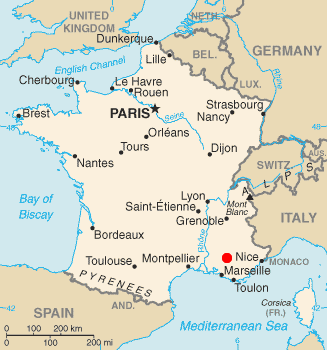
File:Cadarache_(red_dot)_CIA_World_Factbook_map.png · Wikimedia Commons · See Wikimedia Commons
ITER
Sign in to saveAlso known as International Thermonuclear Experimental Reactor, I.T.E.R., The Way to New Energy
ITER (originally an acronym for International Thermonuclear Experimental Reactor, and also meaning "the way" or "the path" in Latin) is an international nuclear fusion research and engineering project designed to demonstrate the feasibility of fusion power. The facility is under construction near the Cadarache research center in southern France. ITER has been under construction since 2013. It is expected to achieve first plasma in 2033–2034, at which point it will be the world's largest fusion reactor, with a plasma volume about six times that of Japan's JT-60SA, previously the largest tokamak
ITER is an international project building a massive nuclear fusion reactor in southern France that aims to prove fusion power can actually work as an energy source. When it starts operating in 2033–2034, it will be the world's largest fusion reactor and could represent a major breakthrough in developing clean, virtually unlimited energy.
AI-generated from the Wikipedia summary — may contain errors.
Key facts
- Organization.logo
- ITER Logo NoonYellow.svg
- Organization.name
- ITER
- Organization.map
- ITER participants.svg
- Organization.headquarters
- Saint-Paul-lès-Durance, France
- Organization.membership
- <!--
- Organization.motto
- The way to new energy -->
- Organization.leader_title
- Director-General
- Organization.leader_name
- Pietro Barabaschi
- Fusion devices.name
- ITER
- Fusion devices.image
- ITER Exhibit (01810402) (12219071813) (cropped).jpg
- Fusion devices.imagetitle
- Small-scale model of ITER
- Fusion devices.type
- Tokamak
- Fusion devices.city
- Saint-Paul-lès-Durance
- Fusion devices.country
- France
- Fusion devices.field
- (peak toroidal field on coil) (toroidal field on axis) (peak poloidal field on coil)
- Fusion devices.heating
- (electrical input) (thermal absorbed)
- Fusion devices.power
- (electrical generation) (thermal from fusion)
- Fusion devices.time
- Up to 1,000 seconds
via Wikipedia infobox
Research organization · ROR
- Type
- Other
- Founded
- 2007
- Location
- Vinon-sur-Verdon, France
- Also known as
- International Thermonuclear Experimental Reactor, The Way
- Status
- Active
GRID grid.466859.0
Official website
ITER - the way to new energy
iter.org →Link to the official site · 3,777 chars · not written by Vinony
Wikidata facts
- Instance of
- tokamak
- Country
- France
- Located in
- Saint-Paul-lès-Durance
- Headquarters
- Research centre CEA Cadarache
- Followed by
- DEMO
- Follows
- Joint European Torus
- Official website
- www.iter.org
- Image
- ITER site 2018 aerial view (41809720041).jpg
- Motto
- The way to new energy
Show 6 more facts
- has goal
- fusion power
- Commons category
- ITER
- sponsor
- United States
- inception
- 2006-00-00
- Commons gallery
- ITER
- social media followers
- 67900
Sources (1)
via Wikidata · CC0
~62 min read
Encyclopedic overview
36 sectionsContents
- Background
- Organisation history
- Directors-General
- Objectives
- Timeline and status
- Reactor overview
- Technical design
- Vacuum vessel
- Breeder blanket
- Magnet system
- Additional heating
- Cryostat
- Divertor
- Cooling systems
- Location
- Participants
- Members
- Non-members
- Domestic agencies
- ITER EU
- ITER China
- ITER India
- ITER Japan
- ITER Korea
- ITER Russia
- ITER US
- Funding
- Manufacturing
- Criticism
- Responses to criticism
- Similar projects
- See also
- Notes
- References
- Further reading
- External links
ITER (originally an acronym for International Thermonuclear Experimental Reactor, and also meaning "the way" or "the path" in Latin) is an international nuclear fusion research and engineering project designed to demonstrate the feasibility of fusion power. The facility is under construction near the Cadarache research center in southern France. ITER has been under construction since 2013. It is expected to achieve first plasma in 2033–2034, at which point it will be the world's largest fusion reactor, with a plasma volume about six times that of Japan's JT-60SA, previously the largest tokamak.
The long-term goal of fusion research is to generate electricity; ITER's stated purpose is scientific research, and technological demonstration of a large fusion reactor, without electricity generation. ITER's goals are to achieve enough fusion to produce 10 times as much thermal output power as thermal power absorbed by the plasma for short time periods; to demonstrate and test technologies that would be needed to operate a fusion power plant including cryogenics, heating, control and diagnostics systems, and remote maintenance; to achieve and learn from a burning plasma; to test tritium breeding; and to demonstrate the safety of a fusion plant.
Excerpted from Wikipedia’s “ITER” article, available under the CC BY-SA 4.0 licence.
Gallery (27)
On the map
3 mapped locations