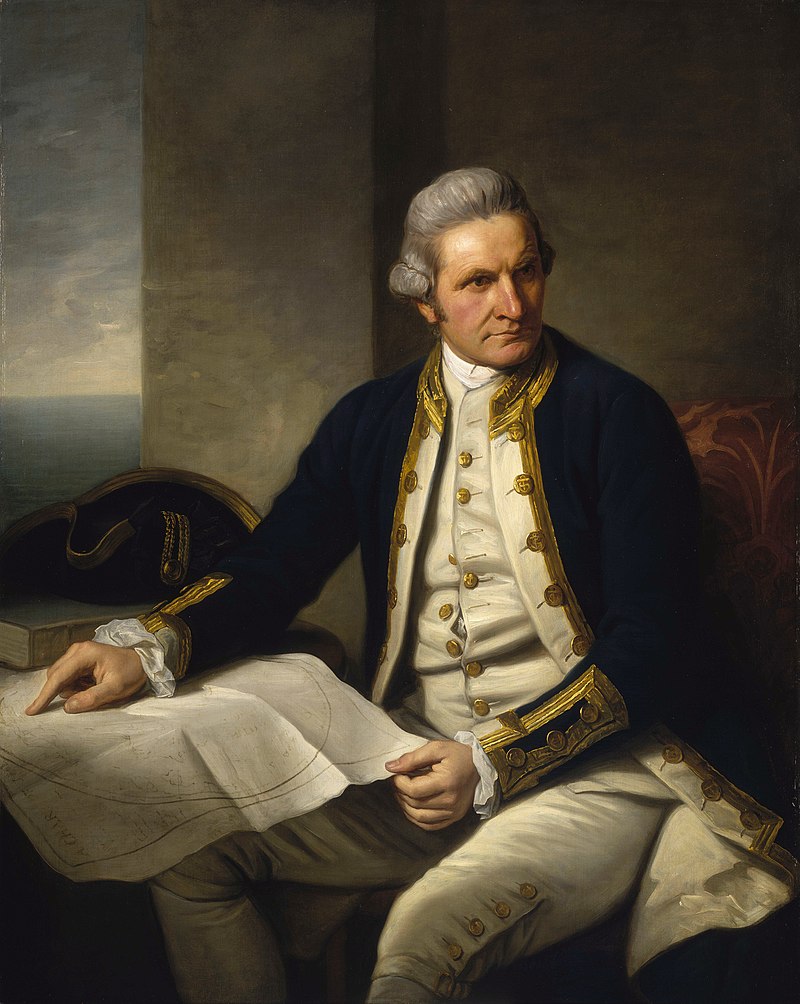
File:Captainjamescookportrait.jpg · Wikimedia Commons · See Wikimedia Commons
James Cook
Sign in to saveAlso known as Captain James Cook, Captain Cook, James Cooke, Cook, James, James Marton Cook
British explorer, cartographer and naval officer (1728–1779)
OverviewAI-generated
James Cook was a male person from the United States. He is recognized in the Royal Society collection and has been referenced by 3,308 other encyclopedia articles. His works include *Voyages of Captain James Cook*, *Remarks on the law of principal and factor*, *Voyage Towards the South Pole and Round the World - Volume I*, *Voyage Towards the South Pole, and Round the World - Volume II*, and *Journals of Captain Cook*.
He was born in 1728 and died in 1779. A quote attributed to him states, "If I have failed in discovering a Continent it is because it does not exist." He is associated with Commons categories and galleries under the name James Cook.
Synthesized by Vinony from 22 facts across 8 sources: Wikidata, Last.fm, Crossref, Wikiquote, MusicBrainz, Open Library, Vinony collections, Vinony graph. Generated from structured data (not the Wikipedia text) and checked against those facts — may still contain errors.
Wikidata facts
- Instance of
- human
- Given name
- James
- Family name
- Cook
- Gender
- male
- Citizenship
- Kingdom of Great Britain
- Place of birth
- Marton
- Place of death
- Kealakekua Bay
- Occupation
- botanist
- Languages spoken
- French
- Native language
- English language
- Participant in
- third voyage of James Cook
- Field of work
- cartography
- Military branch
- Royal Navy
- Military rank
- captain
- Image
- Captainjamescookportrait.jpg
- Significant event
- death of James Cook
Show 16 more facts
- Commons Creator page
- James Cook
- Commons category
- James Cook
- member of
- Royal Society
- date of birth
- 1728-11-07
- date of death
- 1779-01-01
- topic's main category
- Category:James Cook
- Commons gallery
- James Cook
- manner of death
- homicide
- name in native language
- James Cook
- ethnic group
- English people
- cause of death
- stab wound
- writing language
- English language
- has works in the collection
- Memoria Chilena
- P6944
- James Cook
- P8168
- Hans Werner Olm
Sources (11)
via Wikidata · CC0
~40 min read
Encyclopedic overview
Captain James Cook (7 November 1728 – 14 February 1779) was a British Royal Navy officer, explorer, and cartographer who led three voyages of exploration to the Pacific and Southern Oceans between 1768 and 1779. He completed the first recorded circumnavigation of the main islands of New Zealand, and led the first recorded visit by Europeans to the east coast of Australia and the Hawaiian Islands.
Cook joined the British merchant navy as a teenager before enlisting in the Royal Navy in 1755. He first saw combat during the Seven Years' War, when he fought in the Siege of Louisbourg. Later in the war he surveyed and mapped much of the entrance to the St. Lawrence River during the Siege of Quebec. In the 1760s he mapped the coastline of Newfoundland and made important astronomical observations which brought him to the attention of the Admiralty and the Royal Society. This acclaim came at a pivotal moment in British overseas exploration, and it led to his commission in 1768 as commander of HMS Endeavour for the first of his three voyages.
Excerpted from Wikipedia’s “James Cook” article, available under the CC BY-SA 4.0 licence.
Gallery (12)
Available in 169 languages
- Español
- Français
- Deutsch
- 中文
- 日本語
- Русский
- Português
- Italiano
- العربية
- हिन्दी
- Afrikaans
- Albanian
- Albanian
- Amharic
- Aragonese
- Armenian
- Arpitan
- Assamese
Show 150 more
- Asturian
- azb
- Azerbaijani
- Bahasa Indonesia
- Bangla
- Bashkir
- Basque
- bat_smg
- be_x_old
- Belarusian
- Bikol
- Bosnian
- Breton
- btm
- Bulgarian
- Burmese
- Catalan
- Central Kurdish
- Chechen
- Chuvash
- Cornish
- Crimean Tatar
- Croatian
- Czech
- Danish
- Egyptian Arabic
- Esperanto
- Estonian
- Faroese
- Fiji Hindi
- Fijian
- Filipino
- Finnish
- Friulian
- Galician
- Gan Chinese
- gcr
- Georgian
- Greek
- Guarani
- Haitian Creole
- Hausa
- Hebrew
- Hungarian
- Icelandic
- Ido
- Iloko
- Interlingua
- Irish
- Jamaican Creole English
- Javanese
- Jju
- Kabyle
- Kalmyk
- Kanuri
- Kara-Kalpak
- Kazakh
- kbp
- Kongo
- Kotava
- Kurdish
- Kyrgyz
- Ladino
- Latin
- Latvian
- Lezghian
- Ligurian
- Limburgish
- Lithuanian
- Lombard
- Low German
- Luxembourgish
- Macedonian
- Maithili
- Malagasy
- Malay
- Malayalam
- Maltese
- Māori
- Marathi
- Minangkabau
- Mingrelian
- Mirandese
- Mongolian
- Moroccan Arabic
- Nederlands
- Nepali
- Newari
- Northern Frisian
- Norwegian
- Norwegian Nynorsk
- Occitan
- Odia
- Old English
- olo
- Ossetic
- Pampanga
- Pashto
- Piedmontese
- Polski
- Punjabi
- Quechua
- rki
- Romanian
- Rusyn
- Santali
- Scots
- Scottish Gaelic
- Serbian
- Serbian (Latin)
- Sicilian
- simple
- Sindhi
- Slovak
- Slovenian
- Sundanese
- Svenska
- Swahili
- Tahitian
- Tajik
- Talysh
- Tamil
- Tatar
- Telugu
- Tiếng Việt
- Toki Pona
- Türkçe
- Tuvinian
- Ukrainian
- Urdu
- Uzbek
- Venetian
- Veps
- Volapük
- Waray
- Welsh
- Western Frisian
- Western Panjabi
- Wu Chinese
- Yakut
- Yiddish
- Yoruba
- Zaza
- zh_classical
- zh_min_nan
- zh_yue
- Zhuang
- فارسی
- ไทย
- 한국어
via Wikidata sitelinks · CC0