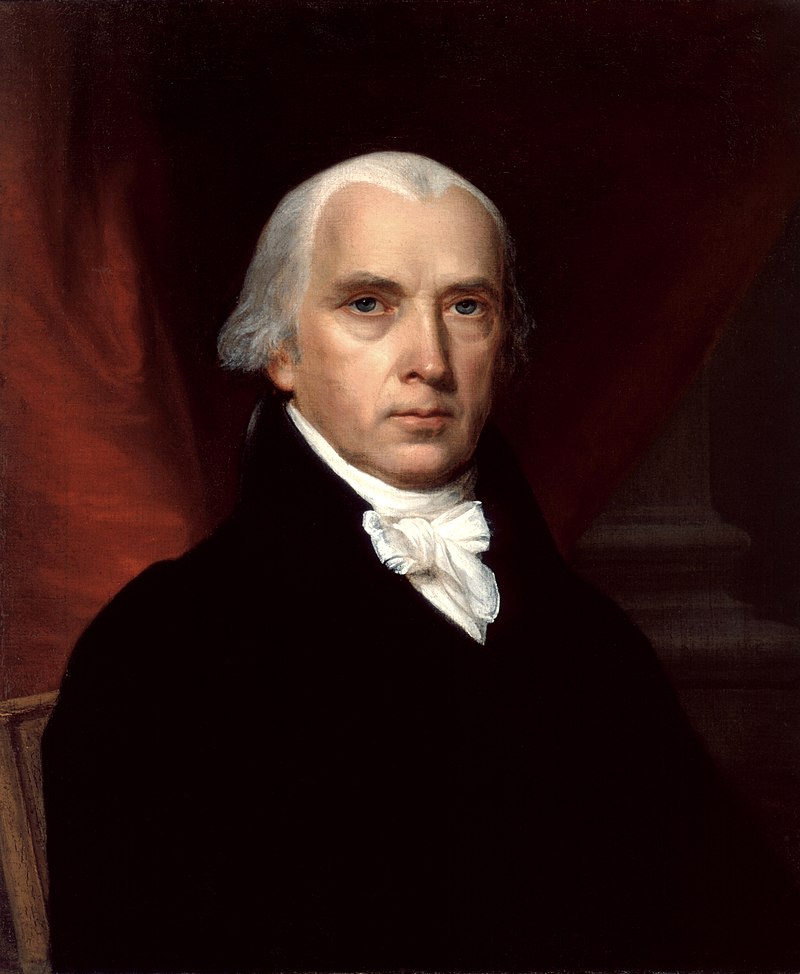
File:James_Madison.jpg · Wikimedia Commons · See Wikimedia Commons
James Madison
Sign in to saveAlso known as James Madison, Jr., James Madison Jr., President Madison, President James Madison
President of the United States from 1809 to 1817 (1751–1836)
OverviewAI-generated
James Madison, Jr. was an American politician, writer, diplomat, and philosopher. He served as the fourth President of the United States and previously held the positions of Speaker of the United States House of Representatives, United States Secretary of State, and President-elect of the United States. A member of the Democratic-Republican Party, he was educated at Princeton University and worked in Washington, D.C.
Born in Port Conway in 1751, Madison died at Montpelier in 1836, where he is also buried. He was married to Dolley Madison and had no children. His notable works include *Der Föderalist*, *The case of Marbury v. Madison*, and *An address delivered before the Agricultural Society of Albemarle*. He was a member of the American Philosophical Society, the American Academy of Arts and Sciences, and the American Antiquarian Society.
Synthesized by Vinony from 29 facts across 3 sources: Wikidata, Open Library, Vinony collections. Generated from structured data (not the Wikipedia text) and checked against those facts — may still contain errors.
Person · Open Library
- Born
- 16 March 1751
- Died
- 28 June 1836
- Works
- 443
Top works
- Der Föderalist
- An address delivered before the Agricultural Society of Albemarle, on Tuesday, May 12, 1818
- The case of Marbury v. Madison, 1 Cranch, 137
- Letter from the Secretary of State to Mr. Monroe on the subject of the attack on the Chesapeake. The correspondence of Mr. Monroe with the British government. And also, Mr. Madison's correspondence with Mr. Rose on the same subject
- Letters from the Secretary of State to Messrs. Monroe and Pinkney, on subjects committed to their joint negotiations
via Open Library + Wikidata
Wikidata facts
- Instance of
- human
- Given name
- James
- Gender
- male
- Citizenship
- United States
- Place of birth
- Port Conway
- Place of death
- Montpelier
- Spouse
- Dolley Madison
- Father
- James Madison, Sr.
- Occupation
- statesperson
- Educated at
- Princeton University
- Political party
- Democratic-Republican Party
- Languages spoken
- Greek
- Native language
- English language
- Religion
- deism
- Notable work
- Federalist Papers
- Eye colour
- blue
- Image
- James Madison.jpg
- Height
- 163
- Number of children
- 0
- Work location
- Washington, D.C.
Show 21 more facts
- Commons category
- James Madison
- date of birth
- 1751-03-16
- date of death
- 1836-06-28
- topic's main category
- Category:James Madison
- member of
- American Antiquarian Society
- place of burial
- Montpelier
- birth name
- James Madison, Jr.
- Commons gallery
- James Madison
- Commons Creator page
- James Madison
- name in native language
- James Madison
- manner of death
- natural causes
- cause of death
- heart failure
- writing language
- English language
- on focus list of Wikimedia project
- Wikipedia:Vital articles/Level/4
- different from
- James Maddison
- candidacy in election
- 1812 United States presidential election
- IPA transcription
- ˌdʒeɪmz ˈmædɪsn
- medical condition
- epilepsy
- influenced by
- John Witherspoon
- archives at
- New York Public Library Main Branch
- maintained by WikiProject
- WikiProject International relations
Sources (14)
via Wikidata · CC0
~40 min read
Encyclopedic overview
James Madison (March 16, 1751 [O.S. March 5, 1750] – June 28, 1836) was an American statesman, diplomat, and Founding Father who served as the fourth president of the United States from 1809 to 1817. Madison was popularly acclaimed as the "Father of the Constitution" for his pivotal role in drafting and promoting the Constitution of the United States and the Bill of Rights.
Madison was born into a prominent slave-owning planter family in Virginia. In 1774, strongly opposed to British taxation, Madison joined with the Patriots. He was a member of both the Virginia House of Delegates and the Continental Congress during and after the American Revolutionary War. Dissatisfied with the weak national government established by the Articles of Confederation, he helped organize the Constitutional Convention, which produced a new constitution designed to strengthen republican government against democratic assembly. Madison's Virginia Plan was the basis for the convention's deliberations. He became one of the leaders in the movement to ratify the Constitution and joined Alexander Hamilton and John Jay in writing The Federalist Papers, a series of pro-ratification essays that remain prominent among works of political science in American history.
Excerpted from Wikipedia’s “James Madison” article, available under the CC BY-SA 4.0 licence.
Gallery (12)
Available in 143 languages
- Español
- Français
- Deutsch
- 中文
- 日本語
- Русский
- Português
- Italiano
- العربية
- हिन्दी
- Afrikaans
- Albanian
- Amharic
- Aragonese
- Armenian
- Asturian
- Awadhi
- Aymara
Show 124 more
- azb
- Azerbaijani
- Bahasa Indonesia
- Balinese
- Bangla
- Basque
- be_x_old
- Belarusian
- Bikol
- Bislama
- Bosnian
- Breton
- Bulgarian
- Burmese
- Catalan
- cdo
- Cebuano
- Central Kurdish
- Chuvash
- Cornish
- Corsican
- Crimean Tatar
- Croatian
- Czech
- Danish
- Divehi
- Egyptian Arabic
- Esperanto
- Estonian
- Ewe
- Fiji Hindi
- Filipino
- Finnish
- Galician
- Georgian
- Greek
- guw
- Haitian Creole
- Hakka Chinese
- Hausa
- Hebrew
- Hungarian
- Icelandic
- Ido
- Iloko
- Interlingua
- Irish
- Javanese
- Kazakh
- Kinyarwanda
- Kurdish
- Kyrgyz
- Latin
- Latvian
- Ligurian
- Limburgish
- Lingua Franca Nova
- Lithuanian
- Lombard
- Low German
- Luxembourgish
- Macedonian
- Madurese
- Maithili
- Malagasy
- Malay
- Malayalam
- Manx
- Marathi
- Mazanderani
- Mingrelian
- Mongolian
- Moroccan Arabic
- Nederlands
- Nepali
- Norwegian
- Norwegian Nynorsk
- Occitan
- Old English
- Ossetic
- Pampanga
- Pashto
- Piedmontese
- Polski
- Punjabi
- Quechua
- Romanian
- Scots
- Scottish Gaelic
- Serbian
- Serbian (Latin)
- Sicilian
- simple
- Sinhala
- Slovak
- Slovenian
- Sundanese
- Svenska
- Swahili
- Tajik
- Tamil
- Tatar
- Telugu
- Tiếng Việt
- Türkçe
- Turkmen
- Ukrainian
- Urdu
- Uyghur
- Uzbek
- Volapük
- Waray
- Welsh
- Western Panjabi
- Wu Chinese
- Yiddish
- Yoruba
- Zaza
- zh_classical
- zh_min_nan
- zh_yue
- فارسی
- ไทย
- 한국어
via Wikidata sitelinks · CC0