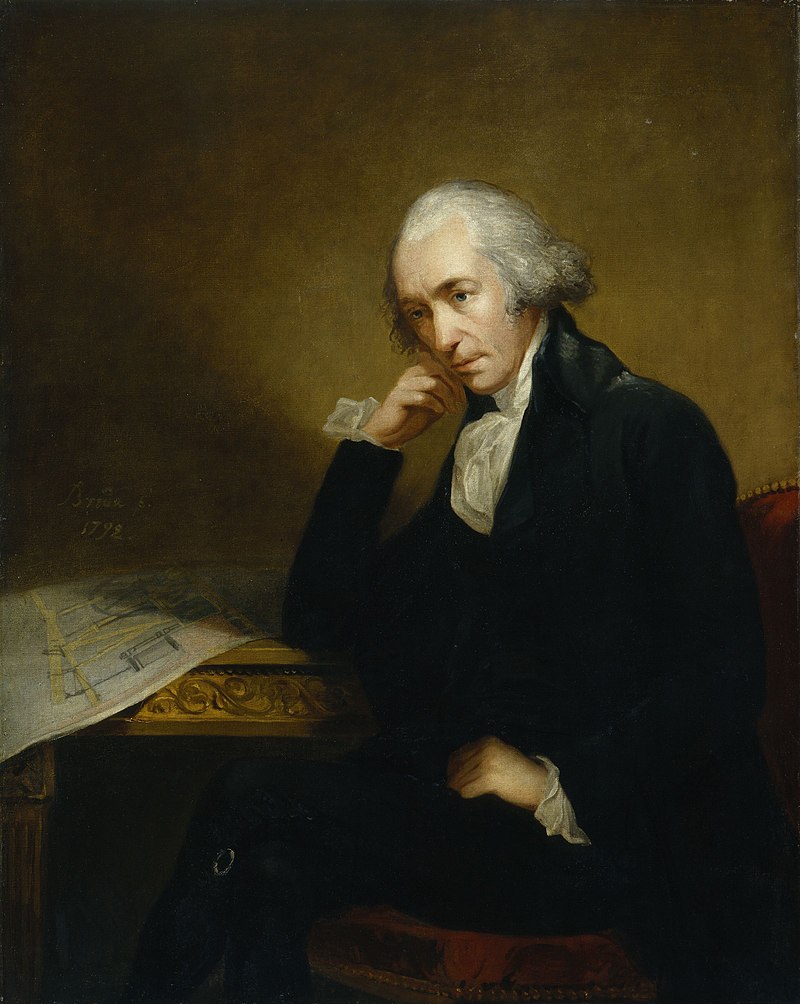
File:Watt_James_von_Breda.jpg · Wikimedia Commons · See Wikimedia Commons
James Watt
Sign in to saveAlso known as James, Sr. Watt, James von Breda Watt
British engineer (1736–1819)
James Watt was a Scottish engineer who lived from 1736 to 1819 and made crucial improvements to the steam engine, which became a driving force of the Industrial Revolution. His innovations made steam engines much more efficient and practical for industrial use, fundamentally transforming manufacturing, transportation, and power generation in the modern world.
AI-generated from the Wikipedia summary — may contain errors.
Wikidata facts
- Instance of
- human
- Given name
- James
- Family name
- Watt
- Gender
- male
- Citizenship
- Scotland
- Place of birth
- Greenock
- Occupation
- technician
- Educated at
- University of Glasgow
- Employer
- University of Glasgow
- Languages spoken
- English language
- Field of work
- instrument maker
- Image
- James Watt by Henry Howard.jpg
- Work location
- Birmingham
- Residence
- Glasgow
Show 16 more facts
- Commons category
- James Watt
- member of
- Lunar Society of Birmingham
- date of birth
- 1736-01-19
- date of death
- 1819-08-19
- topic's main category
- Category:James Watt
- Commons gallery
- James Watt
- name in native language
- James Watt
- ethnic group
- Scottish people
- influenced by
- Thomas Newcomen
- on focus list of Wikimedia project
- Wikipedia:Vital articles/Level/4
- writing language
- English language
- manner of death
- natural causes
- relative
- Robert Watson-Watt
- P8168
- Cynoglossum
- P12749
- Metzerlen-Mariastein
- date of burial or cremation
- 1819-09-02
Sources (12)
via Wikidata · CC0
~36 min read
Encyclopedic overview
Statue of Watt (Hunterian Museum, Glasgow, by Francis Chantrey)
James Watt (/wɒt/; 30 January 1736 (19 January 1736 OS) – 25 August 1819) was a Scottish inventor, engineer and chemist who improved on Thomas Newcomen's 1712 Newcomen steam engine with his Watt steam engine in 1776, which was fundamental to the changes brought by the Industrial Revolution in both his native Great Britain and the rest of the world.
Excerpted from Wikipedia’s “James Watt” article, available under the CC BY-SA 4.0 licence.
Gallery (12)
Available in 146 languages
- Español
- Français
- Deutsch
- 中文
- 日本語
- Русский
- Português
- Italiano
- العربية
- हिन्दी
- Afrikaans
- Albanian
- Albanian
- Amharic
- Aragonese
- Armenian
- Arpitan
- Assamese
Show 127 more
- Asturian
- azb
- Azerbaijani
- Bahasa Indonesia
- Balinese
- Bangla
- Bashkir
- Basque
- bat_smg
- be_x_old
- Belarusian
- Bosnian
- Breton
- btm
- Bulgarian
- Buriat
- Burmese
- Catalan
- Central Kurdish
- Chechen
- Chuvash
- Cornish
- Croatian
- Czech
- Danish
- Egyptian Arabic
- Esperanto
- Estonian
- Fiji Hindi
- Filipino
- Finnish
- Galician
- Georgian
- Greek
- Guarani
- Haitian Creole
- Hausa
- Hebrew
- Hungarian
- Icelandic
- Ido
- Iloko
- Interlingua
- Interlingue
- Irish
- Javanese
- Kannada
- Kanuri
- Kara-Kalpak
- Kazakh
- kbp
- Kurdish
- Latin
- Latvian
- Limburgish
- Lithuanian
- Lombard
- Low German
- Luxembourgish
- Macedonian
- Madurese
- Maithili
- Malagasy
- Malay
- Malayalam
- Marathi
- Minangkabau
- Mingrelian
- Mongolian
- nds_nl
- Nederlands
- Nepali
- Northern Frisian
- Norwegian
- Norwegian Nynorsk
- Obolo
- Occitan
- Odia
- Pashto
- Piedmontese
- Polski
- Punjabi
- Quechua
- Romanian
- Rusyn
- Santali
- Scots
- Scottish Gaelic
- Serbian
- Serbian (Latin)
- simple
- Sindhi
- Slovak
- Slovenian
- Sundanese
- Svenska
- Swahili
- szy
- Tajik
- Tamil
- Tatar
- Telugu
- Tiếng Việt
- Türkçe
- Turkmen
- Tuvinian
- Ukrainian
- Urdu
- Uzbek
- Veps
- Volapük
- Waray
- Welsh
- West Flemish
- Western Frisian
- Western Panjabi
- Wu Chinese
- Yiddish
- Yoruba
- Zaza
- zh_classical
- zh_min_nan
- zh_yue
- Zhuang
- فارسی
- ไทย
- 한국어
via Wikidata sitelinks · CC0