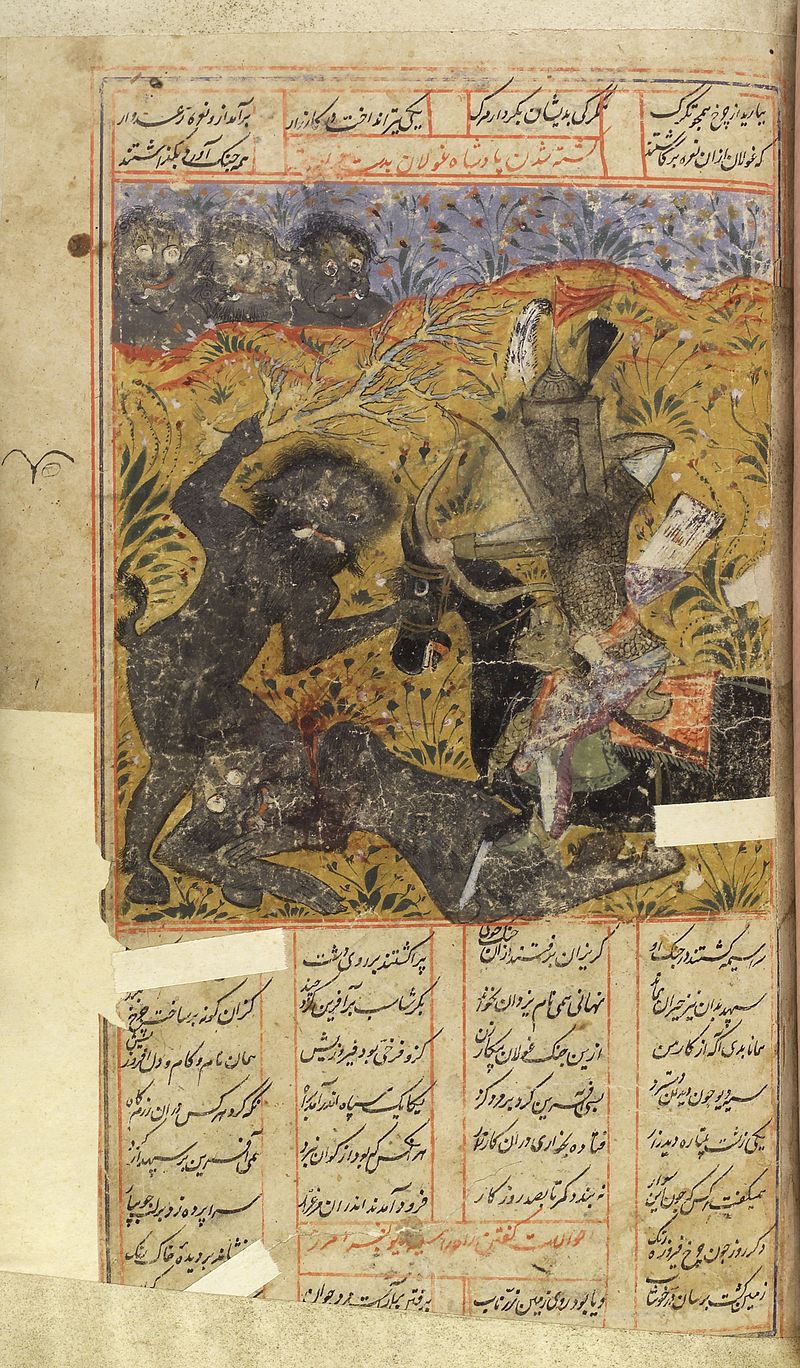
File:Shah_Namah,_the_Persian_Epic_of_the_Kings_Wellcome_L0035191.jpg · Wikimedia Commons · See Wikimedia Commons
jinn
Sign in to saveAlso known as djinny, jinni, jin, genie, jann, djin, djinn, djinni
Jinn (Arabic: جِنّ), also romanized as djinn or anglicized as genies, are supernatural beings in pre-Islamic Arabian religion and Islam. Like humans, they are accountable for their deeds and can be either believers (''Mu'minun) or unbelievers (kuffar''), depending on whether they accept God's guidance.
Jinn are supernatural beings from Arabian and Islamic religious traditions, similar to what some English speakers call "genies." Like humans, they have moral agency and can choose to follow God's guidance or reject it, making them accountable for their actions.
AI-generated from the Wikipedia summary — may contain errors.
Key facts
- Mythical creature.name
- Jinn
- Mythical creature.AKA
- Djinn, jen, genies, Cin, Xhindi
- Mythical creature.image
- Shah Namah, the Persian Epic of the Kings Wellcome L0035191.jpg
- Mythical creature.caption
- Jinn gather to do battle with the hero Faramarz. Illustration in an illuminated manuscript of the Iranian epic Shahnameh.
- Mythical creature.Folklore
- Arab and Islamic
- Mythical creature.Grouping
- Supernatural being
- Mythical creature.Region
- Muslim world
via Wikipedia infobox
Wikidata facts
- Subclass of
- spirit
- Part of
- Islam
- Has part
- Qareen
- Image
- Shah Namah, the Persian Epic of the Kings Wellcome L0035191.jpg
- Said to be same as
- demon
Show 8 more facts
- described by source
- New International Encyclopedia
- Commons category
- Genies
- topic's main category
- Category:Jinn
- Unicode character
- 🧞♂️
- native label
- جِنِّيَّات
- on focus list of Wikimedia project
- Wikipedia:Vital articles/Level/4
- described at URL
- www.oxfordreference.com/display/10.1093/acref/9780198609810.001.0001/acref-9780198609810-e-3713
- Stack Exchange tag
- islam.stackexchange.com/tags/jinn
Sources (2)
via Wikidata · CC0
~42 min read
Encyclopedic overview
25 sectionsContents
- Etymology and translation
- Pre-Islamic era
- Fear and veneration
- Poetry and soothsaying
- Islam
- Quran
- Exegesis
- Jurisprudence
- Folklore
- Modern and post-modern era
- Post-modern literature and movies
- Prevalence of belief
- Visual art
- Architectural representation
- Talismanic representation
- In the ''Kitāb al-Bulhān''
- Magical practices
- Comparative mythology
- See also
- References
- Notes
- Citations
- Sources
- Further reading
- External links
Jinn (Arabic: جِنّ), also romanized as djinn or anglicized as genies, are supernatural beings in pre-Islamic Arabian religion and Islam. Like humans, they are accountable for their deeds and can be either believers (''Mu'minun) or unbelievers (kuffar''), depending on whether they accept God's guidance.
Since jinn are neither innately evil nor innately good, Islam acknowledged spirits from other religions and could adapt them during its expansion. Likewise, jinn are not a strictly Islamic concept; they may represent several pagan beliefs integrated into Islam. Islam places jinn and humans on the same plane in relation to God, with both being subject to divine judgement and an afterlife. The Quran condemns the pre-Islamic Arabian practice of worshipping or seeking protection from them.
Excerpted from Wikipedia’s “jinn” article, available under the CC BY-SA 4.0 licence.
Gallery (36)
Available in 91 languages
- Español
- Français
- Deutsch
- 中文
- 日本語
- Русский
- Português
- Italiano
- العربية
- हिन्दी
- Afrikaans
- Albanian
- Aragonese
- Armenian
- Assamese
- Asturian
- Azerbaijani
- Bahasa Indonesia
Show 72 more
- Bangla
- Bashkir
- Basque
- Bosnian
- Breton
- Bulgarian
- Catalan
- Central Kurdish
- Chechen
- Croatian
- Czech
- dag
- Danish
- Esperanto
- Estonian
- Finnish
- Galician
- Georgian
- Greek
- Hebrew
- Hungarian
- Javanese
- Kashmiri
- Kazakh
- kge
- Kurdish
- Latvian
- Limburgish
- Lingua Franca Nova
- Lithuanian
- Macedonian
- Malagasy
- Malay
- Malayalam
- Mazanderani
- Moroccan Arabic
- Nederlands
- Norwegian
- Occitan
- Pashto
- Polski
- Punjabi
- Romanian
- Scots
- Serbian
- Serbian (Latin)
- simple
- Somali
- Sundanese
- Svenska
- Swahili
- Tajik
- Talysh
- Tamil
- Tatar
- Telugu
- Tiếng Việt
- Toki Pona
- Türkçe
- Ukrainian
- Urdu
- Uzbek
- Waray
- Western Frisian
- Western Panjabi
- Wolof
- Wu Chinese
- Yiddish
- zh_yue
- فارسی
- ไทย
- 한국어
via Wikidata sitelinks · CC0