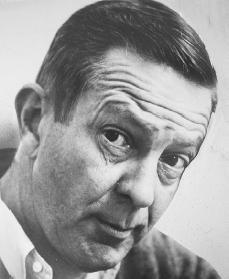
File:Johncheever.jpg · Wikimedia Commons · See Wikimedia Commons
John Cheever
Sign in to saveAmerican novelist and short story writer (1912-1982)
Film & TV
Quincy, Massachusetts, USA
John William Cheever (May 27, 1912 – June 18, 1982) was an American novelist and short story writer. He is sometimes called "the Chekhov of the suburbs". His fiction is mostly set in the Upper East Side of Manhattan, the Westchester suburbs, old New England villages based on various South Shore towns around Quincy, Massachusetts, where he was born, and Italy, especially Rome. He is "now…
Known for
- The Shady Hill Kidnapping — Narrator1982
- American Playhouse — Narrator (voice)1982
- The Swimmer — Man at Pool Party (uncredited)1968
- Robert Montgomery Presents — Mr. Blake1950
via TMDB
Key facts
- Born
- John William Cheever , ( 1912-05-27 ) May 27, 1912, Quincy, Massachusetts , U.S.
- Died
- June 18, 1982 (1982-06-18) (aged 70), Ossining, New York , U.S.
- Occupation
- Writer novelist
- Period
- 20th century
- Genre
- Short story , fiction
- Literary movement
- Symbolism
- Years active
- 1935–1982
- Notable works
- " The Enormous Radio " " The Five-Forty-Eight " The Wapshot Chronicle " The Swimmer " The Wapshot Scandal Bullet Park Falconer Oh What a Paradise It Seems
- Notable awards
- Pulitzer Prize (1979), National Book Critics Circle Award (1981)
- Spouse
- Mary Winternitz ( married</span>"}]]}'>m. 1941 )
- Children
- Susan Benjamin Federico
via Wikipedia infobox
Wikidata facts
- Instance of
- human
- Given name
- William
- Gender
- male
- Citizenship
- United States
- Place of birth
- Quincy
- Place of death
- Ossining
- Occupation
- novelist
- Employer
- University of Iowa
- Languages spoken
- English language
- Image
- Johncheever.jpg
Show 9 more facts
- date of birth
- 1912-05-27
- date of death
- 1982-06-18
- cause of death
- kidney cancer
- manner of death
- natural causes
- birth name
- John William Cheever
- name in native language
- John Cheever
- contributor to the creative work or subject
- The New Yorker
- Commons category
- John Cheever
Sources (3)
via Wikidata · CC0
~18 min read
Encyclopedic overview
John William Cheever (May 27, 1912 – June 18, 1982) was an American short story writer and novelist. He is sometimes called "the Chekhov of the suburbs". His fiction is mostly set on the Upper East Side of Manhattan; the Westchester suburbs; old New England villages based on various South Shore towns around Quincy, Massachusetts, where he was born; and Italy, especially Rome. His short stories included "The Enormous Radio", "Goodbye, My Brother", "The Five-Forty-Eight", "The Country Husband", and "The Swimmer", and he also wrote five novels: The Wapshot Chronicle (National Book Award, 1958), The Wapshot Scandal (William Dean Howells Medal, 1965), Bullet Park (1969), Falconer (1977) and a novella, Oh What a Paradise It Seems (1982).
His main themes include the duality of human nature: sometimes dramatized as the disparity between a character's decorous social persona and inner corruption, and sometimes as a conflict between two characters (often brothers) who embody the salient aspects of both—light and dark, flesh and spirit. Many of his works also express a nostalgia for a vanishing way of life (as evoked by the mythical St. Botolphs in the Wapshot novels), characterized by abiding cultural traditions and a profound sense of community, as opposed to the alienating nomadism of modern suburbia.
Excerpted from Wikipedia’s “John Cheever” article, available under the CC BY-SA 4.0 licence.