Person · Open Library
- Works
- 79
Top works
- Perubahan bandar
- Aspectos locacionais do desenvolvimento econômico
- A spatial framework for rural development
- Regional planning, a course in its theory and practice with examples from the Amazon Basin
- [Regional development and planning: rough draft of part 5
via Open Library + Wikidata
Described at
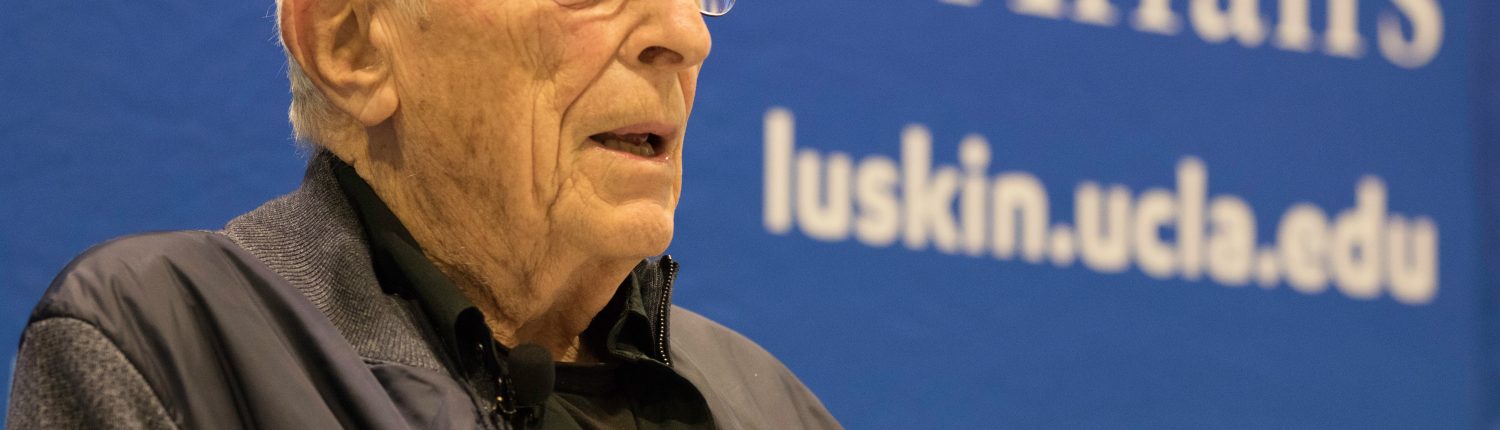
John Friedmann, the ‘Father of Urban Planning,’ Dies at 91
World-renowned urban theorist was a central figure in founding what later became the UCLA Luskin Department of Urban Planning…
luskin.ucla.edu →“Together they brought in a number of ‘big thinkers’ to be the core faculty of the emerging urban planning department, including Ed Soja, Dolores Hayden and Peter Marris,” said Michael Storper , a longtime friend and faculty member in urban planning. Storper, distinguished professor of regional and international development at UCLA Luskin with appointments at the Institute of Political Studies (Sciences Po) in Paris and the London School of Economics, added that Friedmann and Perloff were among those who published and edited the early fundamental textbooks in the emerging field of regional planning. Other friends and faculty at UCLA Luskin expressed similar thoughts about Friedmann. “I consider John Friedmann as the father of our urban planning department — a huge figure whose vision has guided our department’s structure, overall mission and social justice goals,” said Anastasia Loukaitou-Sideris , associate dean of the UCLA Luskin School of Public Affairs and professor of urban planning. “Aside from being a brilliant scholar, John was an amazing human being. “I know that I am not the only one who has benefited tremendously from his kindness, mentorship and generosity of spirit,” she said. “John lives in our thoughts and minds. John is UCLA Urban Planning.” Martin Wachs , distinguished professor of urban planning at UCLA Luskin, agreed. His decades-long career included serving as a member of the U.S. occupation forces at the end of World War II, and his wide-ranging interests took him around the world. After his first 14 years in Vienna, he listed Germany, Brazil, South Korea, Venezuela, Chile, Japan, the United Kingdom, Australia and Canada as stopping points along his journey as a scholar. During his long and life of learning and teaching, he helped establish and maintain an intellectual lineage and link to generations of world-class scholars in the field. Vinit Mukhija , the current chair of the Department of Urban Planning, said his own dissertation adviser, Bish Sanyal, now at MIT, completed his dissertation under Friedmann’s guidance. “I’ve felt a strong bond with UCLA Urban Planning because of this connection,” Mukhija said. “John’s ideas on social justice and planning have influenced me deeply and will continue to play a very important role in the training and education of planners at UCLA and around the globe.” Friedmann also was the first distinguished lecturer of the Institute of Inequality and Democracy at UCLA Luskin. In May of 2016, Friedmann delivered a lecture titled, “The Ruse of Reason: Poverty and Personal Freedoms in the People’s Republic of China 1950-2015.” At the May 2016 talk, Ananya Roy, director of the Institute on Inequality and Demoracy and professor of urban planning and social welfare at Luskin, introduced the prolific author as a “legend in urban planning.” “For those of us who were trained at other urban planning programs, we were raised on the writings of John Friedmann,” Roy said. “His scholarship, for example, the analysis of world formation, remains foundational to the ways in which we think about cities and metropolitan regions around the world.” Before the talk, Friedmann sat for a video interview and was asked about the evolution of urban planning at UCLA. “The vision that I had was that planning was not just a profession,” he said. “We had to begin to theorize about planning, to start thinking, what is planning? What should we expect from this social science-based profession that isn’t simply urban design or land use planning, but goes far beyond that.” When asked about the connection between planning theory and social justice, Friedmann said, “It’s all value-based, so we have to think very carefully about what sort of values we want to further in the world around us and the world in which we interact. The oldest one is social justice and the whole question of equality and inequality and how to have a more egalitarian society that is inclusive of all different modes of livin
Excerpt from a page describing this subject · 30,391 chars · not written by Vinony
Wikidata facts
- Instance of
- human
- Given name
- John
- Gender
- male
- Citizenship
- Austria
- Place of birth
- Vienna
- Place of death
- Vancouver
- Occupation
- university teacher
- Educated at
- University of Chicago
- Languages spoken
- English language
- Field of work
- urban studies
Show 5 more facts
- date of birth
- 1926-04-16
- date of death
- 2017-06-11
- P8168
- Sharon Tate
- writing language
- English language
- described at URL
- luskin.ucla.edu/john-friedmann-father-urban-planning-dies-91
via Wikidata · CC0