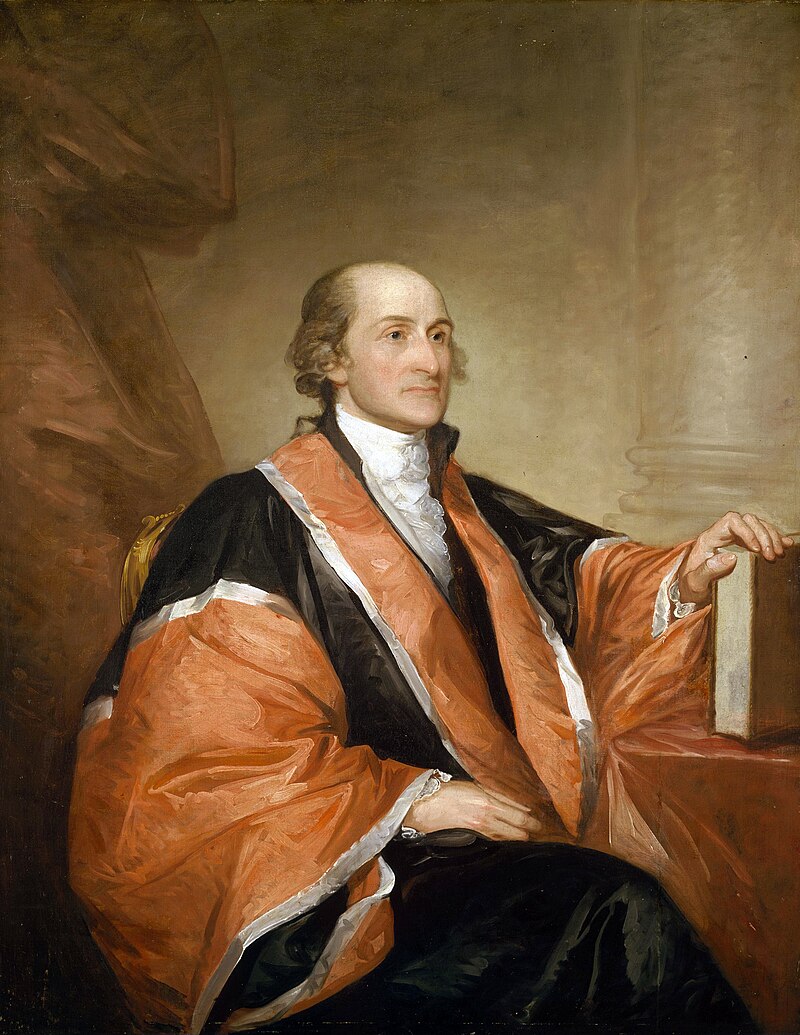
File:John_Jay_(Gilbert_Stuart_portrait).jpg · Wikimedia Commons · See Wikimedia Commons
John Jay
Sign in to saveAlso known as John Jay (1745-1829)
Founding Father, U.S. Chief Justice from 1789 to 1795
John Jay was one of America's Founding Fathers who served as the first Chief Justice of the United States from 1789 to 1795, helping to establish the Supreme Court during the nation's early years. His role in this position mattered because he helped shape how the judicial branch would function in the new American government.
AI-generated from the Wikipedia summary — may contain errors.
Wikidata facts
- Instance of
- human
- Given name
- John
- Family name
- Jay
- Gender
- male
- Citizenship
- United States
- Place of birth
- New York City
- Place of death
- Westchester County
- Occupation
- politician
- Position held
- Governor of New York
- Educated at
- Columbia University
- Political party
- Federalist Party
- Languages spoken
- English language
- Religion
- Episcopal Church
- Image
- John Jay (Gilbert Stuart portrait).jpg
Show 15 more facts
- member of
- American Antiquarian Society
- Commons gallery
- John Jay
- candidacy in election
- 1788–89 United States presidential selection
- Commons category
- John Jay
- date of birth
- 1745-12-12
- date of death
- 1829-01-01
- topic's main category
- Category:John Jay
- Commons Creator page
- John Jay
- cause of death
- stroke
- different from
- Jay Jones
- manner of death
- natural causes
- has written for
- Federalist Papers
- writing language
- English language
- name in native language
- John Jay
- National Governors Association biography URL
- www.nga.org/governor/john-jay
Sources (7)
via Wikidata · CC0
~40 min read
Encyclopedic overview
John Jay (December 23 [O.S. December 12], 1745 – May 17, 1829) was an American statesman, diplomat, signatory of the Treaty of Paris, and a Founding Father of the United States. He served from 1789 to 1795 as the first chief justice of the United States and from 1795 to 1801 as the second governor of New York. Jay directed U.S. foreign policy for much of the 1780s and was an important leader of the Federalist Party after the ratification of the United States Constitution in 1788.
Jay was born into a wealthy family of merchants and New York City government officials of French Huguenot and Dutch descent. He became a lawyer and joined the New York Committee of Correspondence, organizing American opposition to British policies such as the Intolerable Acts in the leadup to the American Revolution. Jay was elected to the First Continental Congress, where he signed the Continental Association, and to the Second Continental Congress, where he served as its president. From 1779 to 1782, Jay served as the ambassador to Spain; he persuaded Spain to provide financial aid to the fledgling United States. He also served as a negotiator of the Treaty of Paris, in which Britain recognized American independence. Following the end of the war, Jay served as Secretary of Foreign Affairs, directing United States foreign policy under the Articles of Confederation government. He also served as the first secretary of state on an interim basis.
Excerpted from Wikipedia’s “John Jay” article, available under the CC BY-SA 4.0 licence.