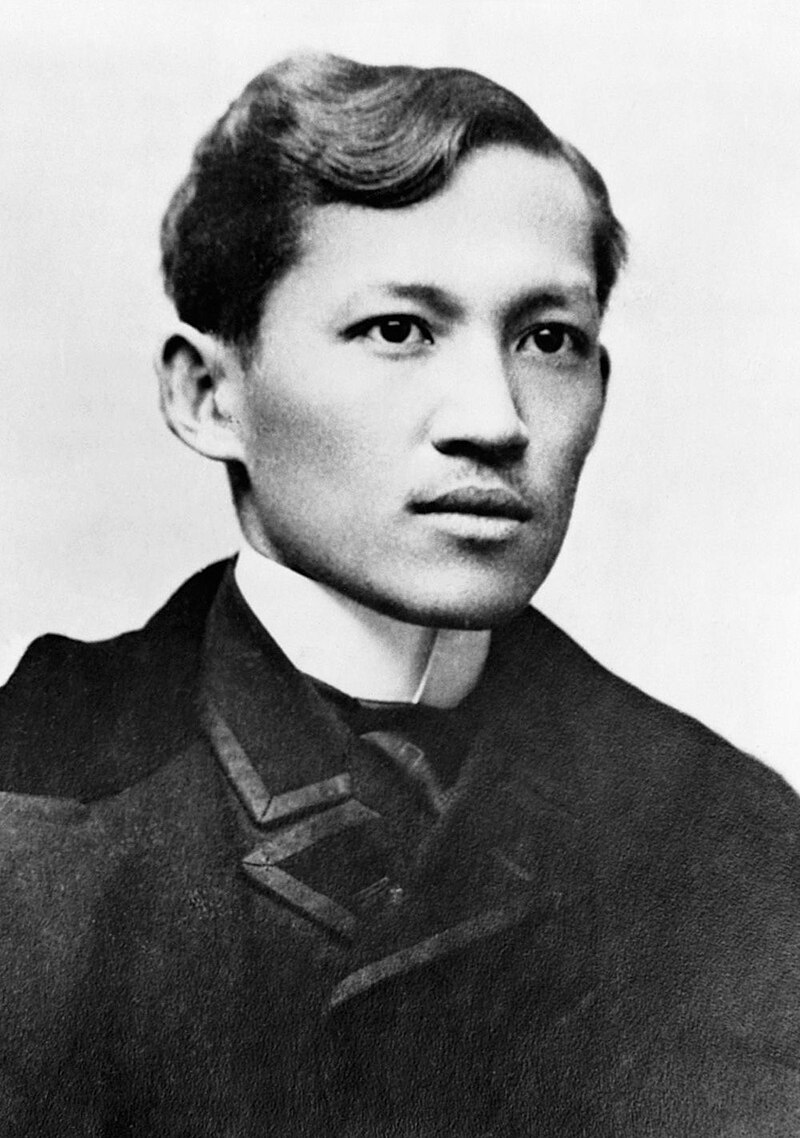
File:Jose_Rizal_full.jpg · Wikimedia Commons · See Wikimedia Commons
José Rizal
Sign in to saveAlso known as Dimasalang, Laong Laan, José P. Rizal, José Protasio Rizal
Filipino nationalist, writer and polymath (1861–1896)
OverviewAI-generated
José Rizal was a writer, linguist, ophthalmologist, and painter born José Protasio Rizal-Mercado y Alonso-Realonda on June 19, 1861, in Calamba. A citizen of the Captaincy General of the Philippines, he was educated at Ateneo de Manila University, University of Santo Tomas, Complutense University of Madrid, and Heidelberg University. He studied under Otto Heinrich Enoch Becker and spoke Spanish, Tagalog, German, and French. His writing languages included Tagalog, Spanish, and English.
Rizal authored notable works such as *Noli Me Tángere*, *El filibusterismo*, *Mi último adiós*, *Lolo José*, and *The social cancer*. He used pseudonyms including Dimas-Alang, Laón Laán, and Laón Laang. He was married to Josephine Bracken and had a sibling named Paciano Rizal. He died by capital punishment via gunshot wound in Manila on December 30, 1896.
Synthesized by Vinony from 28 facts across 3 sources: Wikidata, Open Library, Europeana Sparql. Generated from structured data (not the Wikipedia text) and checked against those facts — may still contain errors.
Person · Open Library
- Born
- 19 Jun 1861
- Died
- 30 Dec 1896
- Works
- 170
Top works
- Publications
- Noli me tangere
- Lolo José
- The social cancer
- Huling pahimakas
via Open Library + Wikidata
Wikidata facts
- Instance of
- human
- Gender
- male
- Citizenship
- Captaincy General of the Philippines
- Place of birth
- Calamba
- Place of death
- Manila
- Spouse
- Josephine Bracken
- Occupation
- politician
- Languages spoken
- English language
- Religion
- deism
- Notable work
- Mi último adiós
- Student of
- Otto Heinrich Enoch Becker
- Field of work
- linguistics
- Movement
- Propaganda Movement
- Image
- Jose Rizal full.jpg
- Convicted of
- conspiracy to commit a crime
- Political ideology
- reformism
Show 16 more facts
- Commons category
- José Rizal
- date of birth
- 1861-06-19
- date of death
- 1896-12-30
- cause of death
- gunshot wound
- topic's main category
- Category:José Rizal
- manner of death
- capital punishment
- birth name
- José Protasio Rizal-Mercado y Alonso-Realonda
- Commons gallery
- José Rizal
- Commons Creator page
- José Rizal
- writing language
- English language
- significant person
- Marcelo H. del Pilar
- pseudonym
- Laón Laang
- penalty
- capital punishment
- member of
- Freemasonry
- ethnic group
- Tagalog people
- name in native language
- José Rizal
via Wikidata · CC0
Works in European collections
1 object attributed to José Rizal, held across European museums, libraries & archives · via Europeana
~40 min read
Encyclopedic overview
José Protasio Rizal Mercado y Alonso Realonda ( Spanish: [xoˈse riˈsal, -ˈθal], Tagalog: [hoˈse ɾiˈsal]; June 19, 1861 – December 30, 1896) was a Filipino nationalist, writer, and polymath active at the end of the Spanish colonial period of the Philippines. He is popularly considered a national hero of the Philippines, although no official proclamation formally declares him as such. An ophthalmologist by profession, Rizal became a writer and a key member of the Filipino Propaganda Movement in the 1880s, which advocated political reforms for the colony under Spain.
By the early 1890s, amidst the Calamba land dispute, Rizal grew more separatist in his stance, conflicting with several colleagues in the Propaganda Movement. On July 6, 1892, a few days after establishing the secret society La Liga Filipina within Manila, Rizal was arrested by Spanish authorities for alleged possession of a seditious document, being banished to Dapitan in the island of Mindanao. During his exile, Rizal met Josephine Bracken, an Irish woman who later became his common-law wife.
Excerpted from Wikipedia’s “José Rizal” article, available under the CC BY-SA 4.0 licence.
Gallery (12)
Available in 76 languages
- Español
- Français
- Deutsch
- 中文
- 日本語
- Русский
- Português
- Italiano
- العربية
- हिन्दी
- Afrikaans
- Armenian
- Azerbaijani
- Bahasa Indonesia
- Basque
- Bikol
- Breton
- Bulgarian
Show 57 more
- Burmese
- Catalan
- cbk_zam
- Cebuano
- Central Kurdish
- Croatian
- Czech
- Danish
- Egyptian Arabic
- Esperanto
- Estonian
- Filipino
- Finnish
- Galician
- Georgian
- Hebrew
- Hungarian
- Ido
- Iloko
- Interlingua
- Irish
- Kabyle
- Latin
- Latvian
- Malagasy
- Malay
- Malayalam
- Mirandese
- Nederlands
- Norwegian
- Occitan
- Pampanga
- Pangasinan
- Pashto
- Polski
- Quechua
- Romanian
- Scots
- Serbian
- Serbian (Latin)
- simple
- Slovak
- Svenska
- Swahili
- Tamil
- Tiếng Việt
- Türkçe
- Ukrainian
- Venetian
- Waray
- Welsh
- Wu Chinese
- zh_min_nan
- zh_yue
- فارسی
- ไทย
- 한국어
via Wikidata sitelinks · CC0