File:Kappa_uc_lc.svg · Wikimedia Commons · See Wikimedia Commons
Kapa
Sign in to saveAlso known as Κ, κ
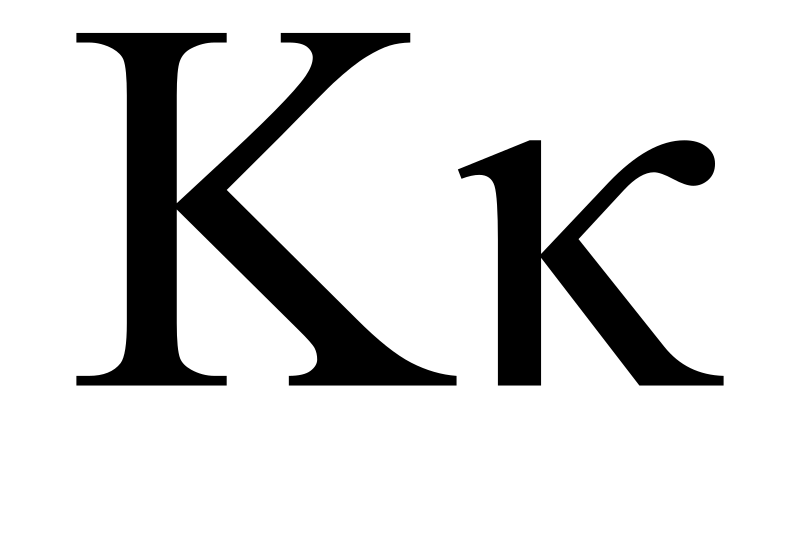
thumb|right|75px|Variant kappa|class=skin-invert-image thumb|right|Greek word καί written with a handwritten variant of kappa, from the Byzantine period|class=skin-invert-image Kappa (; uppercase Κ, lowercase κ or cursive ; , káppa) is the tenth letter of the Greek alphabet, representing the voiceless velar plosive sound in Ancient and Modern Greek. In the system of Greek numerals, has a value of 20. It was derived from the Phoenician letter kaph (𐤊). Letters that arose from kappa include the Roman K and Cyrillic К. The uppercase form is identical to the Latin K.
Kappa is the tenth letter of the Greek alphabet that represents a hard "k" sound in both ancient and modern Greek. It has influenced other writing systems, serving as the origin for the Roman letter K and the Cyrillic letter К, and holds the numerical value of 20 in the Greek numeral system.
AI-generated from the Wikipedia summary — may contain errors.
Wikidata facts
- Part of
- Greek alphabet
- Followed by
- Λ
- Follows
- iota
- Image
- Greek uc kappa.svg
Show 5 more facts
- Commons category
- Kappa (letter)
- Unicode character
- ϰ
- TeX string
- \varkappa
- Commons gallery
- Κ
- different from
- K
via Wikidata · CC0
Gallery (7)
Available in 89 languages
- Español
- Français
- Deutsch
- 中文
- 日本語
- Русский
- Português
- Italiano
- العربية
- Abkhazian
- Afrikaans
- Albanian
- Aramaic
- Armenian
- Asturian
- Bahasa Indonesia
- Bangla
- Basque
Show 70 more
- Bavarian
- be_x_old
- Belarusian
- Breton
- Bulgarian
- Catalan
- cdo
- Central Kurdish
- Croatian
- Czech
- Danish
- Esperanto
- Estonian
- Extremaduran
- Faroese
- Finnish
- Galician
- Georgian
- Greek
- Haitian Creole
- Hakka Chinese
- Hebrew
- Hungarian
- Icelandic
- Ido
- Irish
- kge
- Komi
- Kurdish
- Latin
- Latvian
- Lezghian
- Lithuanian
- Low German
- Luxembourgish
- Malay
- Malayalam
- Marathi
- nah
- Nederlands
- Northern Sami
- Norwegian
- Norwegian Nynorsk
- Occitan
- Polski
- Punjabi
- Romanian
- Scottish Gaelic
- Serbian
- Serbian (Latin)
- simple
- Slovak
- Slovenian
- Svenska
- Swahili
- Tibetan
- Tiếng Việt
- Türkçe
- Ukrainian
- Veps
- Volapük
- Waray
- Welsh
- Wu Chinese
- Zaza
- zh_min_nan
- zh_yue
- فارسی
- ไทย
- 한국어
via Wikidata sitelinks · CC0