File:Karnaugh.svg · Wikimedia Commons · See Wikimedia Commons
Karnaugh map
Sign in to saveAlso known as K-map
method to simplify boolean algebra expressions; refinement of Edward Veitch's 1952 Veitch diagram
Wikidata facts
- Named after
- Maurice Karnaugh
- Image
- Karnaugh map KV 2Variables 06.png
- Has use
- Boolean function
Show 4 more facts
- different from
- Venn diagram
- maintained by WikiProject
- WikiProject Mathematics
- discoverer or inventor
- Maurice Karnaugh
- Commons category
- Karnaugh maps
Sources (1)
via Wikidata · CC0
~19 min read
Encyclopedic overview
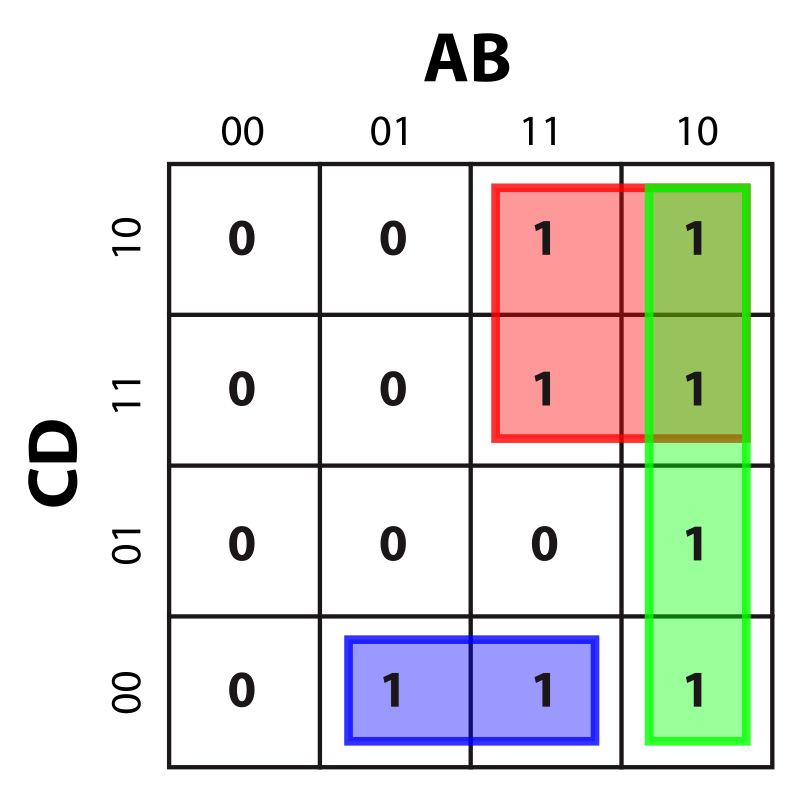
An example K-map.
A Karnaugh map (KM or K-map) is a diagram that can be used to simplify a Boolean algebra expression. Maurice Karnaugh introduced the technique in 1953 as a refinement of Edward W. Veitch's 1952 Veitch chart, which itself was a rediscovery of Allan Marquand's 1881 logical diagram or Marquand diagram. They are also known as Marquand–Veitch diagrams, Karnaugh–Veitch (KV) maps, and (rarely) Svoboda charts. An early advance in the history of formal logic methodology, Karnaugh maps remain relevant in the digital age, especially in the fields of logical circuit design and digital engineering.
Excerpted from Wikipedia’s “Karnaugh map” article, available under the CC BY-SA 4.0 licence.