File:Nomorekaroshi-shimbashiprotest-june-13-2018.jpg · Wikimedia Commons · See Wikimedia Commons
karōshi
Sign in to saveAlso known as kwarosa, guòláosǐ, gwarosa, Karoshi Death, Karōshi, overwork death, Karoshi
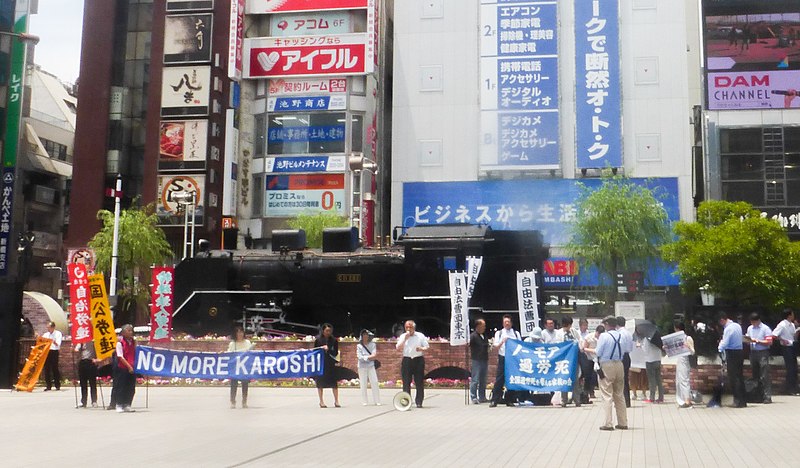
thumb|upright=1.34|A "No More Karoshi" protest in Tokyo, 2018 thumb|500px|Deaths due to long working hours per 100,000 people in 2016 (15+) thumb|right|500px|Average annual hours actually worked per worker in OECD countries from 1970 to 2020 , which can be translated into 'overwork death', is a Japanese term relating to occupation-related sudden death.
Key facts
- Chinese.t
- 過勞死
- Chinese.s
- 过劳死
- Chinese.p
- guòláosǐ
- Chinese.j
- gwo3 lou4 sei2
- Chinese.kanji
- 過労死
- Chinese.kana
- かろうし
- Chinese.hangul
- 과로사
- Chinese.hanja
- 過勞死
- Chinese.rr
- gwarosa
- Chinese.mr
- kwarosa
- Chinese.nihon
- karôsi
- Chinese.romaji
- karōshi
- Chinese.bpmf
- ㄍㄨㄛˋ ㄌㄠˊ ㄙˇ
via Wikipedia infobox
Research
84 papers- Whole-genome sequencing of a sporadic primary immunodeficiency cohort.Nature · 2020
- Factors Affecting Domiciliary Non-Invasive Ventilation Compliance.Lung · 2022
- Overwork, stroke, and karoshi-death from overwork.Acta neurologica Taiwanica · 2012
- Recognition, Compensation, and Prevention of Karoshi, or Death due to Overwork.Journal of occupational and environmental medicine · 2016
- Sesamin regulates breast cancer through reprogramming of lipid metabolism.Journal of biomolecular structure & dynamics · 2026
via PubMed
Wikidata facts
- Instance of
- cause of death
- Subclass of
- social issue
Show 2 more facts
- Commons category
- Karoshi
- facet of
- occupational health and safety
Sources (1)
via Wikidata · CC0
~15 min read
Encyclopedic overview
14 sectionsContents
- History
- Karoshi Hotline
- Effects on society
- Government policies
- Corporate response
- Media attention
- In other countries
- China
- India
- South Korea
- Sweden
- See also
- Notes
- External links
thumb|upright=1.34|A "No More Karoshi" protest in Tokyo, 2018 thumb|500px|Deaths due to long working hours per 100,000 people in 2016 (15+) thumb|right|500px|Average annual hours actually worked per worker in OECD countries from 1970 to 2020 , which can be translated into 'overwork death', is a Japanese term relating to occupation-related sudden death.
The most common medical causes of karoshi deaths are heart attacks and strokes due to stress and malnourishment or fasting. Mental stress from the workplace can also cause workers to commit suicide in a phenomenon known as karōjisatsu ().
Excerpted from Wikipedia’s “karōshi” article, available under the CC BY-SA 4.0 licence.