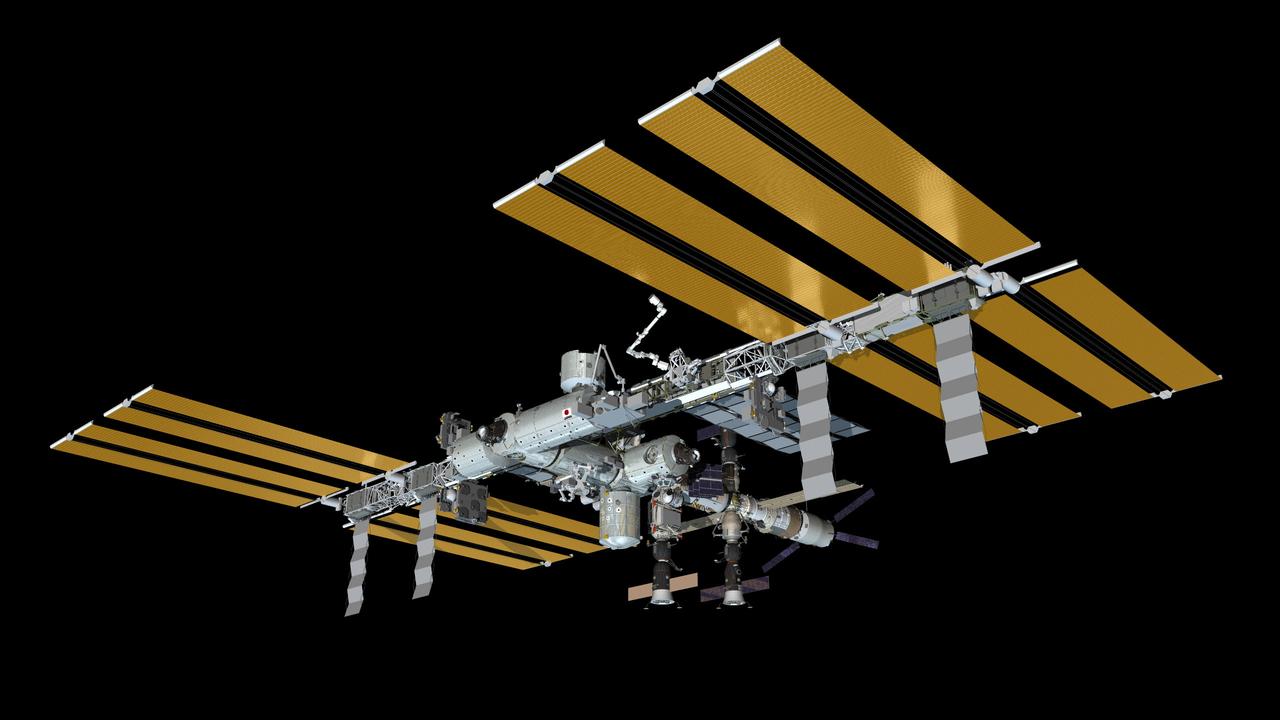
Current Configurations of ISS for use on HSF · NASA · NASA — public domain
Kepler-29
Sign in to saveKepler-29 is a Sun-like star in the northern constellation of Cygnus. It is located at the celestial coordinates: Right Ascension , Declination . With an apparent visual magnitude of 15.456, this star is too faint to be seen with the naked eye. It is a solar analog, having a close mass, radius, and temperature as the Sun. Currently the age of the star has not been determined due to its 2780 light-year (850 parsecs) distance. As of 2016 no Jovian exoplanets of 0.9–1.4 have been found at a distance of 5 AU.
Astronomical data · SIMBAD
- Object type
- Er*
- Spectral type
- G7
- Distance
- 2,892 light-years
- Redshift
- z = -0.00019835089587583177
- Coordinates
- RA 298.3483° · Dec 47.4912°
via SIMBAD · CDS Strasbourg
Wikidata facts
- Instance of
- eruptive variable star
- Constellation
- Cygnus
- Distance from Earth
- 851.9
- Diameter
- 1140000
- Radius
- 0.73
- Mass
- 0.76
- Variable-star type
- rotating variable star
Show 16 more facts
- Commons category
- Kepler-29
- catalog code
- TIC 273875635
- effective temperature
- 5378
- apparent magnitude
- 15.54
- parallax
- 1.1276
- epoch
- J2000.0
- metallicity
- 0.44
- stellar rotational velocity
- 1.1
- surface gravity
- 100000
- luminosity
- 0.42787123
- right ascension component of proper motion
- 6.487
- declination component of proper motion
- 16.183
- right ascension
- 298.34834067208
- declination
- 47.4912324379075
- spectral class
- G7
- radial velocity
- -59.47
via Wikidata · CC0
~1 min read
Encyclopedic overview
2 sectionsContents
- Planetary system
- References
Kepler-29 is a Sun-like star in the northern constellation of Cygnus. It is located at the celestial coordinates: Right Ascension , Declination . With an apparent visual magnitude of 15.456, this star is too faint to be seen with the naked eye. It is a solar analog, having a close mass, radius, and temperature as the Sun. Currently the age of the star has not been determined due to its 2780 light-year (850 parsecs) distance. As of 2016 no Jovian exoplanets of 0.9–1.4 have been found at a distance of 5 AU.
==Planetary system== In 2011 an analysis of the first four months of data from the Kepler space telescope detected 1235 planetary candidates two of which orbited this star. Later study of the transit-timing variations of the system lead to the confirmation of both planets. The planetary orbits are lying in Orbital resonance to each other, with orbital period ratio being exactly 7:9.
Excerpted from Wikipedia’s “Kepler-29” article, available under the CC BY-SA 4.0 licence.