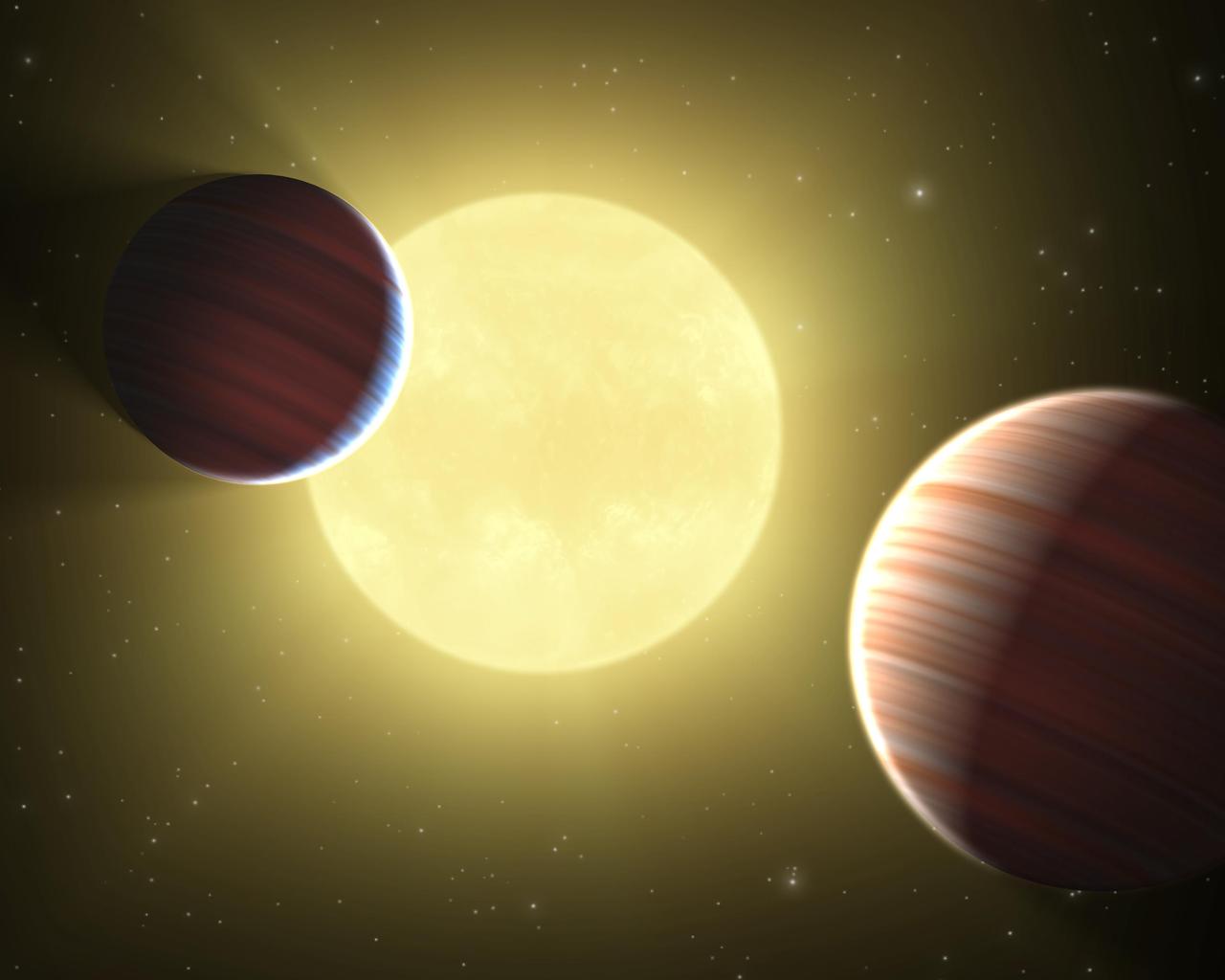
Worlds on the Edge Artist Concept · NASA · NASA — public domain
Kepler-9
Sign in to saveKepler-9 is a sunlike star in the constellation Lyra. Its planetary system, discovered by the Kepler Mission in 2010 was the first detected with the transit method found to contain multiple planets.
Astronomical data · SIMBAD
- Object type
- Er*
- Spectral type
- G2
- Distance
- 2,061 light-years
- Redshift
- z = 0.000008749758060311308
- Coordinates
- RA 285.5740° · Dec 38.4009°
via SIMBAD · CDS Strasbourg
Wikidata facts
- Instance of
- eruptive variable star
- Constellation
- Lyra
- Child body
- Kepler-9 d
- Distance from Earth
- 614
- Diameter
- 1520000
- Radius
- 0.96
- Mass
- 1.02
- Variable-star type
- rotating variable star
- Image
- Kepler-9 Worlds on the Edge.jpg
Show 18 more facts
- metallicity
- 0.07
- spectral class
- G2
- catalog code
- KIC 3323887
- effective temperature
- 5774
- apparent magnitude
- 13.791
- parallax
- 1.5823
- epoch
- J2000.0
- stellar rotational velocity
- 1.1
- surface gravity
- 34000
- topic has template
- Template:Kepler-9
- luminosity
- 0.9383876
- right ascension component of proper motion
- 2.472
- declination component of proper motion
- -14.691
- right ascension
- 285.57397680299994
- declination
- 38.40088245886
- Commons category
- Kepler-9
- radial velocity
- 3.09
- age estimated by a dating method
- 2
Sources (1)
via Wikidata · CC0
~4 min read
Encyclopedic overview
6 sectionsContents
- Nomenclature and history
- Characteristics
- Planetary system
- See also
- References
- External links
Kepler-9 is a sunlike star in the constellation Lyra. Its planetary system, discovered by the Kepler Mission in 2010 was the first detected with the transit method found to contain multiple planets.
==Nomenclature and history== Kepler-9 was named for the Kepler Mission, a project headed by NASA that was designed to search for Earth-like planets.
Excerpted from Wikipedia’s “Kepler-9” article, available under the CC BY-SA 4.0 licence.