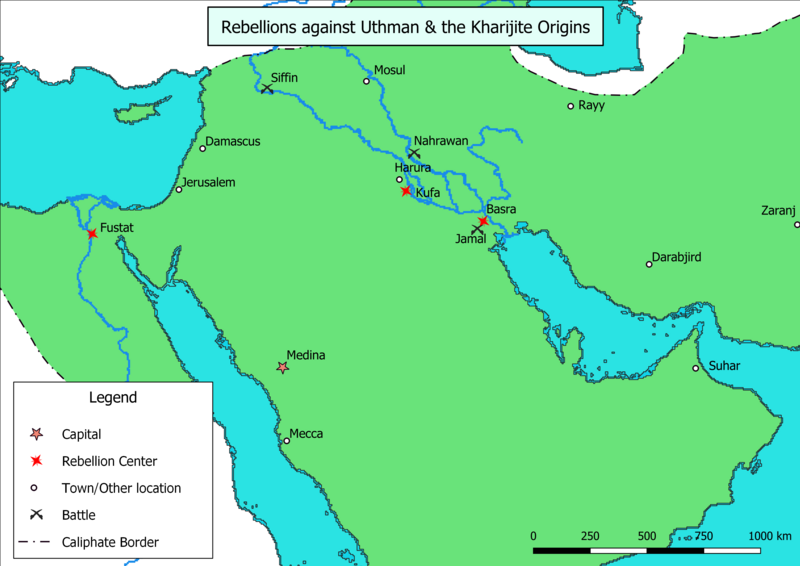
File:Rebellions_against_Uthman_&_the_Kharijite_Origins.png · Wikimedia Commons · See Wikimedia Commons
Kharijites
Sign in to saveAlso known as Khawarij
The Kharijites (, singular ) were an Islamic sect which emerged during the First Fitna (656–661). The first Kharijites were supporters of Ali who rebelled against his acceptance of arbitration talks to settle the conflict with his challenger, Mu'awiya, at the Battle of Siffin in 657. They asserted that "judgment belongs to God alone", which became their motto, and that rebels such as Mu'awiya had to be fought and overcome according to Qur'anic injunctions. Ali defeated the Kharijites at the Battle of Nahrawan in 658, but their insurrection continued. Ali was assassinated in 661 by a Kharijite
The Kharijites were an Islamic sect that emerged in the 650s when supporters of Ali broke away because they opposed his decision to negotiate with his rival Mu'awiya, believing that only God should judge such disputes and that rebels must be fought instead. Though Ali defeated them militarily, the Kharijites remained active and influential enough to assassinate Ali in 661, making them a significant early force in Islamic history's first major internal conflict.
AI-generated from the Wikipedia summary — may contain errors.
Wikidata facts
- Instance of
- sect
Show 4 more facts
- topic's main category
- Category:Kharijites
- described by source
- Brockhaus and Efron Encyclopedic Dictionary
- native label
- الخوارج
- inception
- 0657-00-00
via Wikidata · CC0
~59 min read
Encyclopedic overview
30 sectionsContents
- Etymology
- Primary and classical sources
- Origins
- Opposition under Uthman
- Emergence during the First Fitna
- Harura
- Nahrawan
- Later history
- Under Mu'awiya
- Second Fitna
- Azariqa
- Najdat
- Moderate Kharijites and their fragmentation
- Sufriyya
- Ibadiyya
- Beliefs and practices
- Governance
- Other doctrines
- Poetry
- Tribal affiliations
- Legacy
- Historical analysis
- Contribution to Muslim theology
- Traditional Muslim view
- Modern times
- See also
- Notes
- References
- Citations
- Bibliography
The Kharijites (, singular ) were an Islamic sect which emerged during the First Fitna (656–661). The first Kharijites were supporters of Ali who rebelled against his acceptance of arbitration talks to settle the conflict with his challenger, Mu'awiya, at the Battle of Siffin in 657. They asserted that "judgment belongs to God alone", which became their motto, and that rebels such as Mu'awiya had to be fought and overcome according to Qur'anic injunctions. Ali defeated the Kharijites at the Battle of Nahrawan in 658, but their insurrection continued. Ali was assassinated in 661 by a Kharijite dissident seeking revenge for the defeat at Nahrawan.
After Mu'awiya established the Umayyad Caliphate in 661, his governors kept the Kharijites in check. The power vacuum caused by the Second Fitna (680–692) allowed for the resumption of the Kharijites' anti-government rebellion, and the Kharijite factions of the Azariqa and Najdat came to control large areas in Persia and Arabia. Internal disputes and fragmentation weakened them considerably before their defeat by the Umayyads in 696–699. In the 740s, large-scale Kharijite rebellions broke out across the caliphate, but all were eventually suppressed. Although the Kharijite revolts continued into the Abbasid Caliphate (750–1258), the most militant Kharijite groups were gradually eliminated. They were replaced by the non-activist Ibadiyya, who survive to this day in Oman and some parts of North Africa. They, however, deny any links with the Kharijites of the Second Muslim Civil War and beyond, condemning them as extremists.
Excerpted from Wikipedia’s “Kharijites” article, available under the CC BY-SA 4.0 licence.
Gallery (27)
Available in 68 languages
- Español
- Français
- Deutsch
- 中文
- 日本語
- Русский
- Português
- Italiano
- العربية
- हिन्दी
- Albanian
- Aragonese
- Asturian
- Azerbaijani
- Bahasa Indonesia
- Bangla
- Bashkir
- Basque
Show 49 more
- Bosnian
- Bulgarian
- Catalan
- Central Kurdish
- Croatian
- Czech
- Danish
- Egyptian Arabic
- Esperanto
- Estonian
- Filipino
- Finnish
- Georgian
- Greek
- Hebrew
- Hungarian
- Ido
- Kazakh
- Kyrgyz
- Latin
- Latvian
- Lithuanian
- Malagasy
- Malay
- Malayalam
- Nederlands
- Norwegian
- Occitan
- Polski
- Romanian
- Serbian
- Serbian (Latin)
- simple
- Sindhi
- Slovak
- Slovenian
- Somali
- Svenska
- Tajik
- Türkçe
- Ukrainian
- Urdu
- Uzbek
- Western Panjabi
- Wu Chinese
- zh_min_nan
- فارسی
- ไทย
- 한국어
via Wikidata sitelinks · CC0